
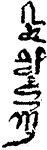
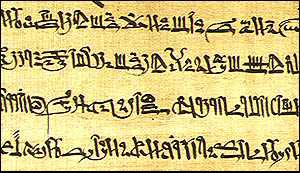
The Hieratic script was invented and developed more or less at the same time as the hieroglyphic script and was used in parallel with it for everyday purposes such as keeping records and accounts and writing letters. It was used until the 26th Dynasty, though by that time, it was only used for religious texts, while the Demotic script was used for most other purposes.
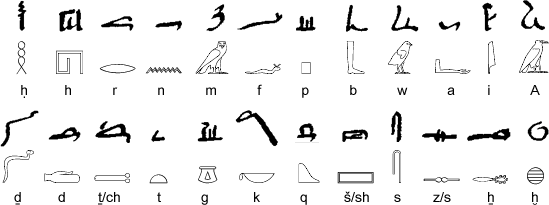
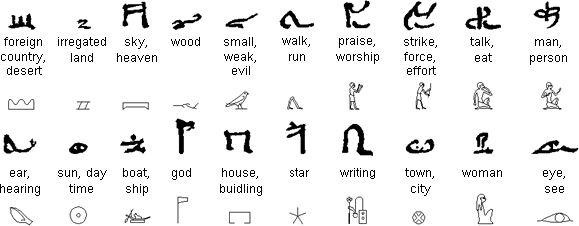
Information about the Hieratic script
http://en.wikipedia.org/wiki/Hieratic
http://www.digitalegypt.ucl.ac.uk/writing/hieratic.html
https://www.ucl.ac.uk/museums-static/digitalegypt//writing/hieratic.html
http://www.egyptologyforum.org/bbs/Stableford/Roberson,%20A_Very_Brief_Introduction_to_Hieratic.pdf
http://www.egyptologyforum.org/bbs/Stableford/HieraticPalaeo_I.pdf
Ancient Egyptian language and Hieroglyphs | Hieratic script | Demotic script | Coptic alphabet | Links | Books about Ancient Egyptian
Akkadian Cuneiform, Ancient Egyptian (Demotic), Ancient Egyptian (Hieratic), Ancient Egyptian (Hieroglyphs), Chinese, Chữ-nôm, Cuneiform, Japanese, Jurchen, Khitan, Linear B, Luwian, Mayan, Naxi, Sawndip (Old Zhuang), Sui, Sumerian Cuneiform, Tangut (Hsihsia)
Page last modified: 15.03.23
[top]

You can support this site by Buying Me A Coffee, and if you like what you see on this page, you can use the buttons below to share it with people you know.

If you like this site and find it useful, you can support it by making a donation via PayPal or Patreon, or by contributing in other ways. Omniglot is how I make my living.

Note: all links on this site to Amazon.com


[top]


