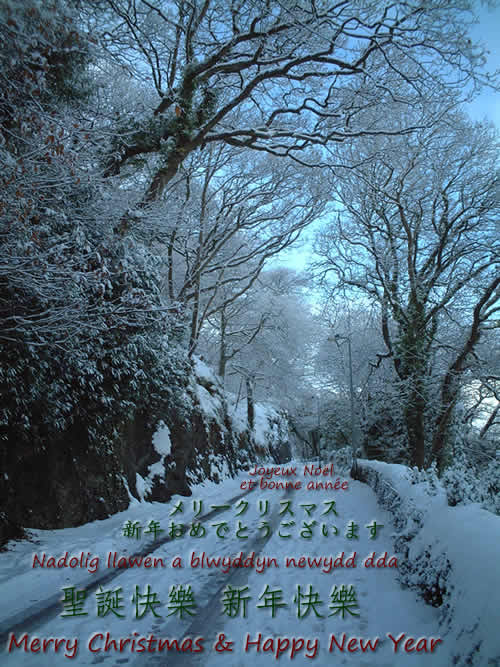
A multilingual Merry Christmas and Happy New Year to you all.
Mae’r nifer o offerynnau yn fy filodfa gerddorol wedi cynyddu eleni, ac mae gen i 30 o offerynnau bellach. Yr offeryn mwyaf newydd ydy piano, sy wedi cyrraedd Dydd Gwener diwetha. Piano ail law ydy o, a dw i wedi ei brynnu o eBay o ddyn yn Salford.
Ar hyn bryd mae gen i piano, iwcalili, mandolin, bouzouki, bodhrán, xaphoon, clarinét, casŵ, ffliwt, dau gitâr, dau harmonica, a cryn dipyn o recorderau, chwibanau ac ocarinas.
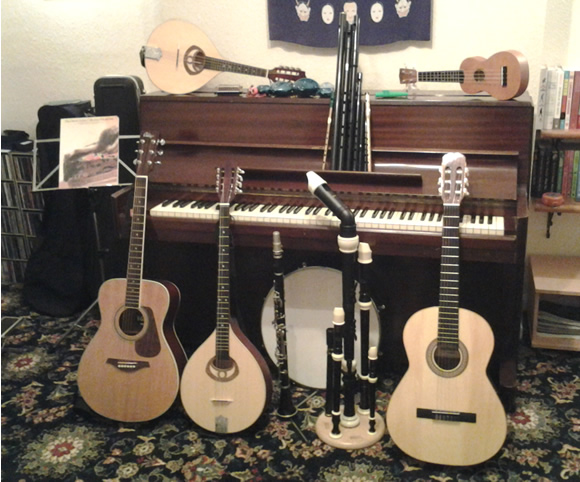
My musical menagerie has grown quite a bit this year and now includes 30 instruments. The newest addition was a piano, which arrived last Friday. It’s a second hand piano that I bought on eBay from a bloke in Salford.
The menagerie currently consists of: a piano, a ukulele, a mandolin, a bouzouki, a bodhrán, a xaphoon, a clarinet, a kazoo, a flute, two guitars, two harmonicas, and quite a few recorders, whistles and ocarinas.
Here’s a recording in a mystery language.
Can you identify the language, and do you know where it’s spoken?
– être/rester coincé/bloqué = to be stuck = bod yn sownd = stankañ
– se coincer/bloquer = to get stuck
– être enlisé = to be stuck (in mud/sand) = bod yn sownd (yn llaca/tywod) = sac’hellañ
– s’enlisé = to get stuck (in mud/sand)
– à mi-chemin = half-way (in distance) = hanner ffordd = hanter hent
– à la moitié de = half-way (activity/time) = hanner ffordd = hanter
– surveiller = to supervise = arolygu, goruchwylio = evezhiañ
– la laverie automatique = laundrette = laundrette, siop golchi dillad = kanndi, kannerezh
– la mamelle, le pis = udder = cadair, pwrs, piw = bronn
– le pis-aller = stopgap = perth dros dro = defot gwell
– le chargement = load = llwyth = kargañ
– la bûche = log = boncyff = kef
– le bûcheron = logger, lumberjack = coetmon = keuneuder, koadour
– les paroles = lyrics = telynegion = gerioù
According to an article I came across today, hard-to-pronounce sounds in languages might have developed to show who belongs to particular groups and who doesn’t.
Apparently ancient tribal groups recognised that such sounds are a good way to identify ‘insiders’ and ‘outsiders’, something they considered very important, as the sounds can only be made properly by those who have grown up speaking a particular language and pronouncing the particular sounds of that language. This is especially true of the clicks found in languages in southern Africa. This is possibly why some languages have a lot more difficult-to-pronounce sounds than others, and perhaps applies most to languages spoken in linguistically and culturally diverse regions – this last speculation is my own and doesn’t appear in the article.
Here’s an interesting article in the New Yorker about conlangs and specifically about Ithkuil, which, according to its creator, John Quijada, is “an idealized language whose aim is the highest possible degree of logic, efficiency, detail, and accuracy in cognitive expression via spoken human language, while minimizing the ambiguity, vagueness, illogic, redundancy, polysemy (multiple meanings) and overall arbitrariness that is seemingly ubiquitous in natural human language.”
For me ambiguity, vagueness, illogic, redundancy, polysemy and overall arbitrariness are some of the things that make languages so interesting, and I suspect that in some ways languages work better because of them. This certainly seems to be true of redundancy, which can help get the message across in less than ideal conditions, i.e. noisy environments, etc, and without ambiguity and polysemy puns and similar word play would not be possible, and poetry would difficult.
I have considered adding details about the Ithkuil script to Omniglot, but decided not to when I saw its complexity.
An interesting Breton word I came across today is mein-glas, or slates (literally, ‘blue stones’). The French equivalent is ardoises, which I had to look up as it’s not a word that crops up every day, unless you’re a roofer or builder.
The Breton word is made up of mein (stones – singular maen) and glas (blue/green), and the French word is of uncertain, possibly Gaulish origin – the ard part might come from the Gaulish word *ard(u) (high), as in the Ardennes [source]. The ard element is also found in the Gaelic languages meaning high, tall, elevated.
Ardoise (slate) appears in such terms as:
– ardoise électronique = notepad computer
– bleu/gris ardoise = blue/grey slate
– toit en ardoise = slate roof
– carrière d’ardoise = slate quarry
Here’s a recording in a mystery language.
Can you identify the language, and do you know where it’s spoken?
– le fil électrique = (electical) wire = gwifren (trydanol), weiar (trydanol) = neudenn (dredan), orjalenn (dredan)
– le fil de fer = (metal) wire = gwifren, weiar = neud-orjal
– en moyenne = on average = ar gyfartaledd = keitad
– le rendez-vous = appointment = apwyntiad, trefniad = emgav
– l’entretien (m) = interview = cyfweliad = emziviz
– la plaque chauffante = griddle = gradell = plakenn-dommañ (?)
– le niveau de vie (élevé/bas) = (high/low) standard of living = safon byw (uchel/isel) = live bevañ (uhel/izel)
– le contact avec les malades / le comportement envers les malades = bedside manner = emzalc’h gant ar glañvourien (?)
– Il a un bon contact avec ses malades = he has a good bedside manner
– le diagnostic = diagnosis = diagnosis = diagnostik
– saper, déstabiliser qn = to undermine = tanseilio = disfontañ
– il était bien pomponné = he was all poshed up
I came across a word that particularly appealed to me in my Breton lesson today – zizolo (discovering) in the sentence Ar vro a zizolo bemdez en doare-se (He discovers the country every day in this way) – referring to Gwennole who goes cycling a lot. It is a mutated form of dizolo (to discover), and appeals to me because of the z’s and sound of the word.
The letter z is relatively rare in most of the languages I know, but is common in Breton and in the Pinyin for Mandarin Chinese. It gives words an interesting and unusual, almost exotic, look and sound, at least to my eyes and ears it does.
Do you notice some letters more than others? Are any letters exotic, unusual or unexpected to you?