Here’s a recording in a mystery language.
Can you identify the language, and do you know where it’s spoken?
Here’s a recording in a mystery language.
Can you identify the language, and do you know where it’s spoken?
I went to a concert featuring poems and songs in Shetland dialect last night – some new, some old, some serious, and some frivolous and very funny. I was able to follow most of the words, but there were some that I didn’t understand, including some of the funny bits, so sometimes when everyone else was laughing, I was wondering what the jokes were.
Some of the performers were more difficult to understand than others, as there is quite a bit of dialect and accent variation between different parts of Shetland that I’m not used to yet. The Whalsay dialect is reputedly the most difficult to understand, and the one people from other parts of Shetland make fun of.
My ears and brain are gradually tuning in to the Shetland dialects and accents, a bit like a radio tuning in to different stations. My understanding of them is on a similar level to my understanding of Irish, Manx and Scottish Gaelic at the moment – I can get most of them when I really concentrate, and some words which I don’t understand the first time make sense when I hear them again in a slightly different context. Sometimes I find it helps to de-focus slightly and to let the words flow in without worrying that I don’t understand all of them.
I’m currently in Lerwick for the Shetland Folk Festival,and at a concert last night I heard some interesting Shetland dialect being spoken and sung.
One word I particularly liked was slockit, which means ‘gone out, extinguished’. It appears in the title of a tune by Tom Anderson, Da Slockit Light, which he was inspired to write after seeing how many of the houses in his home village at Eshaness were dark. He thought about the people who use to live there and how they have moved away or passed. For me it’s fascinating to hear the stories behind tunes and songs like this.
I also discovered today that there is an online dictionary of Shetland dialect with recordings on shetlanddialect.org.uk. Some other interesting Shetland words I came across there include:
– slurd = small, driving rain
– skutamillaskroo = the game of hide-and-seek played among the cornstacks in the yard
– skurtfoo = an armful. e.g. He cam in wi a skurtfoo o paets for da fire.
Korriganed are apparently small creatures that live under standing stones (dolmen/menhirs) in Brittany. They feature in one of the lessons in my Breton course and are explained thus:
“Les korrigans doivent être des êtres particulièrement petits, puisque ce mot est formé de korr, “nain”, puis du diminutif -ig puis du’un autre diminutif – obsolète aujourd’hui – -an. Il s’agit donc de “petits petits nains.”
Or
“The korrigans must be particularly small beings, since the word is formed from corr, “dwarf”, and the diminutive -ig and the another diminutive – now obsolete – -an. So they are “little little dwarfs.”
When I read the explanation in French I saw the word nain and thought it was the Welsh word for grandmother, not realising that is means dwarf or midget in French. So for a while I believed that the Korriganed were tiny grandmothers. Later I realised my mistake and discovered the actual meaning of that word.
According to legend, the Korriganed erected the standing stones in Brittany.
Do you mistake words in one language for words in another at all?
Here’s a recording in a mystery language.
Can you identify the language, and do you know where it’s spoken?
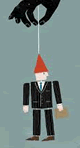
I came across the wonderful word quockerwodger on the BBC Radio 4 programme Wordaholics. Surprisingly it doesn’t appear in the OED, but on World Wide Words it is defined as “a wooden toy figure which jerks its limbs about when pulled by a string”, and also a politician whose strings are pulled by someone else.
It’s origin is uncertain and it doesn’t appear to be related to the dialect words quocken (to vomit/choke), or quocker (a man who goes harvesting at some distance from home).
| français | English | Cymraeg | Brezhoneg |
|---|---|---|---|
| se vendre | to sell out | gwerthu rhth i gyd; gwerthu’r cwbl | gwerzhañ holl (?) |
| la sueur | sweat | chwys | c’hwezenn |
| suer; transpirer | to sweat | chwysu | c’hweziñ |
| suer/transpirer comme un boeuf | to sweat like a pig | chwysu fel mochyn/ceffyl | |
| la scène musicale | the music scene | man cerddoriaeth (?) | |
| ouvert aux éléments | open to the elements | agor i’r gwynt a glaw; agor i’r tywydd mawr | |
| le pavé | paving stone | carreg balmant; fflacsen | pavez |
| la gare routière/d’autobus | bus station | gorsaf fysus | gar ar c’hirri-boutin |
One way English speakers play with English is by making into Pig Latin. This involves move the first sound of each word to the end and adding “ay”; for example Pig Latin becomes Ig-pay atin-lay. If a word starts with a vowel you might add hey, way or yay to the end. This creates a sort of pseudolanguage that sounds vaguely like Latin and can be used as a secret code, or just for fun.
I found an article today about language games like this in other languages.
I knew about Pig Latin, though had never played with, and about Verlan in French, but not about the equivalents in other languages. Have you played any of these games? Do you know of any others?
Last week a friend suggested that it is grammatically correct to say “I go to the bar now”, even if it’s more usual to say “I’m going to the bar now”. We suggested that in English as spoken in the UK the first would be considered wrong, even though it’s understandable. My friend insisted that this is down to usage rather than grammar; that the first version is grammatically correct, and that in varieties of English spoken in Uganda and other parts of East Africa, the first version is more common. We then had quite a discussion about the differences between grammar and usage.
For me grammar is a description of how a language is used, rather than a set of rules on how a language should be used. Rules in a descriptive grammar arise from usage and can change as usage changes, whereas in prescriptive grammar the rules are seen as absolute and unchanging and are based on a theoretical ideal of the language that few people actually use. What is your view on this?
The simple present tense in standard English is often used to indicate a habitual action, e.g. “I go to the pub every Thursday night”, while the continuous present tense is used for current action, e.g. “I’m going to the pub on Thursday night” (a specific instance). I hadn’t thought much about this distinction until I learnt Irish and found that there are different tense for habitual and non-habitual action: “Tá sé ag dul go dtí an teach tábhairne ar oíche Déardaoin” (He’s going to the pub on Thursday night); “Bíonn sé ag dul go dtí an teach tábhairne ar oíche Déardaoin” (He goes to the pub on Thursday night). The second version might be rendered as “He does be going to the pub on Thursday night” in Hiberno-English.
If you have learnt English as a second/foreign language, do you find the differences between the simple and continuous tenses difficult to grasp? This is likely to depend on whether there is such a distinction on your native language.
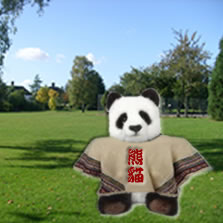
This is a nonsense song that I wrote in March and finally got round to recording today. It began with the sentence ‘There’s a panda in poncho playing ping-pong in the park’ and developed from there. I made up a tune, and found that it also fits to the tune of ‘She’ll be coming round the mountain’. If anyone feels like doing some illustrations for it, please do.
A Panda in a Poncho
There’s a panda in a poncho in the park
Playing ping-poing with a purple ardvaark
While a pig in a wig sings a song about a fig
And an fox washes rocks in a box.
There’s an fox washing rocks in a box
And giving a lecture about grandfather clocks
While a giraffe in a scarf has a laugh with a calf
And poodles eat noodles with a fork.
There are poodles eating noodles with a fork
While a chimp plays chess with a stork
And baboons in bonnets recite silly sonnets
And a gorilla makes faces in a mirror.
There’s a gorilla making faces in a mirror
And chatting with a cheeky chinchilla
While a goat in a boat plays bagpipes to a stoat
And a weasel weaves teasels on an easel.
Here’s a recording: