Language learning in the EU

EU language experts would like to encourge European citizens to learn more languages, especially such languages as Arabic, Chinese and Hindi, according to a report I found today. They hope this will ” boost the EU’s global competitiveness”. They would also like language teaching to be more enjoyable and entertaining in order to try to increase enthusiasm for learning languages.

These proposals will presented tomorrow during the European Day of Languages, which is designed “to celebrate the rich heritage of cultures and traditions embodied in all the languages of Europe”.

Does anyone know who these language experts are, what they do, and who to get a job as one?

Word of the day – proprioception

Proprioception [ˈpɹopɹiːoˌsɛpʃən], from Latin proprius (one’s own) and perception = the sense of the relative position of neighbouring parts of the body.

I came across the word proprioception while reading Richard Robinson very interesting book, Why the toast always lands butter side down – the Science of Murphy’s Law. Proprioception involves knowing where your limbs are, he explains, vital information that enables us to walk, run and stand upright. Apparently if you proprioception malfunctions, you might believe that one or more of your limbs belongs to someone else rather than you.

The book contains some interesting suggestions about how our brains process information – most of the data we receive from our senses is ignored by our concious minds and we construct our experience of the world largely based on past experience, guess work and emotion. So we generally see what we expect to see, hear what we expect to hear, and so on.

This suggests to me that one reason we may find the foreign languages difficult to understand is that we’re less able to rely on the past experience and guess work, as we would in our native tongue.

Gitâr / Giotár / Giotàr

Ddoe penderfynais ddechrau dysgu y gitâr o’r diwedd. Dw i’n meddwl amdano ers talwrn, a ddoe meddyliais “Pam lai?” – mae digon o awydd, arian ac amser ‘da fi. Dw i wedi darganfod athro ym Mrighton ar y we, a bydda i’n cysylltu â fe yfory. Yn gynta, bydd rhaid i mi prynu gitâr.

Inné chinn mé ar an giotár a fhoghlaim faoi dheireadh. Tá mé ag smaoineamh air ar feadh tamaill fhada, agus inné smaoinigh mé “Cén fáth nach dhéanaim?” – tá fonn mór, airgead agus am agam. Fuair mé múinteoir i mBrighton san idirlinn agus déanfaidh teagmháil leis amárach. Ar-dtús caithfidh mé giotár a cheannach.

An-dè chuir mi romham an giotàr ag ionnsachadh fa dheòidh. Tha mi a’ smaoineachadh air airson greis mhòr, agus an-dè smaoinich mi “Carson nach ionnsaich mi?” – tha dealas, airgead agus aimsir agam. Fhuair mi tidsear ann an Brighton agus cuiridh mi fios air a-màireach. An toiseach feumaidh mi ceannaich giotàr.

Cuairt Nam Blog

Today I found an online version of a BBC television programme called “Cuairt Nam Blog”, in which the presenter, a Scottish Gaelic tutor from Glasgow, meets a number of people who blog in Scottish Gaelic. She find the bloggers through Tìr nam Blòg, a site which amalgamates blogs in Gaelic, and visits the author of An Gaidheal Alascanach in Juneau, Alasaka, and the man behind Latha ann an L.A. in Los Angeles, both of whom speak Gaelic fluently. She also mentions Gaelic bloggers in Kazakstan and Japan. The programme is in Gaelic, with English subtitles.

I read the blogs mentioned in the programme now and then and it’s nice to see the people behind them and learn a bit more about them. I think I should try to write in Gaelic on my other blog, though my Gaelic is not as good as my Irish and Welsh yet. When I write something in Gaelic, I takes me ages as I have to look up many of the words and check the grammar.

Language hotspots

The Enduring Voices Project, which I came across today on the National Geographic website, has the aims of documenting endangered languages and preventing language extinction by identifying the most crucial areas where languages are endangered and embarking on expeditions to:

Understand the geographic dimensions of language distribution
Determine how linguistic diversity is linked to biodiversity
Bring wide attention to the issue of language loss

There’s a map on the site which shows the areas of the world with a particular high density of endangered languages, and also provides information about the languages and a few recordings. The ‘hotspots’ on the map are colour coded to give an idea of the severity of the problems. The areas with the most endangered languages are northern Australia, eastern and central Siberia, central South America, and the northwest Pacific plateau of North America.

Here are a few random factoids from the site:

The Yukaghir people (Siberia, 30-150 speakers) traditionally measured time with a unit called ‘the kettle boiled,’ about an hour long. A longer interval was called ‘the frozen kettle boiled,’ which took about 90 minutes.

Tuvan (200,000 speakers) has a word that means ‘the two wives of my two brothers.’ If you had three brothers, or one of your two brothers was unmarried, you would never use this word.

A noun in Tabassaran (95,000 speakers, Dagestan (Russia)) may have up to 53 distinct forms, using suffixes that describe the location and movement of objects in relation to that noun.

Dw i ‘nôl

Ddes i ‘nôl o Brâg nos Sul ar ôl gŵyl ardderchog. Dinas hardd a diddorol yw Prâg, ac hoffwn i’n mynd ‘nôl cyn bo hir. O Brâg beiciais ar hyd yr afonydd Vltava ac Elbe hyd at Meissen yn yr Almaen gyda ddeuddeg o bobl eraill o Loegr, Cymru, Canada ac Awstralia, ac arweinydd o Wlad Pwyl. Oedd dwy Gymraes-Gymraeg yn y grŵp a sgwrsiais yn Gymraeg gyda nhw.

Beicion tua 30 milltir y dydd – pellter eitha cyffyrddus. Oedd y tywydd yn ddiflas yn ystod hanner cynta’r wythnos – cymylog a gwyntog gyda cryn dipyn o law – ond oedd hi’n braf ar ôl hynny. Arhoson mewn gwestai cyffyrddus gyda gymeriad mewn trefi hanesyddol a deniadol. Oedd y bwyd yn eitha blasus ac oedd digonedd ohonof.

Nos Fawrth, es i’r Hammersmith Irish Centre yn Llundain i gymryd rhan dosbarth mewn canu caneuon o Iwerddon. Meddyliais byddem yn canu ganeuon yn y Wyddeleg, ond y caneuon a ganon ni oedd i gyd yn Saesneg. Dim ots ‘da fi – dw i’n hoffi canu yn unrhyw iaith. Mae hi’n haws cofio geiriau caneuon yn Saesneg hefyd. Mae’r tiwtor yn dda iawn, mae’r pobl eraill yn y dosbarth yn neis, a mwynheais yn dda iawn.

Ar ais arís

Tháinig mé ar ais ó Phrág oíche Dhomhnaigh i ndiaidh saoire iontach. Is cathair álainn agus suimiúil í Prág, agus ba mhaith liom ag dul ar ais go luath. Ó Phrág rothaigh mé i rith na n-aibhneacha Vltava agus Elbe go Meissen sa Ghearmáin le dáréag daoine eile as Sasana, ón Bhreatain Bheag, as Ceanada agus ón Astráil, agus eolaí ón Pholainn. Ina measc bhí beirt bhan atá Breatnais acu agus rinne mé comhrá Breatnaise leo.

Rothaigh muid thart ar 30 míle gach lá – ní raibh sin ró-fhad, is dóigh liom féin. Bhí an aimsir go dona ar dtús – scamallach agus gaofar le cuid mhaith báisteach – ach bhí sé níos fearr i ndiaidh sin. D’fhán muid in óstáin compordach le caractar i mbailte stairiúil agus tarraingteach. Bhí an bia réasúnta blasta agus bhí go leor ann.

Oíche Mháirt chuaigh mé go dtí an Irish Centre i Hammersmith páirt a ghlacadh i rang ar an amhránaíocht Éireanach. Shíl mé go mbeadh na hamhráin as Gaeilge, ach bhí siad uilig as Béarla. Is cuma liom – is maith liom amhráin a chanadh in aon teanga agus tá sé níos éasca liricí as Béarla a chuimhneamh chomh maith. Tá an teagascóir an mhaith, tá na daoine eile deas, agus bhain mé an-sult as an rang.
Being bilingual 有很多好處

The other day I found an interesting interview with Professor Laura-Ann Petitto, a cognitive neuroscientist who has spent the past 29 years seeking to uncover the biological and environmental factors that affect how humans acquire language and how language is organized in the brain. The main aim of her research is the find the biological foundations of language.

She found that the language development of children who grow up bilingually or multilingual is not delayed when compared with monolingual children, as a popular belief suggests. That bilingual and multilingual children do mix languages, just as adults do, and that they do so in a highly principled way. Language mixing is mainly a social phenomenon and the amount of language mixing among children reflects mixing behaviour among adults in their community.

She also studied the optimum time to expose children to two or more languages, comparing groups of children who were exposed to multiply languages at different ages. Some were raised bilingually from birth, others from the ages of three, five, etc. She found that up to nine years old, children immersed in a bilingual environment can become equally fluent in both languages. However if such children are only exposed to one of the languages in school, their ability in that language is much reduced.

Other interesting bits from the interview include the finding that “young children who have rich and early exposure to two languages are […] cognitively more advanced than their monolingual peers on certain highly sophisticated cognitive tasks to do with attention and abstract reasoning.” Also that those children exposed to two languages after the age of nine or so will eventually learn them, but will probably never speak them as well as the early starters.

Language quiz

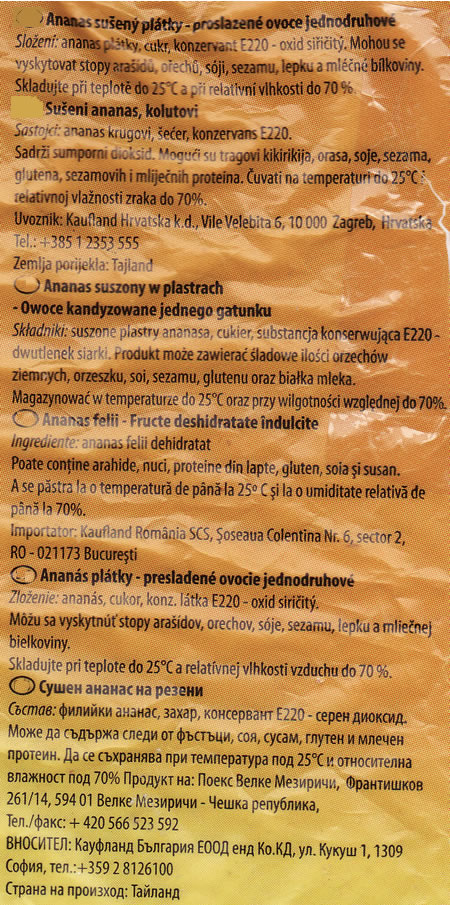
Here’s a multilingual ingredients list from a packet of dried pineapples I bought while in the Czech Republic. How of the languages on it can you recognise?

Multilingual ingredients list from a packet of dried pineapples

As we haven’t had any language quizzes for a while, I thought it was time for one. Also, I’m off to London this evening for a class in Irish Songs and Singing at the Hammersmith Irish Centre, so don’t really have time to write a longer post. I’ll be going to the class every Tuesday for the next 10 weeks and am really looking forward to it.