Kernewek/Kernowek/Kernuak/Curnoack

Moves are apparently being made to establish a single written form of Cornish, which currently has four different spelling systems. The Cornish Language Partnership has set up a Linguistic Working Group consisting of Cornish speakers with a good knowledge of the language to recommend a solution to this excess of orthographies. A conference will be held this month to discuss this matter. If an agreement is reached on a single written form, it will be used in schools and for official purposes.

I understand that the lack of a standard spelling system is discouraging some people from taking Cornish seriously. If a standard can be agreed on, this could lead to more people learning the language.

Here are a few Cornish-related sites I found yesterday.

Cornish for Absolute Beginners
http://www.howlsedhes.co.uk/dallether/dlan0.shtml

Radyo an Norvys – a pod cast in Cornish
http://www.dasunys.net/podcast.htm

Cornish forum – discussions in and about the Cornish language
http://www.dasunys.net/php/

Tablys leveryans – Cornish pronunciation tables
http://www.dasunys.net/tables.htm
Fflat

Cwrddais i â’r perchennog newydd fy fflat a’r holl tŷ ddoe. Daeth e ar ei hald gyda phobl o ddau asiant ystadau gwahanol i weld y tŷ ac i asesu ei werth e – dw i’n poeni bydd y rhent yn cael ei gynyddu yn fawr cyn bo hir. Mae rhywun o’r asiant gosod wedi dweud wrtha i na fydd y rhent yn newid, ond dw i ddim yn hollol credu unrhyw beth bod nhw’n dweud.

Er enghraifft, dywedon nhw wrth y perchennog bydden nhw’n trwsio rhai o bethau trydanol yn y tŷ – dydyn y pethau ddim wedi cael eu drwsio eto. Maen nhw wedi dod i weld y tŷ sawl waith heb hysbysu mi a’r tenantiaid eraill (doedd dim hysbysiad am ymweliad ddoe), ac maen nhw wedi dod i mewn y fflatiau heb daro ar y drws. Pan dw i’n cwyno, maen nhw’n dweud bod y hysbysiad “yn y post” – fel arfer does dim ôl ohono.

Credodd y perchennog bod fy fflat yn wag, achos dyna ddywedodd rhywun yn yr asiant gosod wrtho fe – camgymeriad bach, dywedwn! Ffoniais i nhw dim ond echddoe i ddweud bod i’n eisiau adnewyddu fy nghontract.

Árasán

Bhuail mé le tiarna talún nua m’árasán agus an teach ar fad inné. Tháinig sé le daoine ó dhá gníomhaire eastáit éagsúla chun an teach a fhéachaint agus luach a chuir air – tá eagla orm go mbeidh mo chíos ag ardú go mór roimh i bhfad. Dúirt duine éigin ón ghníomhaireacht cíos liom, nach mbíodh athrú ar an cíos, ach ní bhím ag creidiúint go hiomlán rud éigin atá siad ag rá.

Mar shampla, dúirt siad leis an tiarna talún nua go bhíodh siad ag deisiú roinnt rudaí leictreach sa teach – níl na rudaí deisithe go fóill. Bíonn siad ag teacht chun an teach a fhéachaint go minic gan mé, nó na tionóntaí eile, a chur ar an eolas faoi (ní raibh fógra ar bith faoin cuairt inné), agus bíonn siad ag teacht isteach gan cnagadh ar an doras. Nuair atá mé ag déanamh gearán faoi, bíonn siad ag rá go bhfuil an fógra “sa phost” – ní bíonn lorg air de ghnáth.

Chreid an tiarna talún go raibh m’árasán gan áitiú – sin é cad é a dúirt duine éigin ón ghníomhaireacht cíos leis – botún beag, déarfainn! Chuir mé glaoch orthu arú inné chun mo chonradh a athnuaigh.

House of Languages

House of Languages

According to Eurolang, the Catalan government (Generalitat de Catalunya) is planning to provide over half a million euros to fund the setting up of Linguamón – Casa de les Llengües (House of Languages), a museum dedicated to the world’s linguistic diversity in Barcelona. The museum will use multimedia systems to allow for high levels of interaction with actual or virtual visitors, and will also have an auditorium, a documentation centre, a specialised library and an area for academic research. It is hoped that the museum will become a “worldwide centre of excellence and innovation”.

There is already a website for the project, which contains information in quite a few different languages, including Catalan, Arabic, Welsh, Hindi, Tamazight and even Catalan Sign Language (Llengua de signes catalana). The sign language version has text in Catalan and videos of the sign language. This is the first sign language version of a website I’ve seen.

Unintentional questions

In many languages a raising inflection at the end of a statement makes it into a question. A post I read the other day on Invading Holland discusses the authors’ struggles with the Dutch language. Particularly the way he adds a raising inflection to the ends of statements, not because he want to make them into questions, but because he’s unsure if he’s saying them correctly and seeks confirmation.

This is often misinterpreted because rather than answering the unspoken question, i.e. “Did I get that right?”, people tend to doubt his sanity when he appears to ask them questions like “I’ll have a coffee?” or “I’d like to go to the station?”. He calls it the ‘The Unintentional Question Effect’.

When speaking foreign, I’ve also been known to unleash unintended questions on unsuspecting interlocutors, and have noticed others doing the same thing.

Gwers gyntaf

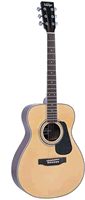
My guitar

Nes i fy ngwers gyntaf ar y gitâr ddoe. Gofynnodd yr athro wrtha i llawer o gwestiynau am fy ngwybodaeth am y gitâr ac am gerddoriaeth a dysgais ef i mi dau cord syml ac sut i strymio hefyd. Heddiw prynais i fy ngitâr cyntaf – gitâr acwstig gan Vintage (y V300).

Rinne mé mo chéad cheacht giotár inné. Chuir an múinteoir go leor ceisteanna orm faoi m’eolas faoi an giotár agus an ceoil agus mhúin sé cúpla corda simplí liom agus cad é méaraigh a dhéanamh. Inniu cheannaigh mé mo chéad ghiotár – giotár fuaimiúil le Vintage (an V300).

Rinn mi mo chiad leasan giotar an-dè. Chuir an tidsear móran ceiste rium mu dheidhinn m’aithne mu an giotar is an ceòl agus theagaisg e mi feadhainn còrda simplidh is diasganaich a deanamh. An-duigh cheannaich mi mo chiad giotar.

Maintenance v reactivation

A post on Tim Ferriss’ blog that I came across the other day, via Confessions of a Language Addict, asks an interesting quesion:

How can you possibly maintain fluency in two foreign languages — let alone five or six — if the opportunities to use them are months or years apart?

He then explains how he reactivated his German before visiting Germany recently by watching German films, reading German manga and a German phrasebook, and also using flashcards. He reckons that once you reach an intermediate to advanced level in a language, trying to maintain it at that level could be a real struggle of you don’t have regular opportunities to use it and you may also develop bad habits. Instead he recommends that you spend 1-3 weeks reactivating and reviving your knowledge of the language before you need to use it.

What do you think? Is it better to keep a language ticking over, or to brush it up only when you really need it?

I’m trying to maintain and improve the languages I’m focusing on at the moment (Czech, Welsh, Irish and Scottish Gaelic), while practising my other languages when I get a chance to keep when ticking over.

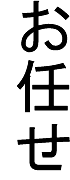
Word of the day – お任せ (omakase)

omakase in the Japanese script

I came across today’s word on Amazon’s Affiliates site today. They use it as the name of a widget which displays products based on Amazon’s understanding of your site, the visitors to your site and the page you place it on. They say it means “leave it up to us”.

お任せ (omakase) is a Japanese word that means “entrust” or “protect”. It’s used mainly in Japanese restaurants, where customers might say “お任せお願いします” (omakase onegaishimasu), which you could also translate as “Chef, I’m in your hands”. When they say this, they are asking the chef to select and prepare food for them in a manner of his choosing. The chef also decides how much to charge. This usually results in a very good meal at a reasonable price as the chef will feel obliged to create a worthy meal out of the freshest foods he has, to reward and retain a valued customer’s trust in him.

Typo Tour

I received an email today about what is apparently the first Typographic Tour of Italy or Il Grand Tour della tipografia italiana. When I first saw the subject of the email I thought someone was organising a tour of Italy especially for typographers. Then I realised it’s actually a virtual tour via images and text on a website. There are also links to GoogleEarth, which enable you to see maps and images of the sites where the examples of type and lettering are found.

The site contains examples of inscriptions and signs from around Italy in a variety of styles and provides information about the people who designed the typefaces. Most of the information is in Italian, but there is also an explanation of the project in English.