This photo was sent in by a visitor to Omniglot who is curious to know what the inscription means. The inscription, which he thinks might be in Russian or Bulgarian, appears on a gravestone in a cemetry in Rhinebeck, NY.
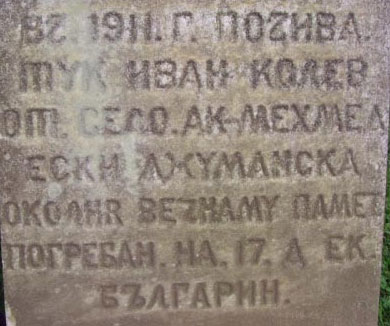
Can any of you help?
Here’s a recording in a mystery language.
Do you know or can you guess which language it’s in and where it’s spoken?
There’s apparently been a significant increase in the numbers of people learning Polish in recent years, especially since 2004, according to this article, and many of them come from the UK or Ireland.
Many language schools that used to teach mainly English and German to Poles are now offering courses in Polish as a foreign language. Such courses are popular with people from the UK and Germany who have been going to teach in Poland since the 1990s, and also with people with Polish partners, and people of Polish origin wanting to get in touch with their roots. Translators and interpreters are studying Polish as there is a great demand for Polish speakers in EU institutions.
Polish is described as a notoriously difficult language that starts out fiendishly difficult and then gets harder, and it’s apparently quite common for students to quit after a few lessons. Some do continue studying later after getting their courage back though. Not surprisingly speakers of other Slavic language find Polish least difficult to learn, Germans find the grammar relatively easy as it has much in common with German grammar, and speakers of Romance languages don’t find the grammar too hard. It’s English speakers who usually find Polish hardest, and Australians are apparently dreaded by Polish teachers.
Are any of you learning Polish?
The inhabitants of the Norway House Cree Nation (Kinosao Sipi), a small community in northern Manitoba in Canada, have been challenged by their chief, Marcel Balfour, to become proficient in Cree (kinose’wi si’pi’hk) by the year 2020, according to an article I found the other day.
The band’s council have decided to make Cree the official language of the community, and will encourage residents to speak it as often as possible. At the moment about three quarters of the people there can understand Cree, some 50% or 60% can speak it, at least to some extent, and its mainly the elder generation who are most comfortable with the language. Balfour himself is not fluent but is determined to become so.
The article doesn’t mention how much community support the initiative has – without such support, it is unlikely to succeed.
Here’s a recording of part of a story in a mystery language.
Do you know or can you guess which language it’s in and where it’s spoken?
Today I found an interesting website called MuturZikin which has many different maps showing where languages and dialects are spoken. The site and the maps are mainly in French and English, with some parts in Basque, Spanish and quite a few other languages. The maps include the native names of the languages, which are given in many other languages as well, and also show language families.
Here are some other language maps:
MLA language map (USA)
World Atlas of language structures
World Language Phyla/Family Mapping
The Language Families of the World
Zompist Language family maps
The other day I came across an interesting article on efforts to keep the Romansh language alive. Romansh or Romansch, which you can hear in last week’s language quiz, is a Romance language spoken mainly in the Swiss Canton of Graubuenden (Grischun/Grigione/Grissons) by about 60,000 people.
There appears to be mixed views on the language – some people are very enthusiastic about the language and do everything they can to encourage its use, others see the language as a handicap.
One significant problem is that Romansh speakers can’t agree which of the five varieties of Romansh should be taught in schools. Lia Rumantscha, the organisation that promotes the language, would like to see Rumantsch Grischun, a standard written form of the language, used in all schools by next year. Other people would prefer to continue using their local varieties of Romansh in schools.
According to a book I was reading yesterday, Sustaining linguistic diversity: endangered and minority languages and language varieties, there have been similar problems in Ireland with the government wanting a standard form of Irish taught in schools, while people in Irish-speaking areas (gealtachtaí) would prefer to use their local varieties of the language.
Here’s a recording of part of a story in a mystery language.
Do you know or can you guess which language it’s in and where it’s spoken?
One of my classmates at university is doing a research project on mutual intelligibility between varieties of English spoken in China, Hong Kong, Malaysia, Singapore and the UK.
It involves listening to recordings of these varieties of English and answering simple questions. The recordings are divided into five sections, each lasting less than 15 minutes, which you can listen to at any time. There’s also a questionnaire to complete.
If you come from one of these places and are willing to help, please go to one of the following pages:
Listening task for native speakers of English
Listening task for native speakers of other languages
Here’s another project you could maybe help with: a researcher from the University of Massachusetts Amherst but temporarily based at Bangor University is doing a study exploring the different meanings the words like, all, each, and every have in everyday life, and exploring their effect on the mathematics performance of children with different language and dialect backgrounds.
This involves completing this online questionnaire (43 questions).
buusuu.com, a website that describes itself as an “online community for learning languages”, provides online lessons in English, Spanish, French and German, as well as opportunities for language learners to learn from one another.
They are currently celebrating their first anniversary and are offering a 10% discount on premium memberships.
They have also added video language lessons recently, and they have an interesting feature about Silbo Gomero, the whistled language of La Gomera in the Canary Islands.