This inscription was sent in by a visitor to Omniglot and appears on a copper plate he bought in Turkey.
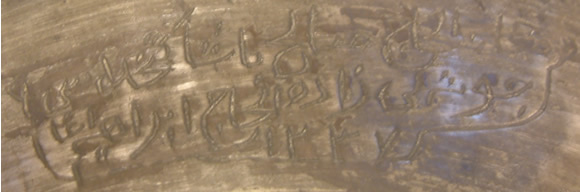
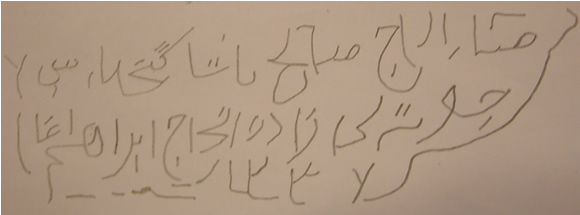
Can any of you decipher the text?
The other day I was talking to a native Welsh speaker from South Wales who has lived in North Wales for many years. I mentioned that people in shops here sometimes switch to English when I talk to them in Welsh, and she told me that the same thing happens to her sometimes.
Apparently the South Wales accent is associated with Welsh learners, and this applies not just to actual learners, but also to native Welsh speakers from South Wales like my friend, who speaks North Walian dialect with a South Walian accent and therefore sounds a bit like a learner. She also told me that she tries to speak North Walian dialect because people round here find South Walian dialects difficult to understand.
In colloquial spoken Welsh and informal written Welsh there are plenty of differences between northern and southern varieties. Some examples of grammatical differences include:
| North Walian | South Walian | Formal Welsh | English |
|---|---|---|---|
| Mae gen/gin i … | Mae … ‘da fi | Mae gynnyf … | I have … |
| Sgin i … | Sdim … ‘da fi | Does gynnyf … | I don’t have … |
| Mi (w)nes i dweud | Mi/Fe ddwedes i | Dwedais | I said… |
| Ti isio …? | Ti moyn …? | Yr wyt ti eisiau …? | Would you like …? |
The auxiliary verb gwneud (to do) plus the main verb (in this example, dweud – to say) are used to form the past tense in North Wales. In South Wales and in formal Welsh the past tense endings are applied to the main verb, and the personal pronouns are not used in formal Welsh.
Differences in vocabulary include:
I moved into my new house yesterday and am currently having new carpets fitted, which got me wondering about the origins of the word carpet.
Carpet has been traced back to the Proto-Indo-European root *kerp- (to pluck, gather, harvest) via the Old French carpite (heavy decorated cloth), the Middle Latin carpita (thick woolen cloth) the past participle of the Latin carpere (to card, pluck).
*kerp- is also the root of the English word harvest, the Greek καρπός (karpos – fruit, grain, produce, harvest, children, poetry [fruit of the mind], profit); and the Irish ciorraigh (to cut, hack, maim).
Sources: Online Etymology Dictionary and Wiktionary.
Today’s word, paraskavedekatriaphobia, means “fear of Friday the 13th”. It comes from the Greek Παρασκευή (Paraskeví – Friday), δεκατρείς (dekatreís – thirteen) and φοβία (phobía, from φόβος (phóbos) – fear).
An alternative name for this phobia is friggatriskaidekaphobia, which combines frigga (Friday) and triskaidekaphobia (fear of the number thirteen).
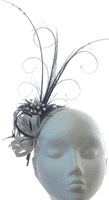
I learnt a new word from the radio this morning – fascinator. They were talking about hats and somebody mentions the fascinator, something I hadn’t heard of before.
A fascinator or facinator hat is: “a small headpiece usually mounted on a base, comb or headband worn jauntily to the front or side incorporating a combination of feathers, flowers, coils, curls and other trimmings.” [Source]
Apparently the fascintor was originally a fine, lacy head covering made of wool or lace and like a shawl. It went out of fashion in the 1970s, but has made a come-back recently in a different form. They are almost exclusively worn by women, especially to special occasions like weddings and big race meetings such as Ascot. [Source]
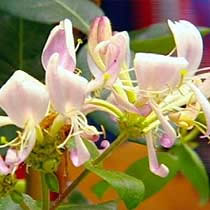
The word zimolez, which is honeysuckle in Czech, came up the other day during a conversation with a Czech friend. It comes from zima (winter) and lézt (to climb, crawl, creep), so could be translated as “winter climber”.
Other interesting words that came up include plšík (doormouse), smršť (tornado) brblat (to grizzle, beef, grouch, mutter) and žbrblat (to mutter to oneself). The root smršť also appears in words related to shrinking and contracting, such as smrštit (to shrink), smrštěný (contracted, shrunk) and smršťovací fólie (shrink wrap).
What delicious consonant clusters!
The English name honeysuckle comes from the Old English hunigsuge (honey-suck). An alternative name is Eglantine, which comes from the Old French aiglent (dog rose), from the Vulgar Latin aquilentus (rich in prickles), from the Latin aculeus (spine, prickle), a diminutive of acus (needle)
Names for honeysuckle in other languages include:
Here’s a recording of a story in a mystery language.
Can you guess the language and where it’s spoken?
Here’s another puzzle for you. It was sent in by a visitor to Omniglot, who writes:
Hoping you can help solve this mystery phrase. My great grandmother used to say this phrase, “I de vreet”, which sounded like “eye deh vreat”. If you could give any insight into what this means. We think it might be Hungarian but are not sure.
Any suggestions?
Here’s a request from a visitor to Omniglot that maybe you can help with:
I purchased a copper pitcher from an antiques dealer in Baghdad recently and found two characters marked under the lip of the pitcher. The dealer wasn’t aware of the marks and assures me that the piece is from Iraq/Iraqi made, yet, though they appear to be some form of Arabic, none of our interpreters have been able to tell me what the marks mean. Can you please tell me what they are? I have studied every alphabet chart online, but cannot find an exact match.
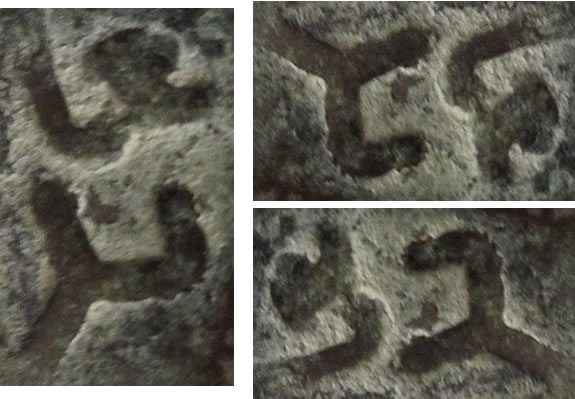
The image on the left was the one sent to me. The other ones are the same image flipped round.