
by Simon Ager
Music has always been an important part of my life and I come from quite a musical family: my mother plays the piano and ukulele, and sings in choirs, and used to play the clarinet. My brother plays the ukulele and occasionally the trumpet, and used to play the piano and trombone, and my sister plays the ukulele, and used to play the piano, cello and recorder.
Here are details of the instruments I play, or used to play, and of the groups I play with and have played with.
Recorder | Piano | Clarinet | Saxophone | Tin Whistle | Harmonica | Ocarina | Guitar | Mandolin | Ukulele | Bouzouki | Bodhrán | Melodica | Cavaquinho | Xaphoon | Harp | Bawu (巴乌) | What do I currently play? | My instruments
My musical adventures | My singing adventures | My Songs | My Tunes
I think the first instrument I learnt was the recorder, which everyone learnt in primary school when I was a child. I don't remember much about this, but at the time I wasn't all that keen on it.
After I moved to Bangor in 2008 I started learning Welsh folk tunes. I found that some of them were in keys I couldn't play easily on the tin whistle, so I got myself a couple of recorders - a tenor and a descant - in order to play them. Later I also acquired treble, bass and sopranino recorders, and since about 2011 I have played them with a group of friends. We play a variety of music from baroque to folk to pop, and I usually play the bass or treble.
Here are a couple of my compositions for recorders:
You can see the score for this piece on MuseScore.
You can see the score for this piece on MuseScore.
[top]
I started playing the piano in 1977 at the age of 7, and had piano lessons for about five years. I learnt how to read music and took a couple of exams - I passed grade 1 but failed grade 2. I enjoyed playing tunes that I knew - things like themes from films and television programmes, but wasn't quite so keen on the things my piano teachers wanted me to play, so didn't practise all that often.
After many piano-less years, during which I occasionally tried to play pianos I came across, particularly at my Mum's when I was visiting, I decided to start playing again and bought myself a piano in 2010. Since then I have played regularly - mainly classical and folk music, plus my own compositions.
Here are a couple of my compositions for the piano:
You can see the score for this piece on MuseScore.
You can see the score for this piece on MuseScore.
[top]
In 1982 after giving up the piano, I started playing the clarient. My mum had played for a while when she was at school and her clarinet had been sitting around in a drawer since then. I found it one day during the summer holidays and decided to have go. I spent that summer trying to teach myself how to play, then my mum arranged lessons when school started again.
I had clarinet lessons until the age of 18, when I left school, and played in wind bands, big bands and and an orchestra, which I really enjoyed. I passed grades 3, 4 and 6 on the clarinet, and also had to take grade 5 theory in order to take grade 6 practical.
The orchestra performed every so often in and around Lancaster, and also went on occasional trips abroad, including one to Perpignan in the south of France, which I went on. Some of the orchestra members were excellent musicians and went on to study music and to do great things with it, but most of us were not quite so talented.
For a while I also played the bass clarinet, which I borrowed from one of the music schools I went to. I loved the instrument and would have liked to have had my own one, but couldn't afford it at the time, and had to give it back after I left school.
I continued playing during my gap year after finishing schoool and during my first year of university, though by then I wasn't having lessons and didn't play as regularly. During my second year at university I was in Taiwan, Japan and China and didn't take any instruments with me and got out of the habit of playing regularly. During my third and fourth years I was busy studying and unfortunately didn't have much time for music.
I didn't play the clarinet for many years and though I tried to start again, it never really happened and I eventually sold my clarinet in 2010.
[top]
After a few years of playing the clarinet, I also started playing the tenor saxophone. I played in wind bands and big bands and really liked the instrument. I also played the soprano saxophone for a while at university. I eventually sold both instruments.
[top]
While I was at school I started playing the tin whistle and got interested in Irish and Scottish music. After finishing school I continued to play for a while, then gave up and lost my whistles.
Since 2005 I have been going to Ireland every year to do courses in Irish language, songs and music, and this inspired me to start playing the whistle again. The tunes I'd learnt while at school started comnig back to me, and I learnt lots of other tunes. I bought myself a variety of high and low whistles, and started playing in folk music sessions. At first I played in sessions when visiting Ireland and Scotland, and then in 2007 I started playing regularly in a session in Rottingdean, near Brighton.
I currently play in folk sessions in Bangor and occasionally elsewhere. We play tunes and sing songs from Wales, Ireland, Scotland and England, and sometimes from other places.
This is one of tunes played on high and low whistles and the piano:
[top]
I was given an ocarina for a birthday while I was at school and taught myself to play it. I didn't play it much for many years, then after being inspired to take up music again by my visits to Ireland, I started playing again, and bought some different size ocarinas from soprano to bass.
[top]
While at university in the late 80s / early 90s I dabbled briefly with the harmonica. I have tried to learn more since then, but have yet to get the hang of it.
[top]
In September 2007 I started playing the guitar, at first a steel string acoustic, and later I got a classical guitar. I had lessons until I left Brighton in July 2008, and have continued to play since then. At first I learnt basic chords and strumming patterns, then decided to learn classical style. I also taught myself to play the melodies of folk tunes.
Here are a couple of my tunes - the first is played just on the guitar, the second on the guitar, cavaquinho and low and high whistles, piano, melodica and bodhrán.
You can see the score for this piece on MuseScore.
[top]
In 2010 I acquired a mandolin and I play it regularly in folk music sessions. It took a little while to get used to it as it was so much smaller than the guitar and has different tuning, but I eventually became comfortable playing it. Mainly I play tunes, but I do play chords occasionally.
Here's a recording of a tune I wrote on the mandolin, which also features the guitar, piano and cavaquinho.
[top]
I started playing the ukulele in 2011. I had thought about trying it for a while, and when I saw that a ukulele group was starting in Bangor, I decided to give it a go. I found it easy to learn and was soon playing along to a variety of songs.
I played with the Bangor Ukulele Society every week until 2018, when it fizzled out. We also played in open mic nights occasionally, went busking, and ukuleled up Snowdon a few times.
I have been to a few ukulele festivals in North Wales and Ireland - my favourite is the Ukulele Hooley, which takes place in Dún Laoghaire in August every year.
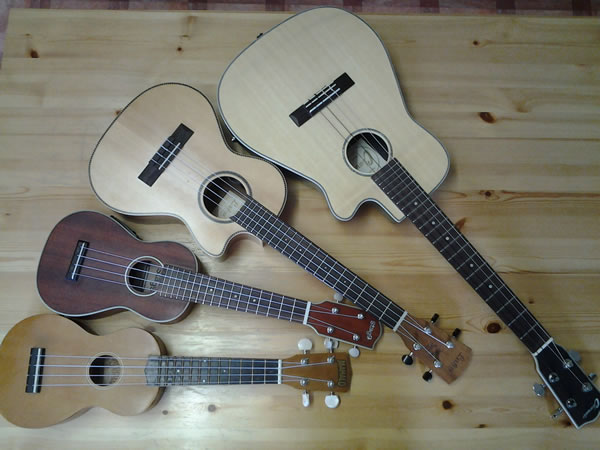
My ukuleles
Here are a couple of songs I wrote, played on ukuleles, and other instruments.
[top]
In 2012 I bought myself a bouzouki after hearing Ryland Teifi, a Welsh musician, playing one at a concert. I really liked the sound of it and it was a bit of am impulse buy. I like the instrument and enjoyed playing it, but eventually decided to sell it as I couldn't really devote enough time to it to become a good player.
[top]
I bought a bodhrán (Irish frame drum) in 2012 and did a course in bodhrán playing at Oideas Gael, and Irish language and cultural centre in Donegal in the northwest of Ireland that summer. I've played the bodhrán in folk music sessions since then - it's particularly handy to have for tunes I haven't learnt yet. I sold my first bodhrán and bought a better one a few years later.
[top]
In 2013 I acquired a melodica. It was an impulse buy - I'd heard one played at a singing workshop, quite liked it and decided to get my own. I find it quite easy to play and quite like it, though don't play it very often. Since then my first melodica has gone out of tune and I got another one.
Here's one of my tunes, The Saturday Hornpipe, played on the melodica:
[top]
After seeing one being played at a concert, I got interested in the cavaquinho, a Portuguese instrument the same size as a soprano ukulele, but with steel strings and different tuning. I have mine tuned to D, G, B, E - like a guitar, but an octave higher [More details]. I bought one in 2013, and really like it. I keep it on my desk and often pick it up and play a tune or two during the day. I also play it sometimes in folk music sessions.
Here are recordings of my own compositions, on the cavaquinho:
[top]
I bought myself a xaphoon or pocket sax in 2013 on a whim after hearing about it from a friend and investigating online. The Xaphoon is an instrument the size of a descant recorder invented by Brian Wittman. It uses a tenor saxophone reed and sounds like a saxophone or clarinet, depending how you play it. Xaphoons were originally made of bamboo, and are now also made of plastic. I liked the instrument, but sold it to a friend after deciding that that I didn't really have the time to master it.
[top]
In 2013 I bought a small folk harp, which was on special offer and I couldn't resist, but returned it after realising that it wasn't a very good one and wouldn't stay in tune. The following year I bought a better one, and did a course in harp playing in Ireland for a week. In 2015 I did another harp course in Ireland, and bought a larger harp. I love playing the harp, and occasionally play in music sessions and open mic nights.
Here are recordings of me playing my compositions, and a Welsh folk tune, on the harp:
You can see the score for this piece on MuseScore.
[top]
In 2016 I bought a bawu (巴乌 [巴烏] bāwū) a Chinese flute from Yunnan in southern China. A friend of mine plays one in sessions we go to, I like the sound, and decided to get one myself. I'm still learning how to play it, and can get some sounds out it.
[top]
I play the mandolin, and sometimes the whistle or cavaquinho, in regular a Welsh folk music session, and occasionally in other sessions. I play recorders with friends once a month, and try to practise my instruments at home as much as possible.
[top]
These are the instruments I currently own (see also the photo below). I can get tunes out of all of them, though some, like the flute and harmonicas, I rarely play and can't play very well, yet.

My musical instruments
In the past I had Bb and A clarinets, tenor and soprano saxophones, a xaphoon and a bazouki, and for a while I played a bass clarient that I borrowed from a musical school I went to.
The exams referred to here are run by the Associated Board of the Royal School of Music (ABRSM). Grade 1 is the easiest one, and grade 8 the hardest. There are insturmental exams for a variety of instruments for classical music and jazz, and also for singing and music theory, as well as diplomas in muscial performance, direction and teaching.
My musical adventures | My singing adventures | My Songs | My Tunes
[top]

You can support this site by Buying Me A Coffee, and if you like what you see on this page, you can use the buttons below to share it with people you know.

If you like this site and find it useful, you can support it by making a donation via PayPal or Patreon, or by contributing in other ways. Omniglot is how I make my living.
Note: all links on this site to Amazon.com


[top]


