Linguistic adventures in Cuba

My linguistic adventures started on the flight out to Cuba, during which I was sitting next to an electrician from Germany. I tried speaking a bit of German with him, but he seemed to prefer using English, which he spoke very well. I also tried out my Spanish on the cabin staff and did my best to understand the announcements in Spanish.

When in Cuba I used my Spanish as much as possible. Some of the people I encountered didn’t speak English, so I had to speak to them in Spanish and was able to communicate fairly well. Other people spoke English and some preferred to practise their English with me rather than to speak Spanish. One feature of Cuban Spanish I noticed was a tendency to drop esses, particularly at the ends of words. For example, they say buena dia rather than buenas dias, and ecuela rather than escuela.

I met some Germans and Austrians and was able to converse with them in German, though I kept on having to use English words when I couldn’t remember the German ones. Not bad considering I haven’t used my German much since leaving school many years ago.

One member of the group was Chinese and I spoke some Mandarin with her. Another member of the group was an Irish speaker and I spoke some Irish with her, though she found it a little difficult to understand me as I speak Donegal Irish, while she speaks Munster Irish. The differences between these dialects are not huge, but they take some getting used to.


I’m back

I returned from Cuba late last night after a long, long journey. Fortunately my luggage didn’t get lost on the way back to London, as it did on the way to Havana. The airline (Iberia) somehow managed to forget to load several baggage containers onto the plane, so when we arrived in Havana, our bags were still in Madrid. Some members of the group got their bags the next day, but I had to wait four days for mine, and one of group didn’t get her bag until we went back to Havana airport to return home.

View of Havana's Malecon (seafront)
A view of Havana from Castillo de los Tres Reyes Magos del Morro

The group consisted of 15 Brits, two people from Ireland and one from Australia, and ranged in age from 30something to 70something. We had a Spanish-speaking tour leader from England, and various local guides. We all got on well and had a great time. Only a few of the group spoke Spanish, but this wasn’t too much of a problem as our local guides and most of the other people we met spoke English, at least to some extent.

The group
The group (plus two random kids)

We travelled all around the island from Havana to Santiago de Cuba, via the Bay of Pigs, Trinidad and Camaguey, and then back via Santa Clara, Soroa and Viñales. Everywhere we went, we were told a lot about the Cuban revolution. We also visited La Comandancia de la Plata in the Sierra Maestra mountains near Santo Domingo where Fidel, Ché and others took refuge after the unsuccessful uprising of 1956; Ché’s memorial in Santa Clara, and the Museum of the Revolution, including the original Granma yacht, in Havana. There were only a few mentions of Cuba’s pre-revolutionary history.

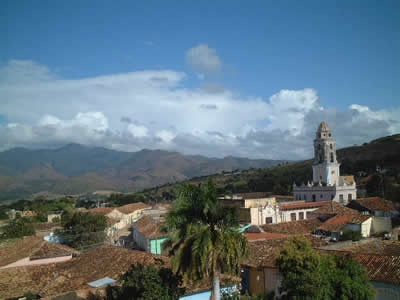
A view of Trinidad
Trinidad

For me, the highlights of the trip were Trinidad, walking in the Sierra Escambray and Sierra Maestra mountains, and a very memorable evening of music and dancing in Viñales, which ended with six of us squeezing into a Lada and being driven at high speed back to our hotel. That was one occasion when my Spanish came in very handy – there were no taxis but we eventually managed to find someone with a car willing to take us all to the hotel. The negotiations were conducted mainly in Spanish.

A view of the Sierra Maestra mountains
Sierra Maestra

As well as practising my Spanish, I also had opportunities to use my German, Irish and Mandarin. I tried to teach some of the other members of the group a bit of Spanish and some juggling as well.

Cuba

Tomorrow I’m off to Cuba for a two-week holiday, so there probably won’t be any more posts on this blog until I get back next year. I’m going on a tour with a small group and will be travelling all over the island and visiting such places as Havana, Trinidad, Camaguey and Santiago de Cuba, where I’ll be on Christmas Day.

¡Hasta luego!

Maintaining multiple languages

A recent post on The Linguist discusses an interesting idea for maintaining one’s abilities in various languages. The idea is that you load up your mp3 player with audio files for the languages you want to maintain and/or improve, then you set it to randomly repeat them. The files could be language lessons, podcasts, audiobooks or anything else you have to hand. This method ensures that you don’t get tired of listening to one particular language, and should help you to switch between languages.

I think I’ll give this a try. I already have quite a few language courses loaded onto my mp3 player and will set up a playlist for the ones I’m working on at the moment. I’ll add more lessons and chapters from my audiobooks to the playlist once I’ve read through them. This will enable me to revise material I’ve already covered. I might add some podcasts in languages such as French, Spanish, Russian and Japanese.

Why you no understand?

Although I’m very used to hearing English spoken by non-native speakers, I do sometimes have difficultly understanding some of what they say. This is often because of mispronunciation and/or misplacement of word stress. Sometimes people have to repeat a word several times before I work out what they’re trying to say.

The same happens to me when I’m speaking other languages. I do my best to get the pronunciation and intonation correct, but am not always successful, which leads to confusion in the minds of those I’m talking to.

Sometimes it’s not the pronunciation, word stress or intonation that lets me down, but the way I put my sentences together and/or the words I use. I may get the words in the wrong order, or use words that are unusual or obscure. Fortunately in some languages you can get away with mixing the words up, as the word order is flexible.

I was talking about this with a Japanese colleague this morning. She told me that at a party she went to recently, where there was a mixture of English and Japanese people, the English people were all speaking English slowly and clearly to make sure that Japanese could understand them. Later she overheard the English people talking amongst themselves and found it quite difficult to understand them as they were speaking at normal speed and using lots of slang.

Regular contact with non-native speakers of your language can help to accustom you to a variety of foreign accents and ways of speaking. In the cases of languages few people study, their native speakers are perhaps less likely to have heard foreigners attempting to speak their language and might be less tolerant of mispronunciation and grammatical errors. I’ve read that this might be true for Czech. Does anybody know if this is the case?

Slavic similiarities

While talking with a Bulgarian contact today, we were discussing the conjugation of the verb ‘to juggle’ in Bulgarian, as you do, and I was struck by how similar Bulgarian verb endings are to Czech ones. Below is the present tense of this verb with the Bulgarian on the left and the Czech on the right.

  • жонглирам (žongliram) / žonglovam – I juggle
  • жонглираш (žongliraš) / žonglov – you juggle
  • жонглира (žonglira) / žonglova – he/she/it juggles
  • жонглираmе (žonglirame) / žonglovame – we juggle
  • жонглирате (žonglirate) / žonglovate – you (pl) juggle
  • жонглират (žonglirat) / žonglovají – they juggle

The more I learn about the Slavic languages, the more similarities I see between them. So far my knowledge is limited to a smattering of Russian, a little Czech, and a few Bulgarian words, so my impressions and thoughts may change as I learn more. One encouraging factoid I’ve discovered is that Czech only has about seven irregular verbs.

I also came across an interesting site today which contains useful words and phrases in a number of Slavic languages, with translations in English and Japanese.

Correction: the Czech conjugation of the verb ‘to juggle’ is actually:

  • žongluji – I juggle
  • žongluješ – you juggle
  • žongluje – he/she/it juggles
  • žonglujeme – we juggle
  • žonglujete – you (pl) juggle
  • žonglují – they juggle

There are Czech verbs with endings similar to the Bulgarian ones above, but not ‘to juggle’, unfortunately.

Practice makes perfect

I’ve been chatting with a number of people in Mandarin, Taiwanese and Japanese today. After many years of neglect, my command of these languages is gradually improving.

My Mandarin is more or less fluent, though there are many gaps in my vocabulary, which I’m doing my best to fill. Some of the people I’ve been talking to told me that they thought I was a native Mandarin speaker, which is encouraging.

I only have a limited knowledge of Taiwanese, but that should improve with practice. I can understand the language to some extent thanks to many years of hearing it while in Taiwan, and when I hear people speaking it, it brings back lots of memories.

My Japanese is also gradually coming back to me. I can’t speak it particularly well at the moment, but can understand quite a lot. When talking to my Japanese contacts today, I was pleased to realise that I could actually follow most of what they said in Japanese. One problem I have is that I often find myself at loss for appropriate verbs when I get to the end of my Japanese sentences.

Are you going ganja, yaar?

A new series of BBC Radio 4’s fascinating programme about language, Word of Mouth, started this week. One of the things they discussed was Hinglish, a blend of English, Hindi, Punjabi and other South Asian languages spoken in India and by people of Indian origin in the UK, and elsewhere.

In the UK, British Indians pepper their English with Hindi and Punjabi words and expressions, such as yaar (a friend), javaani (youth), ganja (bald), chamcha (a spoon, a lackey, or a sycophant). While in India, many people mix English words and phrases with their native languages, for example time kya hua hai? (what time is it?).