Eisteddfod Llangefni

Neithiwr mi es i i Langefni efo Côr y Dysgwyr, ac mi gystadlon ni yn yr eisteddfod ‘na. Dim ond un côr arall yn roedd yn cystadlu – côr o Lanfairpwllgwyngyll – ac mi enillon ni! Mae’r un arweinydd efo’r dau chôr, ac yr un gyfeilydd, ferch yr arweinydd. Dyma’r tro cyntaf i mi mynd i eisteddfod ac roedd hi’n wych, ac roedd y pobl yna yn gyfeillgar iawn.

Yna ystod yr wythnos ‘ma, dw i wedi bod yn brysur efo trawsgrifiad y cyfweliadau dw i wedi recordio yn Ynys Manaw. Dw i wedi trawsgrifio tua dri awr o recordiadau yn barod – rhyw 26,000 o eiriau! – ac mae dau neu dri awr i wneud. Gobeithio bydda i’n gorffen yr wythnos nesaf, ac yna galla i parhau sgwennu fy nhraethawd hir.

Llangefni Eisteddfod

Last night I went the Llangefni with the Welsh Learners’ Choir, and we competed in the eisteddfod there. Only one other choir was competing – a choir from Llanfair PG – and we won! The two choirs have the same conductor, and the same accompanyist, the conductor’s daughter. This was the first time that I’ve been to an eisteddfod and it was good, and the people there were really friendly.

This week I’ve been mainly transcribing the interviews I recorded while in the Isle of Man. So far I’ve transcribed about three hours’ worth or recordings – some 26,000 words! – and there’s another two or three hours to do. I hoping I’ll finish this coming week, and then I can get on with writing the dissertation.

Word of the day – skeet

Skeet, which apparently comes from Old Icelandic, is a word you’re likely to hear frequently in the Isle of Man. It’s means gossip, more or less. People will ask you, “Got any skeet (at you)?” and will try to find out all about who you’ve seen, where they were and what they were doing, who they were with, and so on. The holder of any juicy skeet will try and keep as much of it to themselves for as long as they can to build up the suspense.

You can also have a skeet (look) at something, for example if you’ve brought something new people will ask for a skeet at it, and having a skeet at the neighbours from behind your net curtains is a common practice.

In Manx the word skeet means sneak or news, and jollys-skeet is a voyeur.

Other meanings of skeet include:

– clay targets used in trapshooting – known as clay pigeons in the UK
– a poker hand consisting of a 9, a 5, a 2, and two other cards lower than 9.
– loud, disruptive and poorly educated person of low social status (in Newfoundland slang)
– to squirt

Transcribing conversations

This week I’ve been transcribing the conversations and interviews I recorded while in the Isle of Man. So far I’ve done about an hour’s worth of transcription, which comes out as just over ten thousand words. I have another four hours or so of recordings, and hope to finish transcribing them this week. Then I’ll start writing up my findings. I probably have too much information, but that’s better than too little.

One thing that’s struck me is how disjointed conversations can appear when you write them down. The are loads of repetitions, utterances are often loosely connected with conjunctions like and, so, but or because, they go off on tangents, and often tail off without … Many utterances only make sense in context, and lots of bits can be omitted if the people involved share some common knowledge. There’s also no shortage of interruptions and interjections, and people often finish off one another’s sentences, especially if they know each other well. When you’re speaking you don’t necessarily notice this as much, unless you’re particularly looking out for it.

While it is possible to talk in coherent, well-formed sentences without notes or a script, that doesn’t seem to be how most people talk.

Anturiau yn Ynys Manaw

Mi gyrrhaeddais yn ôl ym Mangor prynhawn ddoe, ac yna gyda’r nos es i i barti yn nhŷ fy nhiwtor. Mi fwynheais fy hunan yn fawr yn Ynys Manaw, mi gwrddais efo llawer o bobl sy’n siarad Manaweg, mi siaradais llawer o Fanaweg, ac mi weles cryn dipyn o’r ynys. Mi gasglais llawer o wybodaeth ar gyfer fy nhraethawd hir. Gobeithio bydda i’n ôl yna cyn bo hir.

Fiontair san Oileán Mhanann

Tháinig mé ar ais go Bangor tráthnóna inné, agus i ndiaidh sin chuaigh mé chun coisir san teach mo theagascóir. Bhain mé an-sult as mo chuairt san oileán, bhuail mé le go leor daoine atá Manainnis acu, labhair mé a lán Manainnis, agus chonaic mé mórán áiteanna ar an oileán. Bhailigh mé a lán eolas ar mo thráchtas chomh maith. Tá súil agam go mbeidh mé ar ais ansin roimh i bhfad.

Contoyrtysyn ayns Mannin

Haink mee er-ash dys Bangor fastyr jea, as ny yei shen hie’m dys possan ‘syn thie my ynseyder. Va taitnys vooar aym ayns Mannin, haink mee ny whail lesh ram Gaelgeyryn, loayr mee ram Gaelg, as honnick mee chooid vooar jeh’n ellan. Ren mee co-phadjer ram fys son yn traghtys aym. Ta treisht orrym dy vee’m er-ash ayns shen roish feer foddey.

Adventures in the Isle of Man

I arrived back in Bangor yesterday afternoon, and went to a party at my tutor’s place in the evening. I really enjoyed my visit to the the Isle of Man, I met a lot of Manx speakers, spoke a lot of Manx, and saw quite a bit of the island. I also collected plenty of information for my dissertation. I hope to be back there before long.

Ramblage and recreation

A photo of the Douglas Head lighthouse

Today while exploring Douglas Head, an rocky headland just south of Douglas, I came across a sign that explained that the area was developed for ramblage and recreation, and other things, in the 1870s. The word ramblage attracted my attention as I hadn’t seen it before. Maybe it’s an old version of rambling. Have you heard it before?

There are quite a few words describe the action of moving along on foot, including walk, ramble, amble, hike, ambulate, march, wander, shuffle, perambulate, plod, run, saunter, stride, stroll, trudge and tramp. I’ve read that in some languages, such as Spanish and French, verbs of motion don’t usually indicate the manner of motion. Is this true of other languages?

More Manx

I spoke quite a lot of Manx yesterday and heard even more at a regular get-together of Manx speakers which happens on Tuesday afternoons in Douglas. About nine or ten people turned up and we spoke in Manx for an hour or so. I occasionally lapsed into English, Welsh or Irish when I couldn’t think of how to say things in Manx, but the others all stuck to Manx and were speaking it fluently. This was the first time I’d heard so many people speaking Manx so well, and I understood a lot of what they said, and managed to work out the meanings of some unfamiliar words from the context.

When I chat with people who are fluent in a language I’m learning my level of language tends to improve. This is partly because I can adapt the things they say for my own purposes, and also because I feel the need to speak the language as well as possible. When I speak to non-fluent learners in languages I know well I try to adjust and simplify what I say so they can understand me. This is a useful exercise because it forces you to explain things simply and clearly and to practise alternative ways of saying things.

Have you had similar experiences?

Mystery writing on rug

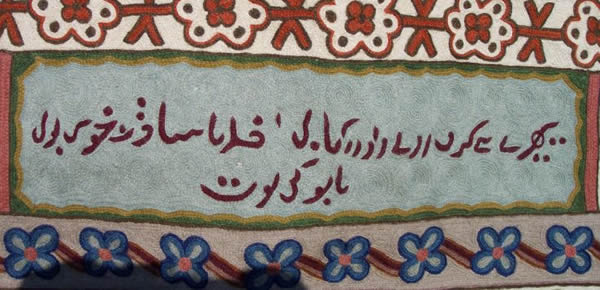
Can decipher this piece of writing or identify the language in which it’s written?

mystery writing

The person who sent in the image thinks the rug is appears on probably comes from Pakistan, and that the writing might be in Persian, Punjabi, Pashto or Urdu.