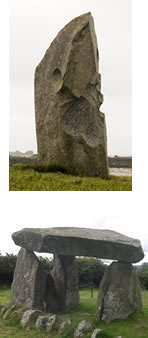
The word menhir come up in discussion yesterday and I posted it on Facebook today along with the the Welsh translation maen hir, which is what I found in this dictionary. This provoked further discussion about whether the two terms mean the same thing. So I thought I’d find out.
A menhir is a standing stone of the kind that Obelix delivers in the Asterix books. According to the Dictionary of Word Origins and the OED, menhir comes from Breton mean-hir (long stone), which is what the Welsh term maen hir means, so it seems that they are the same. The usual Breton word for such standing stones is peulvan, however.
The word dolmen (a prehistoric structure of two or more upright stones surmounted by a horizontal one), comes via French from Breton: the men part means stone, and the dol part either comes from the Breton word tōl (table), a borrowing from the Latin tabula (board, plank), or from the Cornish tol (hole). So dolmen either means ‘stone table’ or ‘stone hole’.
The word dolmen also exists in Welsh, and another word for such structures is cromlech, which exists in Welsh and English and comes from the Welsh words crwm (bent, stooped) and llech (stone), and is related to the Irish word cromleac (‘bent stone’).
In French, “cromlech” is used exclusively to refer to a stone circle, such as this one on Er Lannic island in Brittany http://www.panoramio.com/photo/8977317
Cromlech is Brythonic Celtic or Welsh as the English call it, the word derives from Old Cymraeg pre Roman, meaning a place of Burial within a stone Chamber Crwm ( Chamber) Lech (Ancestors) it is a very Ancient word which was also used in the Gallois region of Northern France and Belgium, there are many place names in France and Belgium that have Cymric Brythonic ancestry eg, Calais Morlais Paris ( Ypres) Arras Ghent (Yrgent) Bruges ( Brig ) and dozens more in Normandy and Brittany ( Brest from the Brythonic Bryste in English it is Bristol) Cotentan Carentan Caen Falais, you have the Rhone in Germany there is the Rhein in Spain there is Ronda and in the Cymru we have Rhondda Rhonddu and Aberrhondda Aberrhonddu also in the North of what is now Scotland you also have Aberdeen which comes from the Brythonic Aberrhonddu , you also have Nantes, which is Common in the Brythonic Celtic for Brooks or Tributaries of Rivers like Abernant , Crynant Nant y ffyllon etc.
What you call Menhir is in Cymraeg Maenhir which is a very ancient word, it means Standing Tall , which does refer to the Individual Standing Stones that are all over the Cymru, many of which have been lost to the Mountain Bogs along with Dolmaens, the Cromlech are often found within Large Neolithic and Bronze age Mounds , the later Iron Age mounds were also built the same, but were still in use well into the 8th Century AD.
I am from a Farming Family and we can Trace our Family back to Roman Times in Ceredigion we have a Farmhouse which dates back in Part to the mid Sixth Century but was after the Norman conquest in the 12th Century allowed to be used by Charter from the Norman Lords Le Breos ( the Bruce in Cymraeg Brewys) and De Clare ( Clyro) both of whom had Brythonic Ancestry and spoke the Cymraeg, later we supplied the Monastries and Abbey’s of Llanthony and Ystrad Fleur ( Strata Florida), till the Reformation under Henry V111.
My Family were better known as the Ap Gwrgant which were in Brythonic Terms pre Christian Chieftains, but from the late 2nd Century were educated in Latin and travelled to Rome and were involved with the Western Roman Emperors, they were to be involved with other Cymric Families the Tydyr, the Ystarth, the Seisyllt , the Brewys and by the late Fifth Century were Brythonic Kings all over Britain, they Flourished until the 12th Century, many of my family are buried in what is what we call Loegr (Lost Lands) better known as England as far East as Canterbury and as far West as St Davids, the last King of our family was Iestyn Ap Gwrgant who was murdered by Robert Fitzhamon the Duke of Gloucester in 1186 and is Buried at Llandaf , he was King of Glamorgan, Gwent and Cyren, so his Kingdom was much of south Wales and a fair Part of England across to Cirencester and Oxford,
diolch yn fawr ich i, rhag Brynnau Gwynion yn Gymru 92 oed
The Dutch provence of Drenthe has a couple of what we call “hunebedden” (singular: “hunebed”). In English brochures these are called dolmen. According to the Van Dale dictionary (the authority on the Dutch language), dolmen is a French megalith and a hunebed is a Dutch / Danish megalith. Does that mean there is no separate English word for “hunebed”?
The word “hunebed” seems derived from “huynen”, which was first used in a Dutch book in 1660 and in 1685, the word “hunebed” was used.
I found one reference mentioning the word “dolmen” (as derived from taol) was first used in the late 18th century.
Jerry – the English equivalents of ‘hunebed’ are dolmen, portal tomb, portal grave or quoit.
And what about “henge” as in “stonehenge”? I’m surprised that wasn’t included.
Cheers,
Andrew
Andrew – the origins of ‘henge’ are uncertain, but the OED suggests that it might have meant something hanging.
I’ve seen ‘Dolmaen’ as a farm name in Wales. ‘Dol’ in modern Welsh translates as ‘meadow’, so it would mean something like ‘rocky meadow’ or ‘meadow with a rock in it’. But it could equally refer to a neighbouring megalith.