
The Cherokee syllabary was invented by George Guess of the Cherokee between 1809 and 1824. At first he experimented with a writing system based on logograms, but found this cumbersome and unsuitable for Cherokee. He later developed a syllabary which was originally cursive and hand-written, but it was too difficult and expensive to produce a printed version, so he devised a new version with symbols based on letters from the Latin alphabet and Western numerals. George Guss is also known as George Gist or Chief Sequoyah (ᏍᏏᏉᏯ / ᏎᏉᏯ)
Sequoyah's descendants claim that he was the last surviving member of his tribe's scribe clan and the Cherokee syllabary was invented by persons unknown at a much earlier date.
By 1820 thousands of Cherokees had learnt the syllabary, and by 1830, 90% were literate in their own language. Books, religious texts, almanacs and newspapers were all published using the syllabary, which was widely used for over 100 years.
Today the syllabary is still used; efforts are being made to revive both the Cherokee language and the Cherokee syllabary, and Cherokee courses are offered at a number of schools, colleges and universities.
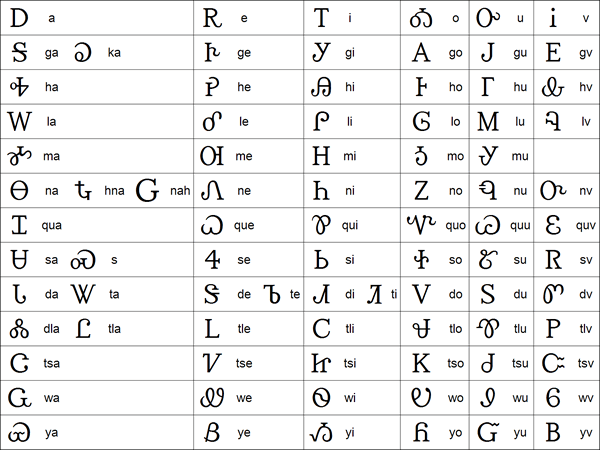
Download script charts Cherooke (Excel)
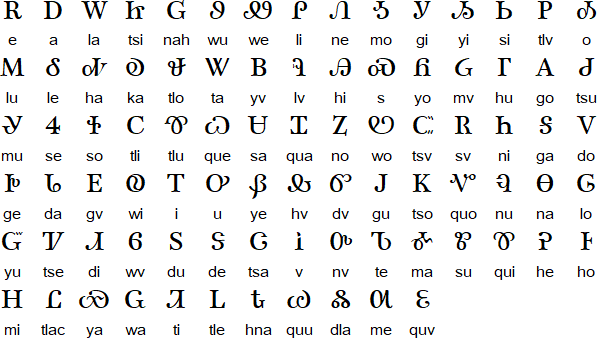
The original order of the Cherokee symbols is show below. This was changed in 1828 by Elias Boudinot, a Cherokee author and editor, to adapt the syllabary for printing. Further changes were made by Samuel Worcester, an American missionary, in 1834.
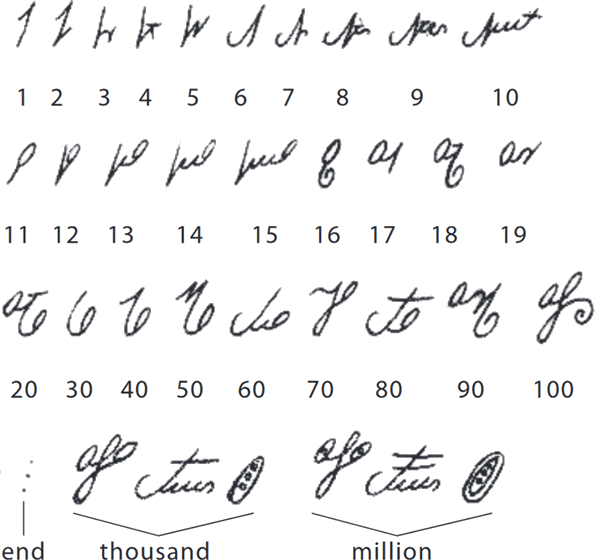
Sequoyah designed numerals for his script, however the Cherokee council voted not to adopt them.
Source:http://www.tiro.com/syllabics/Cherokee/Giasson_ChrkSyll.pdf


Nigada aniyvwi nigegudalvna ale unitloyi unadehna duyugadv gesvi. Getsinela unadanvtedi ale unotlisdi ale saquu gesv tsunilvwisdanedi anatlinvtlv adanvdo gvdi.
All human beings are born free and equal in dignity and rights. They are endowed with reason and conscience and should act towards one another in a spirit of brotherhood.
(Article 1 of the Universal Declaration of Human Rights)
Information about the Cherokee syllabary
https://en.wikipedia.org/wiki/Cherokee_syllabary
https://cherokeespeaks.com/syllabary/
https://language.cherokee.org/posters/syllabary-and-numbers/
https://www.nativehistoryassociation.org/tutor_syllabary.php
https://education.nationalgeographic.org/resource/sequoyah-and-creation-cherokee-syllabary/
Numerals in Cherokee
https://thereader.mitpress.mit.edu/sequoyah-and-the-almost-forgotten-history-of-cherokee-numerals/
Cherokee fonts
https://language.cherokee.org/fonts-and-keyboards/cherokee-fonts/
http://www.wazu.jp/gallery/Fonts_Cherokee.html
https://fonts.google.com/noto/specimen/Noto+Sans+Cherokee
https://www.languagegeek.com/font/fontdownload.html#Cherokee
Afaka, Bamum, Caroline Island Script, Celtiberian, Cherokee, Cypriot, Dunging (Iban), Eskayan, Hiragana, Iberian, Katakana, Kpelle, Loma, Mende (Kikakui), Mwangwego, Nüshu, Nwagụ Aneke, Vai, Yi, Yugtun
Page last modified: 28.07.26
[top]

You can support this site by Buying Me A Coffee, via PayPal or Patreon, or by contributing in other ways.
If you find all the adverts annoying, there is now an Ad-free version of Omniglot which you can access for a small monthly or annual donation.

Note: all links on this site to Amazon.com



[top]


