

Lafni is a fictional language created by Igor W. T. Beccaro Damini to be used in an epic fantasy book series he is writing. It is written with the Lafnyan script and is spoken originally by the Lafni, the dark-elf folk from the island-continent of Ishôa.
Lafni is heavily inspired by the Farsi language. It follows Farsi phonology and phonotactics, except in one aspect: Lafni phonotactics allows a second consonant (a glide) in syllables before the vowel, but this is restricted to /ɾ/ and semivowels (/j/ and /w/). Lafni phonotactics allows two coda sounds after the vowel of a syllable, just like Farsi, but this includes semivowels. However, only one semivowel is allowed per syllable, regardless of whether it comes before or after the vowel.
The syntax, on the other hand, is not particularly close to Farsi, as Lafni has morphological markers to identify the subject, object, and verb, as well as nouns, adjectives, and adverbs. Therefore, Lafni syntax is lighter and more flexible. The grammar is not difficult, as it has only two genders (animate and inanimate), and only nouns inflect for gender and number. Adjectives inflect only for intensity, like in English, but never for number or gender.
It uses two sets of pronouns (like English) to indicate subject and object. Lafni morphology is inspired by Farsi, English, and Portuguese morphology, using morphemes to inflect nouns with semantic information such as "place of," "agent of," or "abundance." It also uses morphemes to transition words from one grammatical class to another, such as turning a noun into a verb or an adjective into an adverb.
The dark elves are heavily inspired, visually, by the Tuareg people. They have dark-brown skin, dark coily hair, and dark eyes, though some have light eyes as well. The island-continent of Ishôa, where they live, is a tropical paradise located between the tropics. They are fearless warriors and a very festive folk.
Visually speaking, the aesthetics and visual patterns of the Lafnyan script are inspired by Hindu abugidas, Semitic abjads, and similar conscripts, such as Tahano Hikamu.
As a whole, Lafnyan cannot be classified strictly as an abjad, an abugida, or an alpha-phonetic system because it does not follow all the mechanical rules of a single category. Lafnyan has its own mechanics that cross the boundaries of various writing system types, from abugida to alpha-phonetic, passing through abjad.
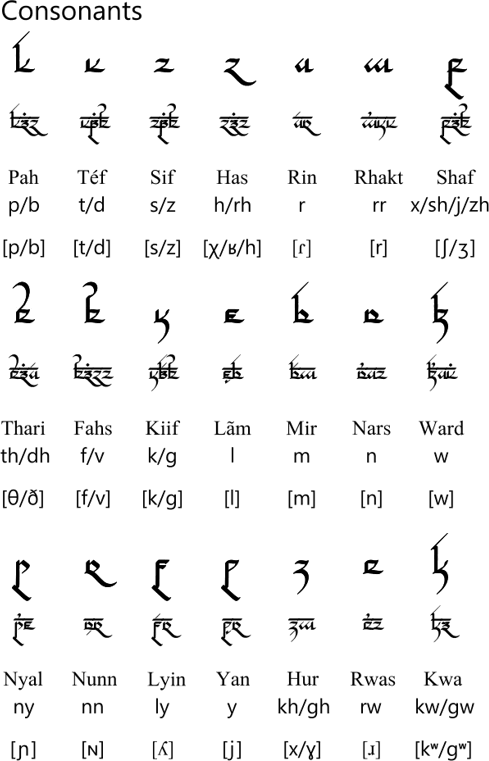
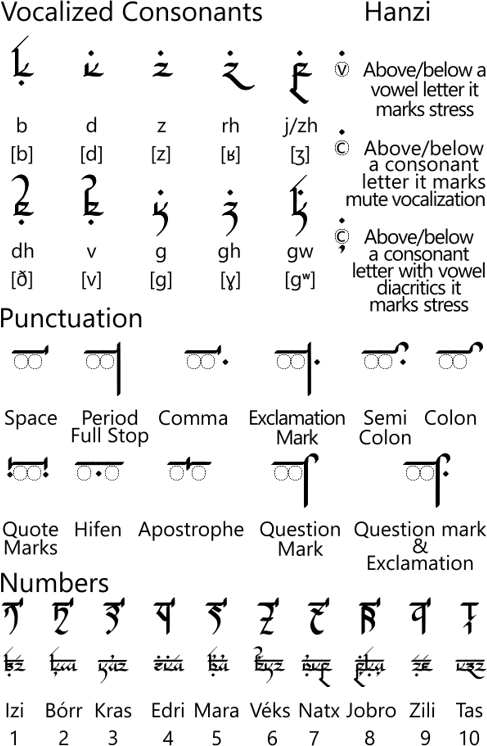
The Lafnyan script is composed of letters for consonants, letters for vowels, diacritics for vowels, and a specific diacritic called "Hanzi," which has a dual function: on vowel letters and consonant letters with vowel diacritics, it indicates word stress; on consonant letters without any other diacritic, it indicates that the consonant is voiced but silent (unpronounced vowel).
Letters, both vowels and consonants, are formed by graphemes.
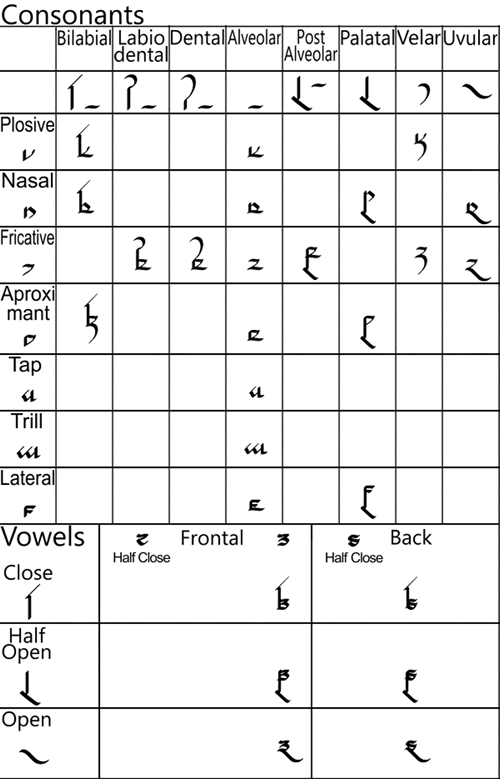
Consonant letters are formed by two groups of graphemes: one group indicates the manner of articulation, and another group indicates the place (or point) of articulation. However, in the case of phonemes that have both voiceless and voiced forms, the voicing of consonants is indicated by the vowel diacritics themselves—and especially by the Hanzi, which, as previously mentioned, indicates that a certain consonant is voiced without an explicit vowel. By default, consonant letters without diacritics represent voiceless phonemes in cases where both forms exist. The grapheme for the alveolar place of articulation is present in all consonant letters from bilabial to postalveolar.
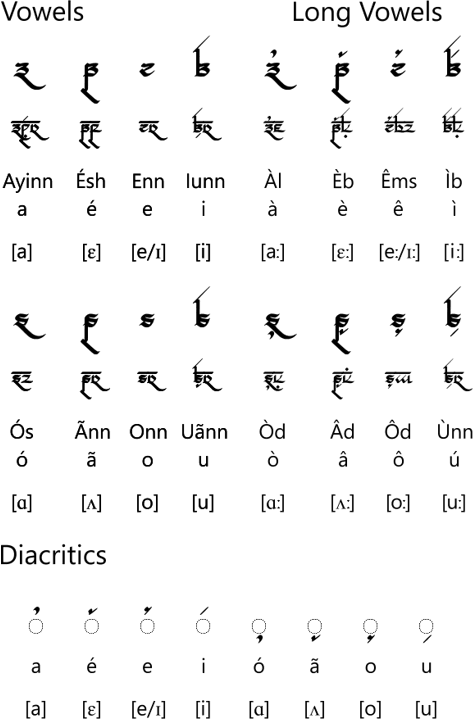
Vowel letters are also formed by two groups of graphemes: one group that indicates whether the vowel is front or back, and another group that indicates vowel height (degree of openness).
Diacritics indicate which vowel follows a letter (be it a consonant or a vowel), forming a syllable (CV), a diphthong, or a long vowel. When positioned above a letter, diacritics indicate front vowels, whereas when positioned below a letter, they indicate back vowels.
Igor Damini is a 46-year-old Brazilian, passionate about linguistics and conlangs. He has been studying linguistics since 2017 and, since then, has been developing his first conlang: Lafni. It will be used in a literary work he is currently writing (based on a tabletop RPG campaign he played in his childhood), along with 7 other conlangs he still intends to create.

Asta mardãn sha nisheden ashali du kali na azdarad du hadamn. Baréfti ma zãlad du virdum, sa kadéf birvune ma vashar y bradad.
All human beings are born free and equal in dignity and rights. They are endowed with reason and conscience and should act towards one another in a spirit of brotherhood.
(Article 1 of the Universal Declaration of Human Rights)
Constructed scripts for: Ainu | Arabic | Chinese languages | Dutch | English | French | Hawaiian | Hungarian | Japanese | Kadazandusun | Korean | Lingala | Malay & Indonesian | Persian | Tagalog / Filipino | Russian | Sanskrit | Spanish | Taino | Turkish | Vietnamese | Welsh | Other natural languages | Colour-based scripts | Tactile scripts | Phonetic/universal scripts | Constructed scripts for constructed languages | Adaptations of existing alphabets | Fictional alphabets | Magical alphabets | A-Z index | How to submit a constructed script
[top]

Note: all links on this site to Amazon.com


You can support this site by Buying Me A Coffee, via PayPal or Patreon, or by contributing in other ways.
If you find all the adverts annoying, there is now an Ad-free version of Omniglot which you can access for a small monthly or annual donation.

This website and its content is copyright of Simon Ager - © Simon Ager 1998-2026. All rights reserved. All images were created by me, unless otherwise indicated. More details

[top]


