podictionary

podictionary – the podcast for word lovers, is a blog I came across today which provides “a word, dictionary etymology & story daily”.

The site covers one word a day and provides details of its meaning, etymology and tells a story related to the word. There is also a podcast of each post. Today’s word, for example, is vicious, and the story is about Sid Vicious and The Sex Pistols.

There are links to some other interesting word-related sites on the links page.

Ble mae’r swyddfa?!

Ddydd Mercher, y dydd ydw i’n gweithio yn y swyddfa, adawais y tŷ fel arfer ond es i yn y cyfeiriad yr hen swyddfa. Sylweddolais fy nghamgymeriad yn y diwedd, a brysiais i ffwrdd yn y cyfeiriad dirgroes. Pan cyrhaeddais yn y swyddfa newydd, gwrthododd y drws i agor achos roedd problem gyda fy ngherdyn adnabod, ac roedd rhaid i mi aros am rhywun arall gyda cherdyn sy’n gweithio.

Yn y hen swyddfa, doedd dim desg neu gyfrifiadur fy hun ‘da fi – defnyddiais ddesgiau pobol eraill pwy oedd i ffwrdd. Dyma’r prifresym ydw i’n gweithio gartref. Yn y swyddfa newydd, mae desg ‘da fi, ond does dim cyfrifiadur ‘da fi eto. Felly eisteddais at desg fy rheolwr, pwy oedd ar ei ŵyl tadolaeth. Gobeithio bydd cyfrifiadur ‘da fi yr wythnos nesaf.

Cá bhfui an oifig?!

Dé Céadaoin an lá a bhím ag obair san oifig, d’fhág mé an teach mar is gnách ach chuaigh mé in aird an sean oifig. Thuig mé mó bhotún faoi dheireadh, agus bhrostaigh mé in aird os comhair. Nuair bhain mé amach ag an oifig nua, bhí fadhb le mó chárta aitheantais agus dhiúltaigh an doras a oscail dom. Bhí orm ag fanacht ar duine eile le cárta i bhfeidhm.

Sa sean oifig, ní raibh deasc nó ríomhaire dom féin agam – bhain mé úsáid as deasca daoine eile a bhí imithe. Seo an príomhréasún a bhím ag obair sa bhaile. San oifig nua, tá deasc agam, ach níl ríomhaire agam go fóill, agus shúigh mé ag deasc mó shaoiste – bhí sé air a shaoire atharachta. Go dóchasach beidh ríomhaire agam an seachtain seo cáite.

Where’s the office?!

On Wednesday, the day I work in the office, I left home as usual but set off towards the old office. When I eventually realised my mistake, I turned round and hurried off in the opposite direction, the right one this time. On arriving at the new office, only a few minutes late, I was unable to get in as the door refused to open when I swiped my ID card over the scanner. Fortunately someone else came along with a card that worked and I slipped in behind them.

I didn’t have a permanent desk or computer in the old office and usually used the desks of people who were away. That’s the main reason why I work at home most of the time. In the new office I have a desk but no computer yet, so I used the boss’s desk, who was away on paternity leave. With any luck there will be a computer for me next week.

Word of the day – uśmiechnięta

Today’s word, uśmiechnięta, means ‘smiling’ in Polish, and appears in the Polish version of Silent Night:

Cicha noc, święta noc,
pokój niesie ludziom wszem,
A u żłóbka Matka święta
czuwa sama uśmiechnięta,
Nad Dzieciątka snem.

The singing group I go to at the Hammersmith Irish Centre in London will be performing (for charity) at Hammersmith tube station a week next Monday. One of the things we’ll be singing will be Silent Night and we’ve decided to try to sing it in Polish and Irish, as well as in English.

We can cope with the Irish version as there are at least five Irish speakers, including myself, in the group, but the Polish version is proving more of a challenge. This week a Polish friend of one of the group members came along to help us with the pronunciation, so we now have a rough idea of what it sounds like. I also found a recording of the Polish version on YouTube.

We’ll probably just sing the first and last lines of the Polish and the rest in English as we’re not sufficiently confident to sing the whole of it.

I found translations of Silent Night in many different languages here, and plan to put some of them on Omniglot in my songs section. Do you have any suggestions for other multilingual songs I could include?

Concentration

When studying a language, or anything else in fact, it’s easy to get distracted as there are often so many other things vying for your attention. If your mind isn’t focused on your studies, you don’t tend to take as much in or to remember it later.

In this interview, Tim Ferriss explains how he does his best studying while on long journeys when there is still else to do. He also suggests that you try to recreate a similar environment at home, or wherever else you study. This could be achieved be switching off televisions, radios, computers and phones, and removing/hiding anything else that you might be tempted to fiddle with or peruse.

On long journeys I tend to take a novel or two in languages I’m studying and/or textbooks for those languages. As I doubt my fellow passengers would appreciate me reading aloud from the novels or textbooks, or repeating the dialogues on the accompanying recordings, I remain silent, which I find less than ideal. I suppose I could pretend to be talking on my phone though. Reading foreign novels without dictionaries, which I don’t usually have with me on such journeys, is a good test of my understanding of the languages, and my powers of determining the meanings of words from the context, and is something I enjoy more then studying.

Do you have any ways for ignoring distractions and maintaining your concentration when studying?

Lingro

The other day the editor of Lingro contacted me asking for comments on his site, which describes as a multilingual online dictionary and language learning site.

The dictionary part can be used to look up words in English, Spanish, French, German, Italian and Polish. You can also open a webpage, Word doc, PDF or text file within the dictionary and look up any of the words by clicking on them. This brings up a pop up with translations of the words, and definitions in some cases. Here’s an example of one of Omniglot’s pages in the English-Spanish dictionary – you can change the language combination at the bottom of the screen.

You can save the words you look up in a personal wordlist, which you can peruse later to check if you remember them. There are some virtual flashcards you can use to help you with this in the games section. You can also edit words and add definitions.

Swyddfa newydd

Dydd Gwener yr wythnos hon, symudon ni, yr Adran Busnes Rhyngrwyd, i ein canolfan newydd – symudodd y myfyrwyr a’r athrawon ar ôl gwyliau hanner tymor y mis diwethaf, a symudan yr adrannau eraill yn ystod yr wythnosau nesa. Cyn hynny, roedd y coleg, yr ysgol saesneg fel iaith estron, y lletyau ar gyfer y myfyrwyr, a’r swyddfa gweinyddiaeth mewn mannau gwahanol. Bellach, mae popeth yn yr un man mewn adeilad newydd sbon ger orsaf rheilffordd Brighton yng nghalon y ddinas.

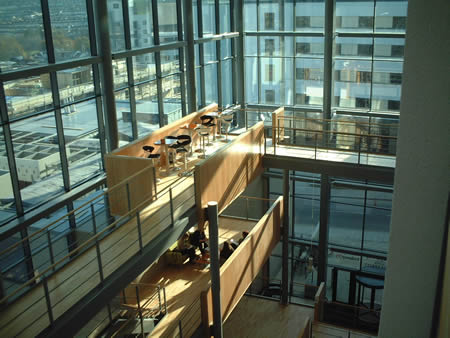
Dyma llun o’r canolfan newydd:

Llun o'r canolfan astudio newydd

Mae’r canolfan newydd yn teimlo yn fwy eang na’r hen swyddfa, ac mae’r golygfeydd yn wych. Mae e’n fwy golau hefyd.

Oifig nua

Dé hAoine an seachtain seo, d’aistrigh muid, an Roinn Gnó Idirlín, i ár ionad nua – d’aistrigh na mic léinn agus an múinteoirí i ndiaidh lár téarma an mhí seo caite, agus aistreoidh na roinne eile i rith na seachtaine seo caite. Roimhe seo, bhí an coláiste, an scoil Béarla mar teanga eachtracha, na hallaí cónaithe ar son na mic léinn, agus an oifig riaracháin in áiteanna éagsúla. Anois, tá gach rud san áit ceanna i bhfoirgneamh úrnua in aice leis an stáisiún traenach Brighton i lár na cathrach.

New office

On Friday of this week, we, the Internet Business Department, moved to our new centre – the students and teachers moved there after half term last month, and the other departments will move there during the next few weeks. Before now, the college, English language school, student residences and administrative office were all in different places. Now everything is in the same place in a brand new building near Brighton railway station and the centre of town.