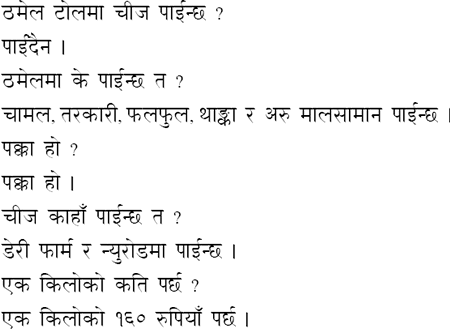
This image was sent in Valérie, who would like to know if anyone knows which alphabet and language it is and what it means.
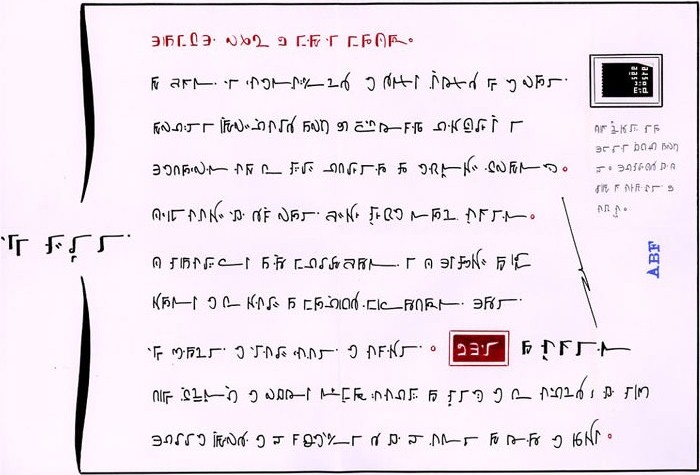
The letters appear to be Hebrew to me, though the way it’s written is not how Hebrew is usually written.
This is a guest post from James P in Chile:
Two things have made me think about “vocabulary worlds” recently: reading past papers for the DELE exam and picking up a José Donoso novel (Coronación) from the library.
The vocab section of the DELE exam is going to be rather a matter of chance as significant proportions of the vocab that is used on a daily basis in Latin America – at least in Chile and on Colombian radio which are my two main sources of spoken LA Spanish – are bound to be different from the vocab used in Spain. That is certainly true of British and US English (“I like your bangs”, “Do you have any spackle?). This, rather than my joking references before, is the more substantial problem with the DELE vocab test, at least for those of us who take it as speakers of LA Spanish: even when the words might be understood by a cultured Chilean or Guatemalan, they are not used much over here as compared to Spain and so we are much less likely to have heard them, even if our total vocabulary is larger than a learner in Madrid or Seville.
José Donoso, in common with a number of other Chilean writers of the second half of the 20th Century, spent a number of years living outside of Chile (in his case in Mexico, Spain and the USA). His diction (choice of vocab) is very unusual (one of my Chilean friends says that he makes up words!). Every author has a range of words they use commonly, but for me it seems that Donoso overlaps much less with my vocab than for example García Márquez, or Roberto Ampuero. Before I get round to Coronacíon I’m reading Pérez-Reverte’s El pintor de Batallas, which also has a different vocab world, one that is new enough for me to learn new words (such as estrambótico and un chasquido), but not so alien I want to give up (which is what happened last time with Donoso when I tried to read Casa de campo about a year ago).
Can others give examples of this phenomena of different “vocab worlds”, either with specific authors or with national forms of a language which is spoken in different countries?
In a speech at the centenary dinner of the Spelling Society, a professor of phonetics from University College London claimed that people should be allowed greater to spell English logically. He believes that the ways of spelling English found in text messages and online chat are a good model to follow. He also said that the apostrophe “causes unnecessary linguistics barriers” and could simply be omitted, or we could use a space instead.
There are some details of the professor’s proposals on the BBC site.
Many have proposed reforming English spelling, few have made any difference.
Do you think the benefits of reforming English spelling would outweigh the drawbacks?
I had my first lecture today, which took place on one of the rooms on the mezzanine floor of the Main Arts building. A mezzanine or entresol is usually an extras floor between main floors of a building. A mezzanine might often projects from the wall like a balcony and may share the same ceiling with the floor below. The term can also be applied to the lowest balcony in a theatre, or for the first few rows of seats in that balcony. The word mezzanine comes via French from the Italian mezzanino, which is derived from mezzano, middle, which itself is from the Latin medianus, of the middle.
The lecture was on semantics and focused on theories of meaning. The lecturer had little time for the formalist view that each word has a core definition independent of context. Instead she explained how the meanings of words and sentences are derived from the context and our knowledge of the world. One exercise we did was to come up with necessary and sufficient conditions for defining pet, friend and bird – quite a challenge.
Today we have a guest post from James P. in Chile.
I am preparing for the advanced DELE exam (just as it will be useful to have a piece of paper to say I can speak Spanish … such is life). I won’t go into how odd it is (muy suyo), but one thing that is very noticeable is that the “vocab” section is very strongly focused on Peninsular Spanish, which makes it almost impossible for all the other Spanish learners. This puts it’s standing as a world level qualification somewhat in question (even native speakers here can’t pass that section).
Let me illustrate with Chilean Spanish. If someone responds to your question about how the party was by saying “bacán won; la pasamo la raja. Había harta mina ¿cachai? Puro carreteando tóo el rato, won.” Is that good or bad? Do you have any idea what they just said to you?
Anyway, it set me thinking about languages with two (or more) “centers” (there is a proper term for this and I can’t remember it at the moment). English is the same: standard UK English is not “better” than standard USA English: there are two norms.
Are there other examples of languages with two or more “standard norms”?
A zeugma is a figure of speech that joins two or more clauses together in a way that allows you to omit the key verb or noun in all but one of the clauses. The word comes via Latin from the Greek ζεύγμα (zeugma) – yoke.
Here are examples of different kinds of zeugma:
Prozeugma or Synezeugmenon
The verb in the first part of this zeugma governs subsequent parts.
Hypozeugma
In hypozeugmas the verb appear at the end of a number of clauses. This results in a sense of suspense in listeners and readers until they reach the end of the sentence.
Syllepsis
A syllepsis joins clauses with different meanings together with a common verb, the meaning of which changes for each clauses. It can be used for comic effect due to the unusual connections and ambiguity involved.
Mi gychwynodd y prifysgol yr wythnos hon efo wythnos groeso. Roedd gyfarfod groeso i’r Ysgol Ieithyddiaeth ac Iaith Saesneg ddoe, ac mi gwrddais i â mwyafrif y tiwtoriaid ieithyddiaeth ac â’r myfyrwyr eraill. Dim ond wyth, yn gynnwys fi, sy’n gwneud graddau meistr mewn ieithyddiaeth – pedwar Saesnes, Siapanes, Groeges ac Americanwr. Efallai bydd myfyrwyr eraill yn cyrraedd yn ystod yr wythnos hon. Mae’r mwyafrif ohonyn nhw yn bwriadu gwneud doethuriaethau ar ôl iddyn nhw’n gorffen eu graddau meistr, ond ar hyn o bryd, dydw innau ddim bwriadu gwneud yr un beth.
Yfory mae rhaid i ni cofrestru, talu ein ffïoedd dysgu, ac yn penderfynu pa fodiwlau i ddewis – mae dau fodwl gorfodol a dau ddewisol pob semester. Yn y semester cyntaf fy modiwlau gorfodol ydy cystrawen, a semanteg a phragmatig, a modiwlau dewisol mewn seineg a dirwedd; dwyieithrwydd a meddwl. Yn yr ail semester bydda i’n gwneud modiwlau mewn seineg, a dirwedd mewn Saesneg, a modiwlau dewisol mewn caffaeliad iaith mewn plant, ac anhwylderau llefaru ac iaith.
University started this week with welcome week. There was a welcome meeting for linguistics postgrads yesterday, and I met most of the linguistics tutors and other students. There are only eight of us, including me, doing masters degrees in linguistics – four from the UK, one from Japan one from Greece, and one from American. Maybe more students will arrive during this week. The majority of them are planning to go on to PhDs after completing their masters degrees, but I’m not planning to do that, at the moment.
Tomorrow we have to register, pay our fees, and decide which modules to do – there are two compulsory and two elective modules each semester. My compulsory modules in the first semester are syntax, and semantics & pragmatics, and elective modules in phonetics and variation, and bilingualism and thought. In the second semester I’ll do compulsory modules in phonetics, and variation in English, and elective modules in child language acquisition, and speech & language disorders.
In English when you talk about scientific, technical, legal or medical topics, you tend to use a lot more words of Latin, Greek and French origin. However in everyday conversation words of Anglo-Saxon and Old Norse origin are much more common. Therefore you could say that English has two distinct registers – a higher register used in academic and other formal settings, and a lower register used elsewhere. New scientific terms are usually coined from Latin and/or Greek roots. Mixing the registers or using one where the other would normal be used can a source of humour.
In other languages, such as German, new words tend to be coined from native roots. This gives you words like Wasserstoff (water material/stuff), for hydrogen, Sauerstoff (sour/acidic stuff) for oxygen, and Stickstoff (close/stuffy stuff) for nitrogen.
According to this post, such words can sound funny to English speakers because they are made from words similar to lower register English ones which are not normally associated with serious vocabulary like this.
There have been suggestions and proposals that new English be coined from native Old English / Anglo-Saxon roots, none of which have really caught on. For example, in a text on atomic theory, Uncleftish Beholding by Poul Anderson, almost all the words are of Anglo-Saxon origin and there are many newly coined words, including beholding for theory, waterstuff for oxygen, ymirstuff for uranium, bulkbits for molecules, and worldken for physics.
There is even a group of people called The Anglish Moot, who aim to create a version of English free of loanwords from other languages.