Schrijfrichting / Scriptpath

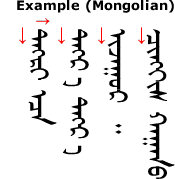
Script direction in Mongolian

Last week a visitor to Omniglot asked me whether there is a single word in English that means writing direction, i.e. the direction in which writing systems are written. The Latin alphabet, for example, is written from left to right in horizontal lines, as are many other writing systems, while writing systems like Arabic and Hebrew are written from right to left in horizontal lines, and a few writing systems, such as traditional Mongolian and Manchu, are written from top to bottom in vertical columns running from left to right – other directions are available.

On Wikipedia I found the word directionality, and I found that there are more precise words for this concept in German and Dutch: Schreibrichtung / Schriftrichtung and Schrijfrichting. On the W3C site I found the term script direction.

The lack of a single-word term in English is partly because in English noun phrases are usually written as separate words, unlike in German and Dutch, where they are often written as single words.

I came up with some alternative possible terms for this phenomenon: scribeway / scribe way, scribepath / scribe path, script direction, script path, script way, script course, script orientation, or using Greek rather than Latin/Germanic roots: graphodromos, or grammadromos (dromos = road in Greek), or mixing Latin and Greek roots: scriptodromos / grammadromos.

What is writing direction called in other languages? Are there any others which use a single word.

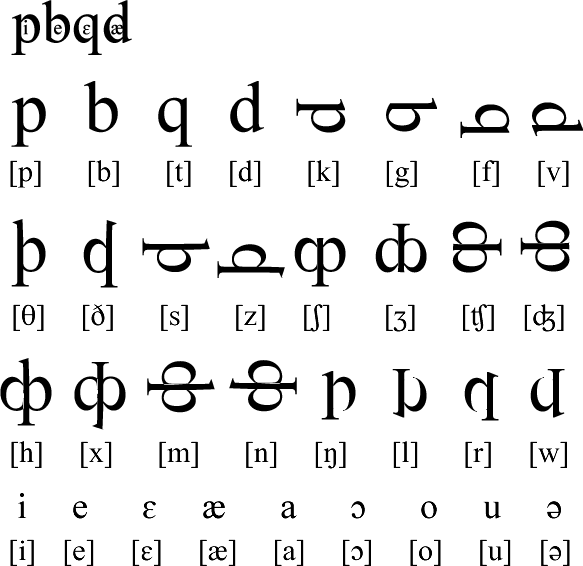
Pibeqɛdæ – new con-script

Here’s a script, called Pibeqɛdæ, that I constructed this afternoon based on the letter p, mainly. It has most of the phonemes used in English, and could be further extended. I put it together just to demonstate to a visitor to Omniglot how you might make a con-script. It turned out quite well, I think.

Pideqedae alphabet

I was just going to float the vowels over the consonants, like in Tengwar, then I thought I’d try putting them in the consonants, and am quite pleased with the results. It isn’t a very practical script as it quite be hard to make a font with vowels that fit inside the consonants.

Bassa Vah puts tone marks inside the vowels, but I haven’t come across any other scripts that put the vowels inside the consonants. Have you?

Emergent con-scripts

A while ago I had an idea for trying to construct a script with symbols based on representations of natural phenomena – animals, birds, plants, features of the landscape, etc – which would be linked to the sounds via acrophony. Then to simplify the images a number of times until I have a set of letters, a bit like the Alphabet Synthesis Machine.

Most writing systems currently in use are derived ultimately from Egyptian Hieroglyphs, which developed from pictures of objects, people, animals, etc, and I thought would be interesting to try to simulate that process and see what emerged. I haven’t come up with anything very interesting yet, but am still working on it.

Have any of you tried something like this?

Iban alphabet

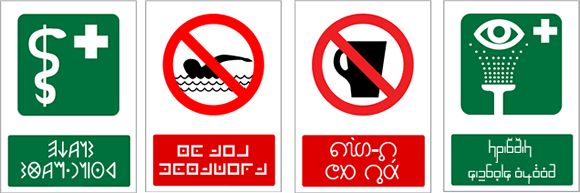
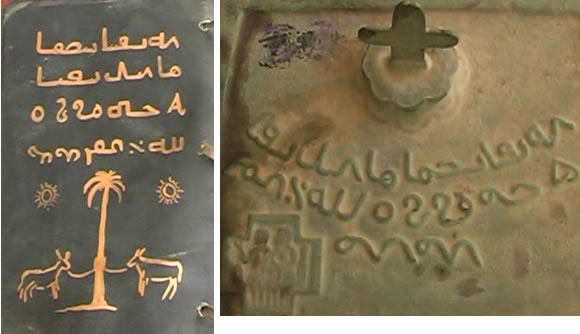
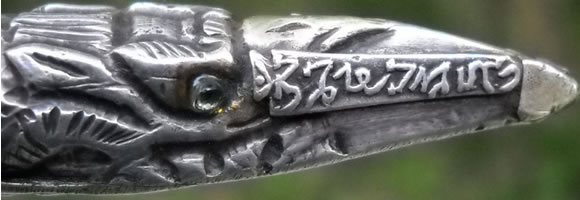
I thought that almost all the world’s writing systems were on Omniglot, but today I discovered another one: the Iban alphabet, which was invented in 1947 by Dunging Anak Gunggu.

Iban alphabet

It’s a partly syllabic, partly alphabetic script that never really caught on, mainly because there was no tradition of writing among the Iban-speaking community. During the past few years there have been efforts to revive it mainly by Dr Bromeley Philip at the Universiti Teknologi MARA (UiTM) in Sarawak, Malaysia – I’ve written to him to ask about the current situation.

Iban is a Malayo-Polynesian language spoken in Malaysia, Indonesia and Brunei, but I’m sure you knew that.

For me it’s always exciting to discover a previously unknown (to me) writing system like this.

Scripts and alphabets

I tend to use the words script and alphabet fairly interchangeably – I might talk about the Arabic script or the Arabic alphabet, for example. However I just noticed today that Wikipedia has one page on the Cyrillic script, which focuses mainly on the history of the script/alphabet, and separate pages for Cyrillic alphabets as used for particular languages (Russian, Bulgarian, Serbian, etc). The Latin/Roman script is treated in a similar way.

It seems that a script refers to the overall writing system rather than to the particular set of letters used to write a particular language, or alphabet. So you could talk about the Devanagari script, and the Hindi alphabet, i.e. the Devanagari letters used to write Hindi.

Have you come across this distinction before? Do you think it’s a useful one to make?

Endangered Alphabets Project

Today we have a guest post by Tim Brookes, founder of the Endangered Alphabets Project.

As some of you know (in part because Simon has been kind enough to publicize my work on Omniglot), I’ve been spending the past three years gathering texts in writing systems that seem in danger of extinction, and then carving those texts in gorgeous pieces of wood, as a twin act of preservation and celebration.

A carved text in Mro
Text in Mro

Now a new and urgent Endangered Alphabets situation has arisen, in a region of southern Bangladesh called the Chittagong Hill Tracts. This upland and forested area is home to 13 different indigenous peoples, each of which has its own genetic identity, its history and cultural traditions, and many of which have their own language and even their own script.

All these languages and scripts are endangered. Schools use Bengali, the official national language, and an entire generation is growing up without a sense of their own cultural history and identity. This is very much the kind of situation that has led to the loss or endangerment of hundreds of Aboriginal languages in Australia and Native American languages in the US. And this loss of cultural identity is closely connected to dropout rates in schools, unemployment, poor health—all the signs of cultural decay and collapse.

The Endangered Alphabets Bangladesh project is an attempt to provide a creative solution to this issue before these languages and scripts are among the estimated 3,000 languages that by mid-century will be lost forever.

A carved text in Maung Nyeu
Maung Nyeu

I’m trying to help by starting a Kickstarter fundraising campaign and forming a coalition of artists and academics from Harvard, Yale, Cambridge, Oxford and Barcelona. We’re going to be working with an extraordinary young man named Maung Nyeu.

Largely self-educated because he couldn’t speak the Bengali used in school, Maung left Bangladesh and got into the University of Hawaii, where he studied engineering so he could go back to the Chittagong Hill Tracts and build a school where indigenous peoples could be educated in their own languages. Now he has come to Harvard to get a graduate degree in education so he can create something unique: children’s schoolbooks in these endangered indigenous languages.

He says, “I’m trying to create children books in our alphabets – Mro, Marma, Tripura, Chakma and others. This will help not only save our alphabets, but also preserve the knowledge and wisdom passed down through generations. For us, language is not only a tool for communications, it is a voice through which our ancestors speak with us.”
We’re trying to help him by combining three artistic disciplines: carving, calligraphy and typography.
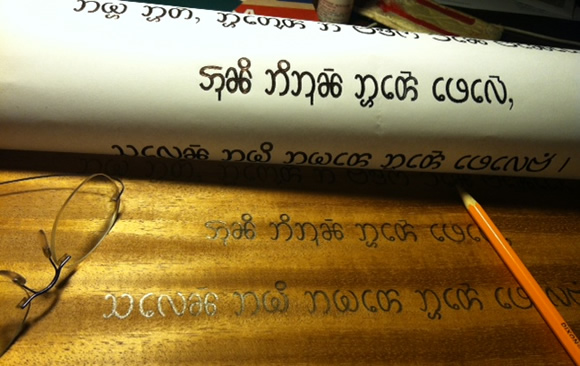
A carved text in Chakma
Text in Chakma

The first step is for me to create a series of beautiful and durable carved signs in the languages and scripts of these endangered cultures, and add them to the traveling exhibitions of the Endangered Alphabets Project. Each carving will feature a short poem I wrote for the purpose. It goes:

These are our words, shaped
By our hands, our tools,
Our history. Lose them
And we lose ourselves.

Our coalition, which includes a typographer and a calligrapher, will create some beautiful script forms of these endangered languages, then convert them into typefaces that can be used to print the books for Maung’s school.

At the moment, everyone is putting in their time on a volunteer basis, but my goal is to raise $10,000 to cover material costs, and to go a small way toward paying for the time, work, travel, shipping and printing involved.

If we can raise these funds, the outcome will be the first sets of children’s schoolbooks ever printed in Mro, Marma, Chakma, and other endangered languages of Bangladesh.

If you’d like to help, please visit the Kickstarter For Bangaldesh site, or pass this link along to others who might want to help.
Thanks!