Suns, moons and sputniks

The Sun / Солнце

Earlier today I was thinking about how I might learn more Russian, and realised that I need to get to grips with the grammar – the verb conjugations, noun declensions and so on. Trying to memorise verb tables and noun declensions and other grammatical gubbins doesn’t appeal to me, so I thought about other ways I might approach this. I thought that one reason why I haven’t learnt these things very well so far, even though I’m halfway through the Russian course, is because I haven’t made a conscious effort to do so, and haven’t practised using them nearly enough. I think I need lots more examples of how they’re used then my course supplies, and need lots of practise using them.

I thought that one possible approach would be to choose a word or topic, then try and make sense of the Wikipedia page about it, with help from Google translate, which not only translates the text into English, but also has transliteration and text-to-speech functions, so I can listen and read the text. So today’s word is the sun, which in Russian is Солнце [‘solntse]. I can only understand some of the words on the Russian page about the sun on Wikipedia, but one that stood out for me was спутники [‘sputniki], which means satellites or moons and is familiar because it’s similar to the name of the the first artificial satellite, Спутник-1 (Sputnik-1), which was launched in 1957. I knew this name, but didn’t know what it meant, until now.

The word sputnik also means ‘fellow traveller’ or ‘travelling companion’ and was short for спутник Земли (sputnik zemlyi – ‘traveling companion of the Earth’). It comes from the Russian с (with, together) and пут (path, way), from the Old Church Slavonic poti, from the Proto-Indo-European root *pent- (to tread/go; path, road), according to the Online Etymology Dictionary. *pent- is also the root of the English word find and the Latin pōns/pontis (bridge).

I had no idea I’d find all that out when I started writing this post. I haven’t learned much Russian, but I have learned other things.

Language learning plans

At the beginning of 2013 I mentioned on this blog that I planned to continue studying Breton and Russian, and maybe have a go at Swedish or Norwegian. I hoped, though didn’t mention, that I would be able to converse reasonably well in Breton and Russian by now, but haven’t achieved that. I continued my studies of both languages throughout most of the year, with some breaks, especially towards the end of the year, but rarely had opportunities to speak either language with others, so my conversational abilities didn’t develop as much as my listening and reading skills.

This year I plan to concentrate on Dutch and Russian, while maintaining and improving my other languages. I know people who speak or who are learning Dutch, so have regular opportunities to speak the language. I hope to find some Russian speakers to speak Russian with as well.

What are you language learning plans for this year?

Merry Christmas

Zalig kerstfeest / Nadolig Llawen / С Рождеством / Nollaig chridheil / Joyeux Noël / Nollick Ghennal / Frohe Weihnachten / Nollaig shona daoibh / A Blithe Yule and a Multilingual Merry Christmas to you.

My Dutch studies a sort of on hold this week, but will continue after New Year – I was planning to learn it just for one month, but will continue as I’m enjoying it and finding it fairly easy, a lot easier than Russian, anyway.

How’s your language learning going?

Fluent Forever

Today we have a guest post by Gabriel Wyner.

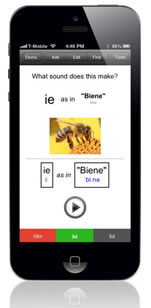
An example of the app on a phone

Hi everyone! I wanted to share with you a project I’ve been working on to help folks learn languages faster. To help introduce it, let me give you some background on myself and what I do.

I’m an opera singer, and for my career, I needed to learn German, Italian, French and Russian. Over the course of studying those languages, I developed a language learning method that began to produce really phenomenal results: I was able to learn French to C1 fluency in 5 months and Russian to B2/C1 fluency in 10. This method eventually turned into an article at Lifehacker, which went viral and led to a book deal with Random House, and has basically turned my life upside-down (In a good way, fortunately! While I don’t have much time for singing, I adore writing and learning about languages!)

One of the central tenets of my methods revolves around pronunciation. I learn pronunciation before anything else, because once my ears are attuned to a language’s sounds, I have a much easier time memorizing vocabulary, and I don’t have to fight against bad, ingrained pronunciation habits when I’m ready to start speaking.

The tricky part in all of this is that effective pronunciation training tools are few and far between. For most common languages, there are some scattered YouTube pronunciation guides, perhaps a brief discussion in the front of your grammar book, but very little that’s comprehensive, systematic, and enjoyable to use. And there’s little to nothing that will successfully train your ears to hear sounds you haven’t heard before – subtle things like the differences between German’s “See” [ze:] and “Sie” [zi:], “Bahn” [ba:n] and “Bann” [ban], or German’s “mein” [maen] and English’s “mine” [maɪn].

However, there is research that describes exactly how to train ears to hear new sounds. It’s a pretty simple process: you find a pair of sounds that are tricky to distinguish (say, German’s mein and English’s mine), you play a recording of one of the words at random, guess which one you heard, and then see whether you were right. Every time you go through this cycle, your ears get better. And with a bunch of well chosen word pairs and good recordings, an app could take you through that cycle and teach you the pronunciation system of a language within a couple of weeks. I’ve made one using Anki for my own Hungarian studies, and it took me ~10 days at 20 minutes a day to get a handle on the [occasionally stupidly difficult] sounds of Hungarian (tyuk vs gyuk, kar/kor/kór, ad/add, has/hass…).

11 days ago, I launched a Kickstarter to fund development of this app. The campaign has done phenomenally well, funding in 2 days and doubling after day 7, which has allowed me to add all sorts of stretch goals and bonuses for all the backers of the project. I think this is going to be a wonderful and much-needed tool for the language learning community, and I’m excited about working on it. If you or anyone you know wish to learn languages, please do help spread the word. You can use these handy links below:

Share via Facebook | Twitter | Google+

Nederlands

I’ve decided to learn Dutch this month and want to see how much I can learn in a month. I haven’t learnt any Dutch before, but can understand it a bit as I speak English and German. I’m using online resources, including courses on Babbel and any others I can find. I will also be listening to Dutch radio and maybe watching some Dutch TV, and maybe learning some Dutch songs. A friend is also learning Dutch this month, so I thought I’d give it a try, and we have a Dutch friend we can practise with.

Any suggestions of online Dutch resources would be appreciated.

How to learn any language in six months

I came across this TED talk yesterday in which Chris Lonsdale, a psychologist from New Zealand who runs a company in Hong Kong, talks about language learning. He believes that anybody can learn a language in six months if they follow the five principles and seven actions that he has formulated after assessing all the research available on language learning.

The bit about principles and actions starts 8 minutes into the video.

There are articles and materials about language learning available on his website.

The five principles are:

1. Focus on language content that is relevant to you.
2. Use your language as a tool to communicate from day 1.
3. When you understand the message you will acquire the language unconsciously, i.e comprehensible input (Krashen, et al)
4. Language is not about accumulating a lot of knowledge but is rather a type of physiological training.
5. Psycho-physiological state matters – you need to be happy, relaxed, and most importantly, you need to be tolerant of ambiguity. Don’t try to understand every detail as it will drive you crazy.

The seven actions are:

1. Listen a lot – it doesn’t matter if you understand or not. Listen to rhythms and patterns.
2. Focus on getting the meaning first, before the words. Body language and facial expressions can help.
3. Start mixing, get creative, and use what you’re learning
4. Focus on the core – the most commonly-used words, and use the language to learn more (What is this/that? How do you say ? etc.)
5. Get a language parent – someone who is fluent in the language and who will do their best to understand what you mean; who will not correct your mistakes; who will feedback their understanding of what you’re saying using correct language, and uses words that you know.
6. Copy the face – watch native speakers and observe who their face, and particular their mouth, moves when they’re speaking
7. “Direct connect” to the target language – find ways to connect words directly with images and other internal representations.

Learning varieties of Chinese

The other day I was talking with a lad from Hong Kong. We were speaking mainly in Mandarin, with odd bits of Cantonese thrown in from time to time – I speak Mandarin fluently, but only know a little Cantonese. I asked him how he had learned Mandarin, and he said that he had just picked it up through listening and speaking, and that it wasn’t too difficult. I’ve heard similar stories from other people from Hong Kong and Macau, and suspect that it is easier for Cantonese speakers to pick up Mandarin than it is for Mandarin speakers to pick up Cantonese or other varieties of Chinese. This is partly because Mandarin is phonetically and grammatically somewhat simpler than the other varieties, and also because there are far more Mandarin speakers, and media in Mandarin is far more common.

Have you experience of the relative difficult/ease of learning different varieties of Chinese?

Brezhoneg

This month I will focusing mainly on Breton (Brezhoneg). I’ve been learning it, on and off, for a year now and can make some sense of written and spoken Breton, though my speaking and writing lag behind quite a bit. I have been using Le Breton sans Peine, which I’ve nearly finished, though I can’t say that I’ve internalised everything. This month I am working through Colloquial Breton. I want to try to improve my productive knowledge of the language, and will try to write something every day on my other blog, Multilingual Musings – I haven’t quite managed this yet as when writing Breton I have to look up most of the words and check the grammar. With practise my writing will become more fluent, I hope, and this will help with speaking, as I see this kind of writing as a way to practise using the language I would use in conversations. I would also like to learn a few Breton songs, and am open to suggestions.

Are any of you studying Breton? Are there any Breton speakers reading this blog?

Wikitongues

I came across a very useful channel on YouTube this week: Wikitongues, which is a collection of videos of people speaking many different languages, including many lesser-studied/known languages and dialects such as Gullah, Luxembourgish and K’iche’ Mayan. The videos I’ve seen so far mostly seem to involve people talking about their native languages and cultures. There are no subtitles on the videos, which would be very useful.

Their aim is to build a collection of videos in as many languages as possible. To find out how to take part I think you can contact them via their website Wikitongues.org.

Frequently-used words

One piece of language learning advice that is quite widely preached is that you should concentrate on learning the most frequently -used words in a language at first, before learning less common words. By doing so you should have enough words to be able to understand and talk about everyday kinds of things. The advice on how to learn the words varies. I tend to absorb them through extensive reading and listening, but others like to use flash cards.

I was thinking about this today and realised that the words and phrases that I use most frequently might not be the same as the ones you use. We will probably have a shared core of words, but beyond that the list for each of us is likely to be different. Lists of frequently-used words are available for a variety of languages and are useful, but it might also be useful to think about what you as an individual most often talk about and to learn how to say those things in the language(s) you’re learning.

One way of finding out which particularly words and expressions you use most often would be to record your conversations for several days or even a week, and then to analyse the recordings. If you have a recording function on your phone, or a small recording device, this could be done discretely. As well as finding out which words and expressions you tend to use, you would also find out the typical topics you talk about. Once this has been done once, the results can be used for any language you’re learning.

Have you ever tried anything like this?