Groupe de conversation Française

Last night I joined a French conversation group which meets regularly in a local pub. I heard about it at a party in January and have been intending to join since then. Last night I finally tracked them down.

All members of the group are English and/or Welsh and can speak French well, or at least can understand it even if they don’t speak it fluently. The group has been going for about eight years and is run by a teacher of English as a foreign language from Bangor University. The rule is that only French is spoken for first two hours, and we stuck to this last night. After that English is allowed, though last night we continued to speak mainly in French.

It was fun, interesting, we discussed all sorts of topics, and I found that I can still speak and understand French reasonably well even though I’ve used it very little during the past 20 years. Welsh, which is currently my dominant foreign language, kept on trying to impose itself on my French, but I managed to keep it in check most of the time. If I’d spoken the mixture of French and Welsh that was brewing in my head the Welsh-speaking members of the group would have probably understood.

One thing we talked about was how it can be difficult to understand mispronounced words, especially in unfamiliar contexts. The leader of the group told us about a student of hers who was talking about a visit to the “islands”, or at least that’s what it sounded like. The leader kept on asking “Which islands?”, but the student kept on saying “the islands”. Eventually she worked out that the student was talking about the Highlands (of Scotland). The mispronunciation may be only slight, but it’s enough to disrupt comprehension, and this can happen not just with foreign languages, but also with different dialects and accents of your native language.

When I meet people with names I’ve never heard before, sometimes I find it hard to take in their names until I’ve seen them written down.
Traghtys

Chur mee my hraghtys stiagh jiu – t’eh yindyssagh cur jerrey er fy yerrey.

Tráchtas

Chuir mé mo thráchtas isteach inniu – tá sé go hiontach é a chríochnú faoi dheireadh.

Traethawd hir

Mi gyflwynes i nhraethawd hir heddiw – mae hi’n wych ei orffen o’r diwedd.

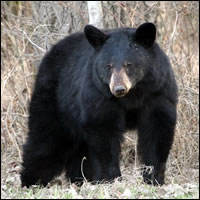
Loaded for bear

Black bear

The phrase “loaded for bear” appears in the novel I’m reading at the moment and is used in the following context: “I know next to nothing about computers but clearly Dommie is loaded for bear.” I take this to mean that Dommie is a computer wizard who’s ready for any challange, and if he were to go hunting, he would have appropriate ammunition for bears.

According to the Free Dictionary, loaded for bear means, “ready and eager to deal with something that is going to be difficult”.

What does this mean? defines this expression as, “To be full of energy. To be prepared for any eventuallity; to be over-prepared.”

The Urban Dictionary defines it as, “Carrying more equipment than necessary. Overloaded.”

I haven’t heard this phrase before and suspect it might be used mainly in American English. Is it familiar to you?

Empty chairing

On the radio the other day they were discussing the possibility of staging televised debates for British politicians similar to the ones that happen during presidential elections in the USA. One commentator thought it was unlikely that the British Prime Minister would be willing to take part in such debates and that if he didn’t, the BBC might “empty chair” him.

According to The Guardian, empty chairing is “the practice of drawing attention to politicians’ refusal to show up. The aim is clear: to embarrass ministers for ducking tough questions.” While according to The Economist, empty chairing involves using an empty studio chair to symbolically represent someone who has refused to appear on a TV programme.

This seems to be similar to the practice of mentioning that somebody was “unavailable for comment” or “refused to comment” on a big news story.

Have you heard the term empty chairing used? Are there equivalents in other languages?

Grian

Ta laa grianagh ayn jiu, as ta ram studeyryn noa roshtyn ayns Bangor.

Grian

Tá lá grianmhar ann inniu, agus ta a lán mic léinn nua ag teacht i mBangor.

Grian

Tha latha grianach ann an-diugh, agus tha mòran oileanaich nuadh a’ ruigheachd ann an Bangor.

Heulwen

Mae’n heulog heddiw, ac mae llawer o fyfyrwyr newydd yn cyrraedd ym Mangor.

Jerrey shiaghtin

Hie mee dys Lunnin yn jerrey shiaghtin shoh chaie dy ghoaill ayrn ayns cuirrey kiaull Sing for Water. Ta shin troggal argid da WaterAid, sheshaght yiastyllagh ta cooney sleih ayns çheeraghyn boght geddyn ushtey glen as slayntaghys. Hee mish ayns shen lesh yn sheshaght chiaullee pobble Bangor, as ghow shin arraneyn lesh 50 sheshaghtyn chiaullee elley voish Sostyn, Bretin, Nalbin as Nerin – mysh 700 jin yn clane. Hie yn cuirrey kiaull dy slane mie, as v’eh yindyssagh goaill arrane lesh whilleen sleih.

Honnick shin cosheeaght mooar, garey aile, çhentagyn as taghyryn elley Feailley yn Thaimish, as va traa yindyssagh ain.

Penwythnos

Mi es i i Lundain y penwythnos diwetha cymryd rhan mewn cyngerdd Sing for Water. Maen nhw’n codi arian am WaterAid, elusen sy’n helpu pobl mewn gwledydd tlawd cael dŵr glân ac iechydaeth. Mi es i efo rhan o’r Côr Cymuned Bangor, ac mi ganon ni efo 50 corau eraill o Loegr, Cymru, yr Alban ac yr Iwerddon – tua 700 o bobl. Roedd y cyngerdd yn dda iawn, ac roedd hi’n ardderchog canu efo cymaint o bobl.

Mi welon ni parêd mawr, gardd tân, tân gwyllt a digwyddiadau eraill Gŵyl y Tafwys, ac mi fwynheuon ni yn fawr iawn.

Shoh recortysyn ny arraneyn / Dyma recordiadau y caneuon:

Sing for Water Anthem

Awaken

Tsmindao Gmerto (წმინდაო ღმერთო)
(Arrane voish yn Çhorshey ayns Shorshish / Cân o Georgia yn Eorgeg)

Limpopo River Song
(Arrane voish yn Çhimbabwe ayns Ndebele / Cân o Zimbabwe yn Ndebele)

Nga iwi e
(Arrane voish Noa Heelan ayns Maori / Cân o Seland Newydd yn Maori)

Ta çhellooishagh ayns YouTube chammah.

Mae fideo ar YouTube hefyd.

Word of the day – platformed

While travelling by train the other day I heard an announcement which explained that passengers in the back two or three coaches of the train would have move forward if they wanted to get off at the next stop as their coaches would not be ‘platformed’. I think this was the first time I’d heard this word.

Have you heard this usage before?

Can you think of an any other ways to express the same thing?

Language quiz

Here’s a recording of song in a mystery language.

Do you know or can you guess which language it’s in and where it’s spoken?

This is one of the songs I’ll be singing tomorrow afternoon at the big Sing for Water event in London. The Bangor Community Choir with be there along with about 50 other choirs and we’ll be raising money for WaterAid. We’ll be singing from 2-3pm in the Scoop next to City Hall and Tower Bridge on the South Bank, and the Bangor choir will be doing some of our own songs from 3.30pm ish by HMS Belfast.

So if you’re around in London tomorrow afternoon please come along to listen and support us, if you can.