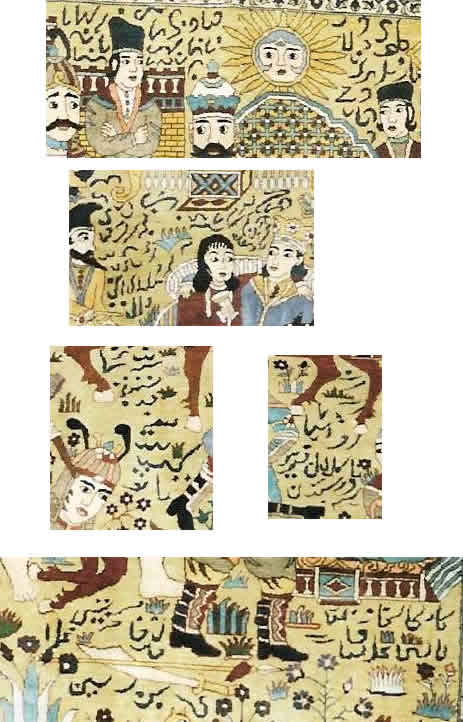
Can anybody decipher the writing on this rug?
A language school in Montreal has come up with an interesting way to teach languages – the students get together in local restaurants where the language they’re studying is spoken. This enables the students to learn languages, and about cultures and cuisines, in a relaxed environment where they can actually use what they’re learning. They also get discount on their restaurant bills, and the restaurants get some free advertising, as well as extra business.
Sounds like a good idea.
Do you know of any similar initiatives?
T’eh feayraghey as goll fliugh ayns shoh er y gherrid, agh ta’n ghrian soilshean jiu. Oie Jardain cheayll mee y çhentagyn as hie mee dy akin ad, agh tra haink mee ayns shen va’n jerrey orroo hannah. S’cummey – honnick mee taishbynys çhentagyn yindyssagh ayns Lunnin ayns Mean Fouyir.
Mae hi’n mynd yn oerach ac yn wlypach yma yn ddiweddar, ond mae’r haul yn disgleirio heddiw. Nos Iau mi glywes i’r tannau gwyllt ac es i allan i weld nhw, ond pan gyrhaedais i yno roedden nhw wedi gorffen yn barod. Dim ots – weles i arddangosfa dân gwyllt ardderchog yn Llundain ym Mis Medi.
Tá sé ag éirí níos fuaire agus níos fliche anseo le déanaí, ach tá an grian ag soilsigh inniu. Oíche Déardaoin chuala mé an tinte ealaíne agus chuiagh mé amach chun iad a fheiceáil, ach nuair a tháinig mé ann ansin bhí siad i ndiaidh críochnaithe cheana féin. Is cuma – chonaic mé taispéantas tinte ealaíne go hiontach i Londain i mí Mheán Fómhair.
Here’s a recording in a mystery language.
Do you know or can you guess which language it’s in and where it’s spoken?
Today’s word, moli, is the Welsh for ‘to praise’ and appears in a song we’re learning at the Welsh learners’ choir. I don’t think it’s commonly-used in modern Welsh, but does appear in some songs and maybe in poems. The more common word for to praise is canmol, which appears to come from the same root.
Related words include moliannus, praiseworthy; molianrwydd / moliant / molud, praise.
The words for ‘to praise’ and ‘praise’ in Irish and Scottish Gaelic are simliar to the Welsh: moladh, and mol, in Manx they’re moylley and moyll, and in Breton they are meuliñ and meuleudi.
Another meaning of moli is ‘to gather scurf in the eyes’. Scurf, or môl, is a word I haven’t come across before and means the stuff that appears in the corners of your eyes during sleep. There’s probably another name for it – does anybody know?
A Japanese company has come up with a gizmo called a Tele Scouter / テレスカウター which can translate what people say to you in foreign languages and display the results via a retinal display attached to your glasses.
The Tele Scouter is a small gadget that fixes onto glasses which incorporates a retinal display, a camera and a microphone. The microphone picks up the language and transmits it to a small computer worn around the waist, which sends it to a server for translation. The translation is then displayed on the retina. The device cannot currently keep up with language spoken at normal speed, and is a bit bulky, but it’s an interesting development.
If the size can be reduced and the speed and reliability increase, this device could be really useful. If it could also translate and/or transliterate written language, if would be even more useful, especially in for languages written with different writing systems.
Here’s a recording in a mystery language.
Do you know or can you guess which language it’s in and where it’s spoken?
Riyr ny yei y passan coloayrtys Frangish, hie mee dys y Thie Bee Blue Sky ayn Bangor as honnick mee Sharon King and the Never Never Cowboys, possan kiaull voish Nalbin. She arraneyder, screeudeyr arraneyn as gitardeyr ee Sharon, as va daa chaillin elley lhee – Vera van Heeringen, ar y gitar, mandalyn, fiddyl as kiaulleeaght cooidjagh, as Isobel Lohss ar y kishtey kiaullee as kiaulleeaght cooidjagh. Va ny arraneyn as y kiaull yindyssagh, as va ennaghtyn mie ayn.
Heno ar ôl y grŵp sgwrs Ffrangeg, es i i’r Tŷ Bwyta Blue Sky ym Mangor ac mi weles i Sharon King and the Never Never Cowboys, grŵp o’r Alban. Cantores, cyddansoddwraig a gitarydd ydy Sharon, ac roedd gynni hi dwy ennod eraill – Vera van Heeringen ar y gitâr, mandolin a ffidl a llais cyfeiliant, a Isobel Lohss ar yr acordion a llais cyfeilliant. Roedd y caneuon a’r gerddoriaeth yn wych, ac roedd naws da yn y lle.