Reviving neglected languages

I often meet people who say that they studied a language or two in school, but have since forgotten most of what they knew as they’ve had little need and few opportunities to speak the language(s). To some extent I’m in a similar position – since finishing school I have rarely spoken French or German, though I did spend three months working in France during my year off before going to university, and my ability in them atrophied. However, since I started going to a French conversation group a few years ago, I have regained my fluency in French – it came back quite quickly, and the polyglot conversation group I started this month gives me opportunities to use my German, which is starting to come back, after nearly 25 years of neglect.

Last week I was wondering why many people seem to find it hard to recover neglected languages they’re learnt in the past, even after only a few years. A friend suggested that my ability to do this might be because I’ve been actively learning languages more or less ever since I was 11 years old, and that by keeping the bits of my brain involved with learning and using foreign languages helps to keep all the languages in there at least partly active. I think there is something in this, as I remember reading about experiments in which bilingual individuals were put in brain scanners, which found that when the bilinguals were focused on one language – hearing it, reading it or speaking it – their other language was also active.

Another factor is how thoroughly you learnt a language in the first place – if you learnt it to a high level, then reviving it later is likely to be easier than if you only acquired a basic knowledge of it. For example I spent only a few months learning Italian and Portuguese on my own, quite a few years ago, and though I can still sort of read and understand them, I can only speak them to a very limited extent. I would need to start again with them really as my knowledge of them is shallow, so there’s not much to revive.

Have you studied languages in the past, neglected them for some time, then managed to revive them?
New song – Hints of Blossom

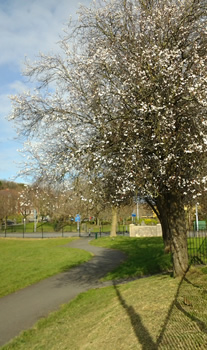
Hints of blossom on a tree

I wrote this song this week inspired by the fine weather we’ve been enjoying in Bangor. It’s been sunny and almost warm during the day with blue skies, and rather cold and frosty at night.

Hints of Blossom
On a cold frosty morning in the month of February
I stepped out from my doorway to see what I could see
The birds were all singing so sweetly in the trees
And the air was so still with barely a breeze.

The sun was shining brightly from a cloudless blue sky
And new lambs were frolicking in fields as I went by
The sea was like a mirror reflecting everything
And hints of blossom on the trees just made me want to sing.

The wheel of seasons was beginning to turn
And everywhere the signs of spring were to be discerned
So with a song in my heart and a smile on my face
I walked through the world at a leisurely pace.

Les mot de la semaine

– un compte courant = current account = cyfrif cyfredol = kont-red
– un compte d’épargne / de dépôt = savings account = cyfrif cynilion = kont-espern
– l’épargne, l’économie = savings = cynilion = arboell
– économiser = to save (money) = cynilo; arbed = armerzhañ
– l’intérêt (m) = interest = llog = laz
– le taux d’intérêt = interest rate = cyfradd llog = feur kampi
– l’assurance-vie (f) = life insurance = yswiriant bywyd = asurañs war ar vuhez
– les nouveaux visages (m); de nouvelles têtes (f) = new faces = gwynebau newydd = pennoù nevez
– retenir son souffle = to hold one’s breath (lit/fig) = dal dy wynt
– concorder = to fit (facts) = cytuno (efo ffeithiau)
– poseur (de tapis) = (carpet) fitter; poseur = fittiwr (carpedi)
– le pépin = glitch, snag, hitch; pip; umbrella = rhwystr; dincodyn; ymbarél = skoilh; disglavier
– greffer = to graft = impio = imboudañ

International Mother Language Day

I just discovered that today is International Mother Language Day, and found this video about it:

According the the UN website,

“International Mother Language Day has been observed every year since February 2000 to promote linguistic and cultural diversity and multilingualism. The date represents the day in 1952 when students demonstrating for recognition of their language, Bangla, as one of the two national languages of the then Pakistan, were shot and killed by police in Dhaka, the capital of what is now Bangladesh.”

The theme for this year is books for mother tongue education.

Slugs and snails and owls

Here some of the words that came up this week at the polyglot conversation group, along with a few related words and expressions.

Kernewek
bulhorn = snail
gluthvelhwenn; melhwenn = slug
kowann; oula = owl
mordardha = to surf
modardh = surf

Cymraeg
malwoden; malwen (malwod, pl) = snail
gwlithen; malwen ddu = slug
tylluan; gwdihŵ = owl
brigdonni; brigo tonnau; reidio tonnau; syrffio = to surf
pori = to surf (the web)
brigdonnwr; brigwr tonnau; syrffiwr = surfer
ewyn môr; brig y don; ewyn y don = surf
talp = nugget, chunk, lump, byte
cnepyn = nugget, nodule, lump, pommel
gwrthrychedd; gwrthrycholdeb = objectivity

Brezhoneg
melc’houed; melc’hwed; mailgorn; melc’houedenn-grogennek = snail
melc’houed; melc’hwedenn; likoch = slug
penn-kazh; toud; korverig = owl

Français
doué(e); de talent = talented
avoir du talent = to be talented
un musicien de talent = a talented musician
aux talents multiples = multi-talented
avoir plusieurs cordes à son arc = to have many tricks up one’s sleeve (be multi-talented)
elle est extrêmement douée = she is extremely talented
l’escargot (f) = snail
la limace = slug
le hibou; la chouettte = owl

Deutsch
die Streichholzschachtel = matchbox
der Streichholzschächtelchen = little matchbox
die Schnecke = snail
das Schneckengehäuse = snail shell
die Nacktschnecke = slug (“naked snail”)
die Eule = owl

Bulhorn

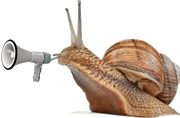
The subject of snails came up this week at the polyglot conversation group and I discovered that the Cornish word for snail is bulhorn /ˈbʊl.hɔɾn/ (pl. bulhornes), which I particularly like, and which conjures up images of bullhorn (megaphone) wielding snails.

We were also talking about slugs and didn’t know the Cornish or Welsh words for them. I suggested malwoden heb dŷ (“a snail without a house”) or malwoden digatref (“a homeless snail”) in Welsh, and bulhorn heb chy (“snail without a house”) was suggested for the Cornish version. I now know that a Welsh slug is a gwlithen or a malwen ddu (“black snail”) and that a Cornish slug is a gluthvelhwenn or a melhwenn. The gwlith and gluth in these words, which mean dew.

I later discovered that the German word for snail is Schnecke – isn’t that a great sound? Definitely a cellar door word for me. A German slug is a Nacktschnecke or “naked snail”.

Skinwel

When I learnt that the Breton word for television is skinwel, I wondered where it came from. Today I think I’ve found the answer (via TermOfis) – skin means ray, and appears in words such as:

skinek = radiant
skinad = radiation
skinañ = to radiate, shine, beam
skinforn = microwave oven (“ray oven”)
skin an Heol = sunbeam (“ray of the sun”)
skingomz = radio (“ray talk”)
skingaser = transmitter (“ray messenger”)
skindommerez = radiator (“ray heater”)
skinlun = x-ray (“ray picture”)

The wel part comes from gwel (view, sight, vision), I think, and appears in such words as:

gwelus = visible
gwelet = to see, look

I find it interesting when new words like this are invented for modern inventions, rather than just borrowing international terms like television, telephone and radio. Other examples in Breton include pellgomz = telephone (“far talk”) and urzhiataer = computer (“order-er”). Such words may not be used in everyday speech, but I think it’s nice to know that they exist.

Can you think of examples in other languages?

Harmony magpie

Harmony magpie

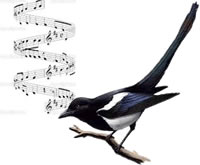
I went to a singing workshop in Porthmadog today and there I heard the interesting term harmony magpie, which is used to describe a someone who ends up singing like those around them, even if the others are singing a different part. The workshop leader recommended that any harmony magpies in the group should make sure that they surround themselves with people singing the same part, rather than going next to someone singing a different part, as they would most likely be drawn into the other part.

Afterwards I was thinking about this and thought about the way my speech tends to become like the speech of people I’m talking to, and thought that I might say that I am a bit of an accent/dialect/language/linguist magpie. I think the technical term for this phenomenon is linguistic accommodation. A linguistic magpie might also be used to describe someone who collects lots of bit of different languages, just like magpies reputedly collect shiny things to put in their nests.

Are you a linguistic magpie, or indeed a harmony magpie?