
Here’s a recording in a mystery language.
Can you identify the language, and do you know where it’s spoken?
Here’s a recording in a mystery language.
Can you identify the language, and do you know where it’s spoken?
The word for to develop in Welsh is datblygu, which is a combination of dad (un-) and plygu (to fold), so Welsh developments “unfold”.
Datblygu also means “to evolve; reveal, disclose, display. to unfold, unwrap, unfurl, unroll, spread out.”
Plygu means “to (cause to) bend, deflect, bow, stoop, refract (light); fold, wrap. to subdue, subjugate, overcome; apply twist (meaning), distort, pervert; submit, yield, waver.”
Plygu comes from the Latin plicō (to fold, coil), from the Proto-Indo-European *pleḱ- (to plait, to weave). The Latin word also means to arrive, which comes from sailors folding their ship’s sails when arriving somewhere.
Plygu is also found in:
– amblygu = to wrap around, surround, wrap together, lap, envelop, cover. (am = around).
– atblygu = to unfold, refold, fold back (at- = to(wards))
– arblygu = to apply, adapt (ar- = fore, opposite)
– darblygu = to deflect (dar- = intensifer)
– diblygu = to unfold explicate, unravel (di- = negative)
– goblygu = to bend, bow, nod, fold, wrap up, leap, cover, hide. to conquer; imply, involve, implicate (go- = sub-)
– gwrthblygu = to bend back, fold back; reflect; pervert (gwrth = against, contra-)
– ymblygu =to bend, bow, stoop (ym- = reflexive)
Source: Geiriadur Prifysgol Cymru and Wiktionary
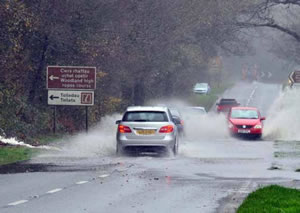
Quite a lot of rain has fallen over the past day or so in the UK, thanks to Storm Angus, so I thought I’d look at the origins of some rain-related words.
The word rain comes from the Old English rēn/reġn (rain), from the Proto-Germanic *regnaz (rain), possibly from the Proto-Indo-European *Hreǵ- (to flow) or from *reg- (moist, wet).
When rain falls heavily it might be called torrential – it certainly was yesterday – a word which comes from torrent (rapid stream), from the Middle French torrent, from Latin torrentem from torrēns (rushing, roaring (of streams); a rushing stream), a word which originally meant “roaring, boiling, burning, parching, hot, inflamed”, and which is the present participle of torrere (to parch).
With heavy rain you get floods, a word which comes from the Old English flōd (a flowing of water, tide, an overflowing of land by water, a deluge, mass of water, river, sea, wave)”, from the Proto-Germanic *floduz (flowing water, deluge), from the Proto-Indo-European root *pleu- (to flow, float, swim), which is also the root of flow.
Sources: Online Etymology Dictionary, Wiktionary, Daily Post
Here’s a video of the sea being rather lively at Colwyn Bay (from the Daily Post).
It wasn’t just raining cats and dogs, but elephants and hippopotamuses too – that’s what it felt like anyway.
More idioms for heavy rain in various languages.
Do you know any interesting expressions for heavy rain?
Here’s a recording in a mystery language.
Can you identify the language, and do you know where it’s spoken?
In French the word for play, as in a theatrical production, is pièce or pièce de théâtre.
Pièce also means:
– a room
– a part (of a mechanism or machine)
– a coin
– a patch (on clothes)
– a document
– a piece, as in a one-piece swimsuit or a twelve-piece dinner service.
The word pièce comes from the Old French piece (piece, bit, part), from the Vulgar Latin *pettia, from the Gaulish *pettyā, from the Proto-Celtic *kʷesdis (piece, portion).
Over expressions featuring pièce include:
– pièce à conviction = exhibit
– pièce d’eau = ornamental lake, ornamental pond
– pièce de rechange = spare part
– pièce de résistance = pièce de résistance (main dish, masterpiece; outstanding event or item)
– pièce détachée = spare part, spare
– en pièces détachées = in kit form
– pièce d’identité = ID
– pièce montée = tiered cake
Source: Reverso, Wiktionary
| français | English | Cymraeg |
|---|---|---|
| s’installer | to settle in | ymgartrefu; ymsefydlu |
| se calmer | to settle down | bod yn llonydd; bod yn dawel |
| se contenter de | to settle for | bodloni ar |
| régler | to settle up | talu’ch dyledion |
| s’établier sur | to settle (land) | sefydlu mewn; cyfandeddu |
| se déposer | to settle (dust) | dawelu; gorweddi |
| rudimentaire | rough and ready (accommodation, method) | ffwrdd-â-hi |
| le décor | (stage/TV) set | set |
| le plateau | (film) set | set |
| la pièce (de théâtre) | play | drama |
| tenace | tenacious | diollwng; anollyngol; diymollwng; cadarn |
Today I came across word that’s new to me – bants – which, according to the Oxford Dictionaries, means:
Playfully teasing or mocking remarks exchanged with another person or group; banter.
It’s also written bantz, and is an abbreviation of banter, a word of unknown origin which first appeared in writing in 1676 in a play by Thomas D’Urfey called Madam Fickle, and is thought to come from London street slang.
Banter has a number of meanings:
1. To engage in banter or playful conversation.
2. To play or do something amusing.
3. To tease (someone) mildly.
4. To joke about; to ridicule (a trait, habit, etc.).
5. To delude or trick; to play a prank upon.
6. To challenge to a match (US, Southern and Western, colloquial)
Apparently it originally meant “to tease or ridicule, usually in an aggressive manner”, and the banter became more friendly over time.
Sources: Wiktionary, World Wide Words, OneStopEnglish
Are there words with a similar meaning in other languages?
This blog has been chosen as one of the Top 100 Language Learning Blogs – a list which includes links to other language-related blogs that might interest you.
Many thanks to those who chose this blog.

Here’s a recording in a mystery language.
Can you identify the language, and do you know where it’s spoken?

Today I came across an interesting Russian idiom in the book I’m reading (Moon Seed, by Stephen Baxter): Ни пуха, ни пера (Ni púkha, ni perá). It means literally “neither fur nor feather” and is used to wish someone good luck.
The phrase was originally used by Russian hunters in a sarcastic/ironic way. The feathers referred to birds, and the fur to animals, so they were saying that they hoped that the other hunters wouldn’t catch any birds or animals.
The usually reply to this phrase is К чёрту (K chëtu), which means “to the devil” or “go to hell”, and is saying “the hell I won’t”.
Source: http://www.linguajunkie.com/learning/russian-proverbs-sayings
An equivalent of this phrase in English is “break a leg”, which is traditionally said to actors to wish them luck before they go on stage, especially on the opening night. According to theatrical superstition it’s bad luck to wish someone good luck.
This phrase first appeared in writing in May 1948 in the The Charleston Gazette as:
“Another [superstition] is that one actor should not wish another good luck before a performance but say instead ‘I hope you break a leg.”
There is a similar phrase in German, Hals und Beinbruch (break your neck and leg), which was apparently used by the Luftwaffe during WWII. This might come from the Hebrew blessing hatzlakha u-brakha‘ (success and blessing), which might have made it’s way into English via German and Yiddish.
Source: http://www.phrases.org.uk/meanings/break-a-leg.html
Are there idiomatic ways to wish people luck in other languages?