The Japanese word 轟々 / ごうごう / ゴーゴー (gōgō) means thundering, roaring, rumbling or booming. The kanji 轟 (gō/kō/todoro) is made up of three carts (車), and is also used as a surname, which is pronounced Kuruma, Gō or Todoroki.
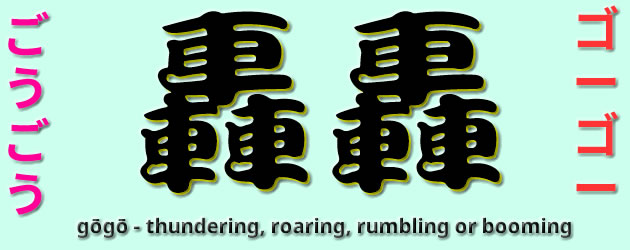
This kanji also appears in words like:
- 轟音 (gō’on) = thunderous roar, roaring sound
- 轟く (todoroku) = to roar, reverberate, be well-known, be famous, palpitate, throb
- 轟かす (todorosu) = to make a thundering sound, to make (one’s name, etc.) widely known, to make (one’s heart) pound
- 轟然 (gōzen) = roaring, thundering, thunderous, deafening, ear-splitting
- 轟き (todoroki) = roar, peal, rumble, booming, beating, pounding
In Mandarin Chinese the character 轰 [轟] is pronounced hōng and means explosion, bang, boom, rumble, to attack, shoo away, expel.
It appears in words like:
- 轰动的成就 [轟動的成就] (hōngdòng de chéngjiù) = a howling success
- 轰动全世界 [轟動全世界] (hōngdòng quánshìjiè) = to set the world on fire
- 轰隆 [轟隆] (hōnglōng ) = to rumble
- 轰轰烈烈 [轟轟烈烈] (hōnghōnglièliè) = vigorously, grand and spectacular, fiery
- 轰赶 [轟趕] (hōnggǎn) = to drive off, shoo away
I like these compound characters that are made up of several duplicated characters. Other examples include
- 林 (hayashi – wood, forest), and 森 (mori – forest) which are made up of several 木 (ki – tree, shrub, bush, wood, timber). Put them together and we get 森林 (shinrin – forest, woods).
- 炎 (honō – flame, blaze, passion), which are made up of two 火 (hi – fire)
- 品 (hin – elegance, grace, article, item), which are made up of several 口 (kuchi – mouth)
- 龖 (tà – flight of a dragon), 龘 (tà – the appearance of a dragon walking) and 𪚥 (zhé – verbose) which are made up of several 龍 [龙] (lóng – dragon).
The dragon examples are rare and in Mandarin, the rest are in Japanese.
Sources: jisho.org, mdbg.net, Line Dict CHINESE-ENGLISH
Fascinating stuff, Simon. I have to say, though, that I give thanks every day that my native language (English) is written using the Roman alphabet!
Japanese is too difficult to learn. I take 1 year to learn, but I also cannot remember them. My friend loves Japanese, so she can learn quickly. She can read, and speak after 4 months.
The way language catches sounds has always fascinated me. It brings back memories of being cooped up inside during a recent thunderstorm and listening to the thunder gōgō outside.
That’s a neat breakdown of 轟々! I didn’t realize the kanji was literally three carts, which makes the rumbling sound association much clearer. It’s interesting how it’s also used as a surname.
Man, I never knew kanji could be so cool. It’s like they can tell a story through their shapes! I remember struggling with my kanji flashcards back in the day—talk about a brain workout, right? What’s your favorite kanji story? 🤔
It’s really interesting how the kanji for ‘gōgō’ is literally three carts, perfectly encapsulating the rumbling sound it describes. That visual representation makes it so much easier to remember the meaning.