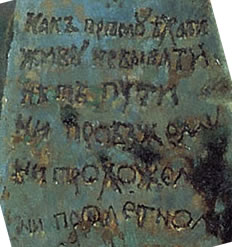
Can anyone decipher the text on this pendant, which probably comes from Rajasthan.
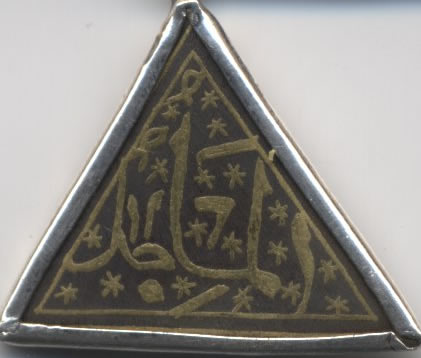
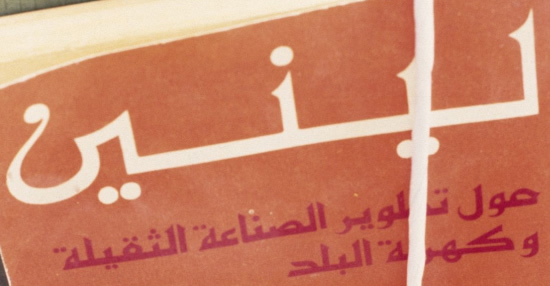
What about this writing which appears on the cover of a book?
Today we have a guest post from Petrea Mitchell
I minored in geology – that is, it was my secondary area of concentration at college. Much of geology deals with things that were known and named well before they were codified as part of science, and it developed a habit for picking up local words rather than inventing its own for “new” phenomena. Thus, while you run into the usual load of classical-language derivatives when talking about things not visible at the surface of the earth, such as the strata (Latin, “layers”) recording various geological ages, or magma (Greek, “ointment”) waiting to erupt, you can also find words from all around the world.
For instance, when the early natural scientists wanted to study the effect of glaciers, they went tromping all over the Alps and picked up words like horn, which is from German, and used in geology to mean a peak shaped by glacial erosion. Glacier itself is French, as are arête (a sharp ridge resulting from erosion), cirque (a circular glacier), and moraine (a pile of debris formed along or at the end of a glacier).
Outcrops which are stuck under a glacier for a long time come out looking something like a shoehorn placed concave side up when the glacier retreats. One of these is a mouton roche (or so I was taught, though I’ve also seen it as roche moutoneé) or “rock sheep”.
But there is room for other areas to contribute to ice-related geology. Out in the tundra (originally a Russian word), repeated cycles of freezing and thawing can form hills with icy cores, called pingoes, from a Greenlandic word for “small hill”.
[Tundra was borrowed from Russian, but originally comes from the Kildin Sami word tū̄ndra, the genitive form of тӯндар (tūndar), ‘treeless plain’]
On a hotter topic, the familiar words lava, crater, and volcano all come from the neighborhood of Mt. Etna. Geyser is borrowed from Iceland, as is jökulhlaup, originally meaning an outburst of water caused by a volcano under a glacier, but used in geology for any sudden glacially-related flood.
Hawai`ian contributes words for two types of solidified lava: aa (ʻaʻā) for high-silica, viscous stuff that freezes into a rough, sharp texture, and pāhoehoe for low-silica lava which presents a relatively smooth surface after freezing. (A good mnemonic for remembering which is which is that aa is what you’re likely to wind up saying if you decide to go walking on that type.) Indonesian gives us lahar for a hot debris flow associated with a volcanic eruption.
On the other hand, another volcanic feature is called a maar, from a German dialect word for “sea”. Maars are formed when molten rock underground comes into contact with groundwater and causes a steam explosion. Since the bottom of the resulting crater then reaches groundwater level, the water seeps into the lower part of it to form a pond or lake. While there is no active volcanism in the area now, there are a bunch in the Eifel region of Germany, where the word comes from.
Japanese famously is the source for tsunami (津波), for which many English speakers have long used the term tidal wave (because it looks like a sudden high tide, rather than a normal ocean wave). Following the Boxing Day earthquake of 2004, tsunami seems to have finally shifted into common usage – but seeing as it means “harbor wave”, it’s hard to argue that everyone is really using a more correct word now, beyond the fact that it’s the official geological term.
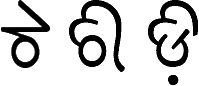
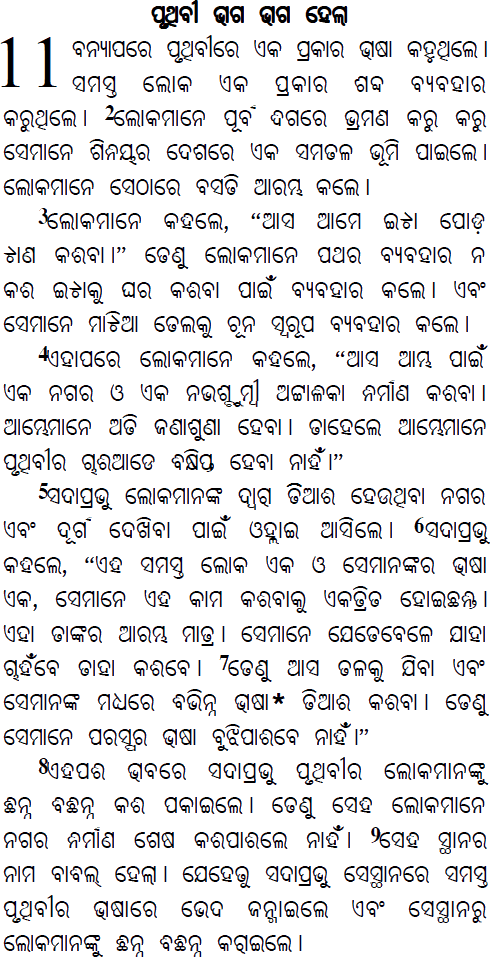
I’m currently trying to transcribe an Oriya version of the Tower of Babel story from a PDF and have come across a number of letters that I can’t quite work out.
They appear in verse 3 and I think they’re conjuncts of some kind, but haven’t been able to find them. Can you help?
Here are the tricky letters:
and here’s the full text:
This pendant was sent in by a visitor to Omniglot who would like to know whether anybody can decipher the inscription on it. It depicts St. George and the dragon and might be from Turkey.
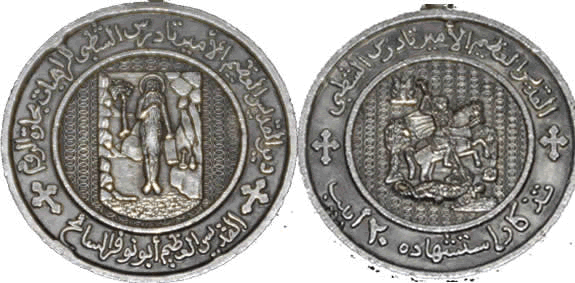
Here’s my attempt to transcribe the inscriptions:
Left image top: ديرالقديس المقيم الأمير تادرس الشطي الهاتحارة الروم
Left image bottom: القديس الفطيم أبونوفاساح
Right image top: القديرا لعكيم الاميس تادرى الشطي
Right image bottom: تذكارإ ستشهاده ٦٠ أبيب
Today we have a guest post from Stephen Dunne.
ἀρετή (arete), noun = meaning virtue, goodness, excellence, purity.
This Classical Greek word is difficult to encapsulate precisely in English but expresses a state of almost distinguished self enlightenment. It can however mean many other things besides virtues attached to the self; the Greeks did use the word to describe the form of inanimate objects like vases or statues.
There are many ways to think of the physical form of arete. In Ancient Greece is was the capacity and fulfilment of attaining one’s potential, perhaps in face of much environmental difficulty.
In Philosophy, arete is central to the notion of Virtue Ethics and many of the ideas stem from Aristotelian thought. Virtue Ethics is a serious challenge to other mainstream moral schools like Deontology or Consequentialism.
These days, it could be argued that many of the books in the post-capitalist self-help genre are centred on the notion of arete, with individuals seeking non material fulfilment.
聽筒 [听筒] (tīngtǒng) is Chinese for telephone receiver; headphone; earphone; earpiece and stethoscope. Its literal meaning is “hearing tube” – 聽 = to hear; to obey, and 筒 = tube; cylinder.
I found this word in an online Chinese dictionary I came across yesterday which looks very useful. You can search for Chinese words or characters using their characters or pinyin spelling, and the entries include traditional and simplified characters, pinyin, recordings of the pronunciation, related words, and English and French equivalents. There’s even the option of inputting characters by hand.
The dictionary seems to be part of the Chinese Tools site, which contains a translator, text-to-speech, name translators for Chinese, Japanese, Korean, Tibetan and other scripts, and other useful tools.