Here’s a recording in a mystery language.
Can you identify the language and where it’s spoken?
Today we have a guest post from Ian at Fluently Spanish:
If you’re like most people who want to learn Spanish, you are sick of the boring methods used by old-fashioned school and college lecturers. All that hope, promise and excitement of learning Spanish can only last so long if you are stuck reading books or having conversations in Spanish that you would never use in real life.
This is why so many people give up before they’ve even learned a second language. Hopefully, with the help of this article you will be able to inject some fun into your Spanish learning and start on your journey to becoming conversationally fluent! Below are three unique, fun and interesting ways to learn Spanish without boring yourself to tears or upping sticks and heading to Barçelona or México.
Post It! everything!
Spanish structure can be learned easily in a book or audio course. What you actually need to learn Spanish and be confident in conversations is words. Label everything in your home with Post It notes and you’ll always be thinking in Spanish. Include sample sentences or phrases using that word every time you use it or look at it. Pick one Post It a day and take it with you to work or school. Use it in conversation with people or freak out the old lady on the bus by spouting off in Spanish. Get out of your comfort zone and start embarrassing yourself. That way, you won’t worry about forgetting words when you are speaking Spanish.
Date a Spanish person
It doesn’t matter where in the world you live, there will always be someone who speaks Spanish. With Facebook, MeetUp.com and many other sites you can find Spanish speakers in your local area. If you have a partner already, just meet up with people to talk with and learn Spanish over a coffee or four. For the singles out there, it’s a whole lot more fun! By dating Spanish speakers you not only get to try and woo them in Spanish, you get to order meals at Spanish restaurants, flirt with them in Spanish via text message and try to be cool and mysterious in a different language! If nothing else, the challenge will again build your confidence in speaking to people in Spanish.
Get Out of Your Comfort Zone
The above two points also do this, but it’s a point worth making again. The best way to keep Spanish learning fun, interesting and unique is to get as far out of your comfort zone as possible. Go to Spanish or Mexican restaurants, drink cervezas in Spanish bars and order it in Spanish, phone Spanish companies or speak with Spanish people on Skype. Whatever you do, train yourself to not worry about making mistakes. Get used to asking ¿Cómo se dice ‘English word here’ en español?/How do you say ‘word’ in Spanish? If you need to refer to a dictionary for a word or phrase, you can just say Momentito… while you look it up!
One of the worst things you can do when learning Spanish is panic and then revert back to English, saying that you only speak a little. Persevere using unique ways of putting yourself under pressure, get out of the classroom and start learning Spanish the right way and I guarantee you’ll enjoy the process and the journey a heck of a lot more!
What unique way will you discover to learn Spanish?
You can learn more about how to speak Spanish fluently by visiting my website and signing up for my free Spanish online classes.
Koro is a Tibeto-Burman language spoken by about 1,000 people in Arunachal Pradesh in north-eastern India. Until recently it was unknown outside this region and was discovered by a team of linguists who are part of the National Geographic’s Enduring Voices Project, which aims to document endangered languages [source].
The linguists started documenting two other little-known languages, Aka and Miji, in 2008, and initially thought that Koro was a dialect of Aka. However they soon realized that Koro was very different from Aka and was in fact a separate language. Koro speakers consider themselves part of the Aka community, and apparently didn’t think they spoke a distinct language [source].
Obrigado to Renato Figueiredo for letting me know about this story.
casual water – “a temporary accumulation of water on the golf course”. Technically the accumulation of water has to be above ground and visible, and this does not include lakes; wet, spongy, mushy or muddy ground; dew or frost, or snow or ice [source].
So in other words casual water is another way of describing a puddle, a diminutive of the Old English word pudd (ditch) which originally referred to pools and ponds as well [source].
Can anyone decipher the writing around this disc?
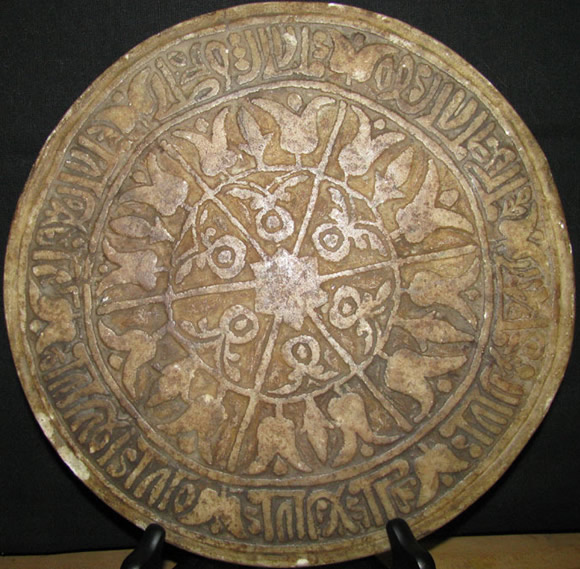
It was sent in by a visitor to Omniglot who’s been told that it’s in a Kufic version of the Arabic script, and who thinks it could be Ottoman Turkish or Persian.
A speaker of Hmong who wrote to me recently mentioned that consonants are called tsiaj ntawv txiv (the father letters) and vowels are called tsiaj ntawv niam (the mother letters) in Hmong, and would like to know whether any other languages have similar names for consonants and vowels.
Here’s a recording in six different languages.
Can you identify the languages and work out which is the odd one out?

I came across today’s word, spurtle, in a book I’m reading at the moment. It’s described as “a wooden utensil for stirring porridge” in the book, while according to Wikipedia it is:
a Scots kitchen tool, dating from at least the fifteenth century. It was originally a flat, wooden, spatula-like utensil, used for flipping oatcakes on a hot griddle. This terminology is now confined to Angus and Perthshire.
Over time, the original implement changed shape and began being used specifically for stirring oatmeal and soups. The rod-like shape is designed for constant stirring which prevents the porridge from congealing and so becoming lumpy and unappetising. It looks like a fat wooden dowel, often with a contoured end to give the user a better grip.
A Golden Spurtle is the first prize at the World Porridge Making Championships, which take place in Carrbridge in Scotland.
The Spurtle is also the name of a Scottish Country dance.
The etymology of spurtle is uncertain, however while searching for it, I found a possibly related word in A etymological dictionary of the Scottish language:
SPURKLE, A sort of spattle. “Scutching spurkle, a stick to beat flax.” “Thacking spurkle, a broad-mouth’d stick for thatching with”. […] perhaps Spurkle is merely a variety of Spurtle.
An Assyriologist at Cambridge University have made recordings of poetry and literature in Babylonian and Assyrian and posted them online. Some of the works date back to about 1,900 BC and include The Epic of Gilgamesh, The Babylonian Epic of Creation and even an Incantation for Dog Bite.
This is the first time such recordings have been made and the main aim is to provide illustrations of theories about Babylonian and Assyrian pronunciation, metre, etc.
Petrichor, noun, /ˈpɛtrɨkər/ – the scent of rain on dry earth.
It comes from the Greek πέτρος (petros – stone) and ἰχώρ (ichor – the fluid that flows in the veins of the Greek gods), and was coined in 1964 by two Australian researchers, I.J. Bear and R.G. Thomas. The smell isn’t of the rain itself but comes from the oils released by vegetation when rain falls [source].
I found this word while searching for dripple, which I hear on the radio last night and which was described as being a type of light rain that isn’t quite drizzle. The only references to dripple I could find gave it’s meaning as “weak or rare” and there was no mention of rain.
I also found the Beaufort Rain Scale, a spoof version of the Beaufort Scale which ranges from:
Force 0: Complete Dryness.
Absence of rain from the air. The gap between two periods of wet.
Associated Phrase: “it looks like it might rain.”
through
Force 4: Visible Light Shower.
Hair starts to congeal around ears. First rainwear appears. People start to remember washing left out. Ignored by all sportsmen except Wimbledon players, who dash for cover. A newspaper being read outside starts to tear slightly.
Associated Phrases: “it’s starting to come down now,” “it won’t last,” and “it’s settled in for the day now.”
to
Force 10: Hurricane.
Not defined inland – the symptoms are too violent and extreme (cars floating, newspaper readers lost at sea, people drowned by inhaling rain, etc.). So, if hurricane conditions do appear to pertain, look for some other explanation.
Associated Phrases: “oh my god, the water tank has burst – it’s coming through the kitchen ceiling,” and “i think the man upstairs has fallen asleep in his bath.”
You can’t tell what language speaks by their appearance, but it’s common to make assumptions about such things. I do this myself and usually expect that people who look Japanese will speak Japanese, and that who look Chinese will speak one or more varieties of Chinese, though I don’t tend to talk to them in the relevant language until I’m sure they do actually speak them.
I came across some amusing blog posts today about how wrong assumptions can be, here and here.