Here’s a recording in a mystery language.
Do you know or can you guess which language it’s in and where it’s spoken?
Here’s a recording in a mystery language.
Do you know or can you guess which language it’s in and where it’s spoken?
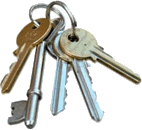
Chaill mee m’ogheryn boayl ennagh ayns Bangor jea. Dy fortanagh va ogheryn vrash ec my vençhiarn thallooin as v’ee sthie tra hellvane mee urree. Cha nel m’ennym ny m’enmys er ny ogheryn, myr shen cha vee feysht ayn dy fow peiagh ennagh ad. Shoh yn chied traa ta shoh jeaynt aym, as ta treisht orrym bee eh y traa s’jerree neesht.
Chaill mé m’eochracha áit éigin i mBangor inné. Go hádhúil bhí mo bhean lóistín sa bhaile nuair a chuir mé scairt uirthi agus bhí eochracha breise aici. Ní raibh m’ainm nó mo seoladh ar na eochracha, agus dá bhrí sin ní bheidh fadhb ann dá mbeadh duine éigin tar orthu. Seo an chead uair go raibh mé ag déanamh seo, agus tá súil agam go mbeidh sé an uair deireanach chomh maith.
Mi golles i fy allweddi rhywle ym Mangor ddoe. Yn ffodus roedd allweddi sbâr gan fy argwylddes tir ac roedd hi’n adref pan ffonies i hi. Doedd fy enw neu gyfeiriad ar yr allweddi, felly na fydd broblem os mae rhywun yn ffeindio nhw. Dyma’r tro cyntaf imi colli fy allweddi, ac gobeithio y tro diwethaf hefyd.
They were talking about tattoos this morning on Radio Cymru and one of the presenters used the word croenlun, which I hadn’t heard before but could understand from the meaning of its component words – croen (skin) and llun (picture, image). This word doesn’t appear in any of my Welsh dictionaries so I suspect it isn’t very common – the usual Welsh word for tattoo is tatŵ.
Other Welsh words containing croen include croendenau (skin thin) – touchy sensitive; croendew (skin thick) and croengaled (skin hard) – thick-skinned, callous; and croeniach (skin healthy) – unhurt, unharmed.
The English word tattoo comes from one of the Polynesian languages – perhaps the Tahitian and Samoan tatau or the Marquesan tatu, which mean “puncture, mark made on skin”.
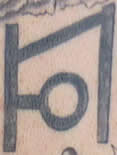
The image on the right was sent in by a visitor to Omniglot who would like to know if anybody recognises the symbol.
It looks like a tattoo and the symbol does look vaguely familiar to me, though I’m not sure where I’ve seen it before.
Crimean Tatar (Qırımtatarca) is a Turkic language spoken in Crimea in Ukraine, and also Uzbekistan, Turkey, Romania and Bulgaria. At different times during the past century is has been written with the Arabic, Latin and Cyrillic alphabets, and all three alphabets are still used by Crimean Tatars in different countries. At a recent seminar in Simferopol in Ukraine it was proposed that all Crimean Tatar adopt the Latin alphabet, according to this report.
The aim of the common Latin-based orthography is to standardise the written language and to unite Crimean Tatars wherever they live.
A visitor to Omniglot who would like to know what the Latin and Greek bits on this postcard mean, and whether anybody has any ideas about the identity of the writer.
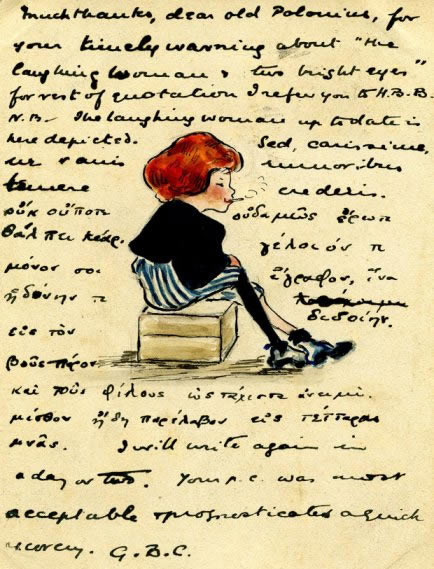
The postcard that was sent to an address in the UK and has a UK stamp on so was probably it was posted in the UK, though the postmark is unreadable, apart from the date – 1904.
The quote about the “laughing woman and two bright eyes” comes from the last stanza of a poem called “The Temptations of St Anthony” which is in Bentley’s Miscellany of 1868 and is by a poet with the initials T.H.S. The full quote is “A laughing woman with two bright eyes is the worsest devil of all”.
Ta mee smooinaghtyn thie y chionnaghey ayns Bangor, as hug mee shilley er thieyn yn çhiaghtyn shoh as yn çhiaghtyn shoh chaie. Foddee verrym çhebb er nane jeu, agh shegin dou loayrt rish turneyr hoshiaght.
Tá mé ag smaoineamh teach a cheannach i mBangor, agus chuaigh mé tithe a feiceáil an seachtain seo agus an seachtain seo caite. B’fhéidir déanfaidh mé tairiscint ar cheann acu, ach tá orm ag labhairt leis aturnae ar dtús.
Dw i’n meddwl am brynu tŷ ym Mangor, ac es i i weld tai yr wythnos hon a’r wythnos ddiwethaf. Efallai mi na i gynnig ar un ohonynt, ond mae rhaid i mi siarad efo cyfreithiwr yn gyntaf.
Here’s a recording in a mystery language.
Do you know or can you guess which language it’s in and where it’s spoken?
I came across the word wintle [‘winəl / ‘wintəl] in Louis de Bernières’ novel Notwithstanding, which I just finished reading. From the context – she walks carefully so as not to wintle on the rimy Bargate stones of the path – I guessed that it meant to slip or something similar.
According the Merriam-Webster Online Dictionary it’s Scottish and means to stagger, reel or wriggle. It’s possibly comes from the Dutch word windtelen (to reel).
Dictionary.com defines it as 1. (noun) a rolling or staggering motion. 2. (verb) to roll or swing back and forth. 3. (verb) to tumble over; capsize.
Have you heard this word before?
I came across the Audio Archive yesterday while searching for information about the pronunciation of English dialects.
The archive is part of an newsgroup about English and contains recordings by English speakers from around the world of a number of different texts.
Other collections of English dialect recordings including the British Library’s Sounds Familiar? and Archival Sound Recordings, the BBC Voices project, Sound Comparisons, the American English Dialect Recordings at the Library of Congress, and the International Dialects of English Archive.
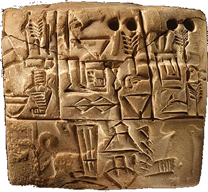
There’s an very interesting series of programmes on BBC Radio 4 at the moment called “A History of the World in 100 Objects“. The objects come from the British Museum and one of recent programmes discussed an ancient Mesopotamian writing tablet, like the one on the right, from about 3,000 BC.
They talk about the invention of writing, and how it was used almost exclusively for record keeping and accounting at first, and that written literature only developed later.
The tablet in question is a record of workers’ daily beer rations – workers were paid in beer as this was before the invention of money.
By the way I’m planing to add a page or two to Omniglot about the history and development of writing, and maybe a chronology as well.