Word of the day – gaffen

gaffen, verb = to gape, gawp, stare

Example of usage:
gaff nicht, sondern hilf mir lieber! = don’t just stand there gawping, come and help!

Related words:
Gaffer(in) = gaper, gawper, starer
Gafferei = gaping, gawping, staring
glotzen = to gawp at something

Today’s word caught my eye while looking through my German dictionary. In British English slang, the gaffer is the boss or foreman, and your gaff is your home, though this usage is a bit old fashioned.

In Scottish Gaelic, the lovely word spleuchd means to gape, gaze, goggle, squint, stare, while the Welsh ceg agored (lit. “open mouthed”) is a stare.

Word of the day – billey

billey (BILL-ya) = tree, plural = biljyn (BILL-jin)

Examples of usage:
Vel biljyn sy gharey? (Are there trees in the garden?)
Ta. Tree biljyn mooarey as un villey beg (Yes. Three big trees and a small tree)

This word came up in today’s Manx lesson. While many Manx words are the same as or similiar to words in Irish and Scottish Gaelic, this particular word caught my eye because it’s completely different. In Irish the word for tree is crann (pl. crainn), while in Scottish Gaelic it’s craobh (pl. craoibhe) or crann . The Welsh words for tree are coeden (pl. coed) and prenn (pl. prennau) – also means wood/timber.

Complementary schismogenesis

Imagine you’re used to leaving only a short pause after someone else has finished speaking before you start; you’re speaking to someone who normally waits longer before speaking, and neither of you are aware of this difference is speaking styles. In such a situation, you will probably dominate the conversation, while the other person will have great trouble getting a word in edgeways. You might conclude that they have nothing much to say, while they might think you’re very pushy and unwilling to let them say anything.

If language and cultural differences become exagerated when they come into contact, what you have is complementary schismogenesis. This is a term coined by Gregory Bateson to describe what happens when people with different cultural norms come into contact: they each react to the other’s differing patterns of behaviour by doing more of the opposing behaviour.

Another example of complementary schismogenesis can happen when someone who is used to standing close to the person they’re talking to has a conversation with someone who feels more comfortable with a larger space between them and the other person. The first person will keep on moving closer while the the second will keep on moving away. This is also an example of proxemics – the study of how people use space.

Source: An Introduction to Language and Linguistics, by Raply W. Fasold & Jeff Connor-Linton

Languages Out There

Today I came across an organisation called Languages Out There that runs an unusual style of language courses – you spend an hour or two studying, then go out on the street with your tutor to practice the language you’ve learnt. For example, you learn out food and drink, then go out for a meal and order in the local language. The idea is to give you plenty of opportunities to make practical use of the language you’re learning with local people.

This sounds like more fun than sitting in a classroom all day – maybe I’ll give it a try sometime next year. They currently offer courses in English, Spanish, Italian, German and Czech.

So many languages, so little time

Often I wonder whether it would be better for me to concentrate on learning one or two languages really well, rather than trying to learn as many languages as possible. Although I’d really like to be fluent in all the languages I’ve studied, am studying and plan to study, I realise that this is perhaps an unrealistic ambition. So my aim, at the moment, is to become as fluent as possible in Spanish, Welsh and Irish, while continuing to study other languages.

Yesterday I came across an interesting blog by someone who describes herself as an “Aspiring Polyglot“. It seems she faces a similar dilemma to me – it’s good to know I’m not the only one!

Word of the day – плотник

плотник (plotnik), noun = carpenter

After a break of a few weeks, I started studying Russian again today. This week’s lesson is about occupations. It provides the Russian words for various jobs, but unfortunately doesn’t tell you how to say “I am a …” or “I work as a …”. Such sentences will hopefully appear later in the course.

Other words for occupations include:

секретарь (sekretar’) = secretary
доктор (doktor) = doctor
медсестра (medsestra) = nurse
зубной врач (zubnoj vrač) = dentist
учитель (učitel’) = teacher
пекарь (pekar’) = baker
механик (mexanik) = mechanic
студент (student) = student

Crosscultural (mis)communication

I’m currently reading some very interesting information about language, culture and particularly crosscultural communication. The ability to speak a foreign language fluenty doesn’t necessarily make for smooth and trouble-free communication with native speakers of that language. There are many differences in the way people use language, such as in volume, intonation, pitch and tone, and also in the topics they discuss, the way they take turns in a conversation and whether they express their opinions directly or indirectly. These differences may also occur among speakers of the same language.

Here are a few examples of potential crosscultural misunderstandings:

When you first meet someone in Germany it’s common and appropriate to discuss such topics as politics and religion, however in the UK and USA doing so might be perceived as intrusive and rude.

Among Chinese communities, it’s normal to discuss financial matters, even with people you’ve just met, though this would isn’t necessarily a welcome topic elsewhere.

The British and Americans generally take it turns to speak during a conversation, however Germans may start speaking while others are speaking in order to demonstrate their interest and enthusiasm.

In Japan it’s common to say “hai!” or make other appropriate noises while someone else is speaking to show that you’re listening. If you’re not used to this, it sounds like the listener is trying to hurry the speaker up so that they can have you say.

When an American says to you with “Hi, how are you”, he or she is not usually asking about your health – it’s just a greeting. This is one that often catches me out.

    Have you experienced any crosscultural communication difficulties recently?

Ar ais arís anois (back again now)

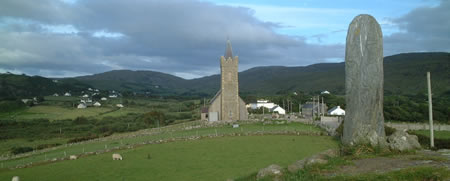
Tháinig mé ar ais chuig Brighton areir i ndhiaidh turas fada go maith – d’fhág mé Gleann Cholm Cille ag a haon déag ar maidin agus chuaigh mé ar a bus go Baile Dún na nGall, cá bhualadh mé le ceann de na scoláire a bhí ar an cúrsa in Oideas Gael, agus rinne mé comhrá léi as Gaeilge agus Béarla ar an bus go Baile Átha Cliatha.

I got back to Brighton last night after quite a long journey – I left Glencolmcille at eleven in the morning and went by bus to Donegal City, where I bumped into one of the other students who was on the course at Oideas Gael and I chatted to her in Irish and English on the bus to Dublin.

Nuair a tháinig mé chuig Gleann Cholm Cille Dé Sathairn seo caite, d’inis daoine liom go raibh féile ann an deireadh seachtaine sin, agus an tráthóna sin chuaigh mé chuig seisiún ar fheabhas in ostán Gleann Cholm Cille le ceoltóirí as Gleann, Oileán Mhanann agus Oileán Leodhais. Bhí cailín ann ag canadh as Manainnis, agus amhránaí eile ag canadh as Gaeilge na hAlban freisin. An lá dar gcionn, bhí cór as Leodhais agus cór áitiúl ag canadh Salm as Gaeilge na hÉireann agus Gaeilge na hAlban in Oideas Gael. Bhí fuaim an cór as Leodhais an chumhachtach agus corraitheach.

When I arrived in Glencolmcille last Saturday, I was told that there was a festival that weekend, and that evening I went to an excellent session at the Hotel Glencolmcille with musicians from the Glen, the Isle of Man and Lewis. There were a lass there who sang in Manx and other people singing in Scottish Gaelic. The next day, a local group and a group from Lewis sang some psalms in Irish and Scottish Gaelic at Oideas Gael.

The group from Lewis sang in very unusual way – they took it in turns to lead the singing, and the others improvised each line. It’s a unique style of singing and the sound they made was very powerful, moving and almost unearthly. There were only ten or them in the group, so the sound of a whole church full of people singing in this way must be incredible.

Bhain mé an sult as an fuílleach an seachtain. Níl ach seachtdeig daoine bhí ann ag foghlaim Gaeilge, triúr i rang a haon, beirt i rang a dó agus dháréag i rang a trí. Bhí go leor daoine ann i mbliana a bhí ann anuraidh, agus bhí sé deas iad a fheiceáil. Ar dtús, bhí ár múinteoir, Gráinne as Béal Feirste, giota beag moillitheach, ach i ndhiaidh tamallín bhí sí ag teacht i gcleachtadh ar chúrsai.

The rest of the week was very enjoyable. There was only seventeen of us studying Irish, three in level one, two in level two and twelve, including myself, in level three. Quite a few were there last year and it was nice to see them again. Our teacher, Gráinne from Belfast, was a bit hesitant at first, but soon got into the swing of things.

This year I stayed in a house in Cashel, over the road from one of the pubs and close to the shops. Two other students were staying there – a retired teacher from Austria and a lad from Roscommon who plays a mean flute. Our host fed us well and made us feel very welcome.

Most nights, after the activities at Oideas Gael, most of us ended up in Biddys, one of the local pubs. There were some good sessions, though not every night. We also watched quite a few football matches.

I learnt a lot during me stay in Gleann Cholm Cille and am now able to understand more Irish, and to speak it with more confidence and fluency. I’ll definitely be going back to Oideas Gael in the not too distant future.

Galway (again)

This morning I returned to Galway after three enjoyable and relaxing days on Inis Mór. While I was there I didn’t have internet access, so it’s taken me a while to delete all the spam – both emails and comments – that’ve been flooding in. Of the 220 messages in my email inbox, only about 30 or so are genuine messages – this is a fairly typical ratio.

On previous holidays I’ve avoided computers altogether – I normally spend all day in front of one, so it’s nice to have a complete break from them. The disadvantage of doing this is that there are usually thousands of messages to sift through when I return home.

Anyway, back to my Inis Mór adventures. On the bus to the ferry, I got chatting with a bloke from Spain and a girl from Canada. They were sitting next to me and were babbling away in Spanish. I eavesdropped on their conversation, was able to understand most of it, and jumped in at a suitable moment. My Spanish grammar and vocabulary still need a lot of work, but I can at least conserve in the language, which is encouraging. Sometimes when I’m studying a language, I wonder if I’ll ever get to the stage when I can converse freely and fluently in it. When I have opportunities to use what I’ve learnt, I’m often pleasantly surprised by how much I can say and understand. For me, this makes all the effort worthwhile.

The ferry ride over to Inis Mór was uneventful – apart from a all too brief sighting of dolphins on the starboard bow, and a cameo appearance by a seal in the harbour at Rossaveal when we were just about to set sail. Quite a few jellyfish were also visible in the amazingly clear waters.

On arrival in Kilronan (Cill Rónáin), the principal settlement on Inis Mór, I wandered off in search of my B&B. After going in completely the wrong direction, several times, I eventually found it. It was quite a way from Kilronan up a substantial hill, but well worth the effort – the views along the way and from the B&B were spectacular, and the B&B itself wasn’t bad either.

I spent my time on Inis Mór exploring the island on a hired bike. I visited most of the sights, inculding the most impressive Dun Aonghasa, an ancient cliff-top fortress. My favorite place was the beach at Portmurvey – white sand, clear blue/green sea and hardly any people. Actually, one afternoon a large party of school kids showed up on the beach. I overheard their teachers saying that they were there to learn Irish. Some of them were talking amongst themselves in Irish quite naturally, others, the majority in fact, had to be reminded regularly to speak Irish rather than English.

One afternoon while sitting on a wall eating a banana outside the supermarket, I got talking to a couple of itinerant accordinists, one from Cork and one from Mayo. They were on the island in the hope of playing in one or more of the local pubs. Later that day I saw them playing outside a pub with some other guys and went to listen. At some point I mentioned that I play the tin whistle, and they insisted that I give them a few tunes. This I did, and they seemed fairly impressed.

Few of the people I met on Inis Mór were Irish speakers so I didn’t get to practise my Irish as much as I’d hoped. Never mind, I’m off to Glencolmcille tomorrow for a week of Irish language studies, and I know there’ll be plenty of people there to speak Irish with.

Time for lunch now.

Gaillimh (Galway)

I’ve just arrived in Galway and will be saying here one night before sailing off to Inishmor (Inis mór) tomorrow. I’ll probably spend this afternoon just relaxing and doing a bit of juggling in Eyre Square.

The weather has been glorious so far – warm or hot and sunny every day. Quite a contrast to this time last year, when it was cool and damp most of the time. But then I was in Glencolmcille for the whole of the holiday.