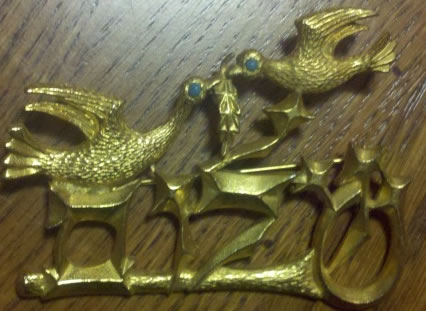
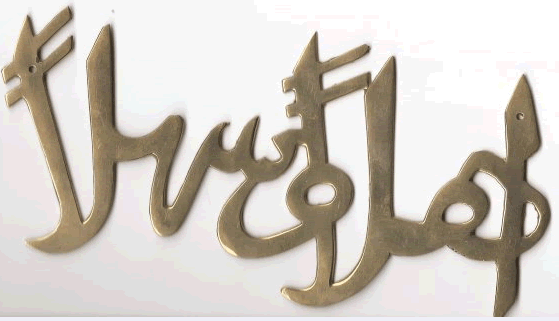
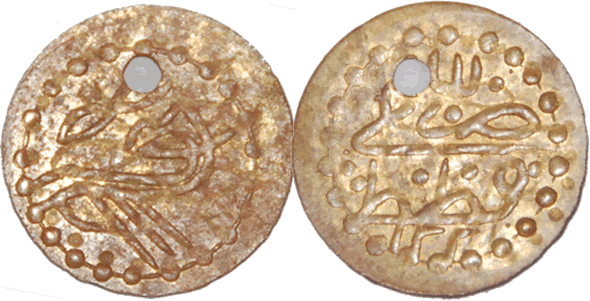
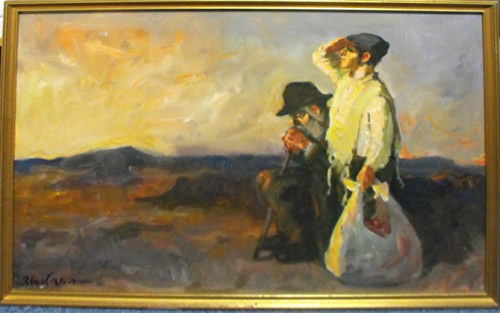
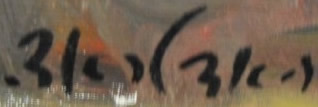
These images was sent in by a visitor to Omniglot who would like to know what they mean.
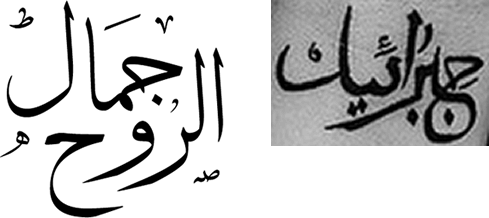
Can you help?
Can anybody identify and/or translate the mysterious inscription below:

There are more details at the Puzzle Museum.
Today we have a guest post by Tim Brookes
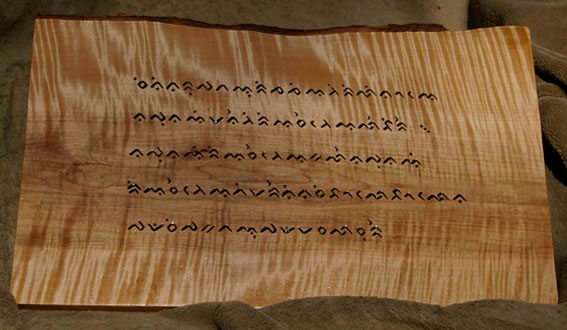
The Endangered Alphabets Alphabets Project is expanding in several directions at once, and at times my head spins.
The original exhibition of 14 carved version of Article One of the UDHR (thanks to Omniglot) is venturing farther and farther afield. It’s currently in the spacious and airy Sachem Library on Long Island, and is about to be the subject of a profile in the New York Times. You can also find a nice piece in The Atlantic.
The Endangered Poem Project is nearing its goal of having my short poem (on the importance of traditional scripts) translated into 20 endangered writing systems. Ten of those are already carved. This part of the project got a huge boost recently while I was visiting Bangladesh, and made contacts that should produce no fewer than three versions in indigenous languages/scripts from the Chittagong Hill Districts: Chakma, Mro, and Marma.
The most ambitious feature of the Alphabets project, though-and the one that has me sweating-is the World Tour fundraiser. When I started this whole enterprise I thought it would be amazing to be able to take the carvings back to their various countries of origin, so as to raise awareness and discussion on the issue of cultural preservation. Needless to say, I can’t afford to do that on my own, so I’m trying to raise funds on Kickstarter.com to do so. I could really, really use some backing on this, especially as the fundraising window closes in three weeks. Anyone who is interested in helping out (and each backer receives a reward for support) should go to Kickstarter.com. Or at least forward the link to anyone who might be interested.
Thanks!
Tim Brookes
A visitor to Omniglot sent in this image of some mysterious writing from an inscription on a Biedermeier glass from 1830-1860, a type of Bohemian / Czechoslovakian glass. Can you make any sense of it?
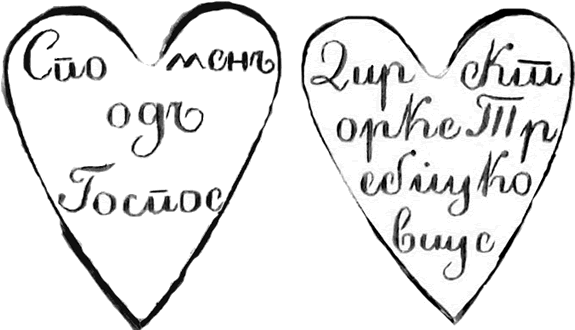
It looks like a cursive form of Cyrillic and reads something like “Сйо мень одь Госйос Дир Кторке Тр?імуко Сиус” or “Sjo menʹ odʹ Gosjos Dir Ktorke Tr?imuko Sius”. I have no idea what this might mean.
A visitor to Omniglot sent in this image of a manuscript and would like to know if anyone can decipher it.
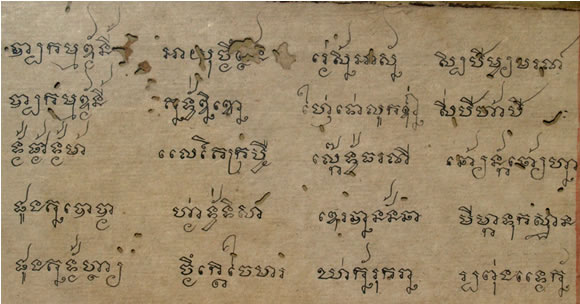
The writing system is Khmer, and the person who sent it in was told that the language might be Pali.
I came across the word ductus today in an interesting article about the origins of the writing. The articles focuses particularly on the development of the Latin/Roman alphabet and traces it’s origins back to ancient Egypt.
Ductus /ˈdʌktəs/ means:
1. the number of strokes that make up a written letter, and the direction, sequence and speed in which they are written
2. a subtle reduction of weight towards the middle of the stroke of the letter
3. (medicine) a duct, tube or canal in the body
Etymology: from Latin, perfect passive participle of dūcō (to lead), from the Proto-Indo-European root *deuk- (to lead), which is also the root of duct, and duke, via the Old French duc and the Latin dux
[Sources: wiktionary and myEtymology.com]
The article uses it in the second sense when talking about how letters shapes have changed and been simplified over time.
The first sense could be used when talking about Chinese Hanzi / Japanese Kanji / Korean Hanja, as the direction and sequence of strokes used to write such characters is fixed and has to be memorised when learning them, and the number of strokes is used to order them in dictionaries and indices.
Incidentally, I’ve just added a page about the Proto-Sinaitic / Proto-Canaanite script , one of the earliest alphabetic scripts, and one of the scripts mentioned in the article.