Language learning lethargy

Cat on dictionaries - an illustration of language learning lethargy

Are there times when you don’t feel like learning languages and can’t summon up much enthusiasm about them? When language learning lethargy strikes, in fact.

For me most of August this year was like that – I did use my languages when I had the chance, and spoke quite a bit of French and Welsh, and odd bits of Italian and Irish. I also listened to plenty of foreign language radio, as I often do. I didn’t go out of my way to find opportunities to practise my languages though, and didn’t study at all for almost the whole month. This is unusual for me.

Sometimes I think to myself, “You already speak five languages more or less fluently, and know quite a few others to varying degrees. Isn’t that enough?”, and my usual answer is “No, I want to learn more!”. Recently however, my motivation to learn more has been low and my answer was “Yes, that’s enough for now.”

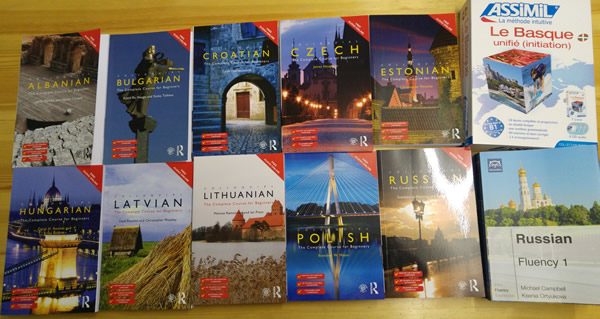
This month I am re-starting my studies with Czech, and am planning to start dabbling with other languages as well. Yesterday my Teach Yourself Swedish course finally arrived – the one I got for free after attending the Polyglot Gathering in Berlin in May. So I will be learning more Swedish before long.

If you come down with language learning lethargy from time to time, how do you deal with it?

Frantastique

Learn French with Frantastique

I’m happy to announce that Omniglot has partnered with Frantastique to help you enhance your language skills and effectively learn French.

Frantastique is a 15 minute daily online training, which is tailored for each user’s level of French.

So how does Frantastique work?

Your daily lesson is sent by e-mail every morning

Every morning, your lesson arrives in your e-mail inbox.

Each lesson contains a selection of exercises, videos, texts, dialogues, conjugation tests, and mini-lessons in French.

Personalized French content
Frantastique’s artificial intelligence engine builds lessons based on your needs, your requests, and your level.

You will discover professional scenarios, a wide variety of accents, and exercises and plenty of humor.

10 to 15 minutes daily is all it takes!

Francophone Culture
Every day, you’ll hear a citation with different accents, film clips, songs and more to help you explore the richness of French culture around the world.

Receive a personalized correction e-mail immediately following your lesson
After clicking the ‘Envoyer’ button, you will receive a correction e-mail with your daily score, explanations of your answers, the scripts of the dialogues or videos, the vocabulary you have requested and more.

Making progress and retaining information
The course automatically adapts to your objectives, needs, and learning speed.

The artificial intelligence engine builds each lesson dynamically to focus on points of difficulty, as well as topics you’ve requested, to ensure you’ve committed what you’ve learned to your long-term memory.

Your French improves effortlessly, daily!

Ominglot is giving away 1 month of Frantastique lessons to all its readers.

Click here to begin your French training.

Here’s a nice whatabout

In the comments on an article I read today in the Guardian – Why North Koreans are developing an appetite for foreign languages – I noticed an interesting turn of phrase:

Here’s a nice Whatabout. I suggest Brits suddenly get keen on learning foreign languages. Start with Arabic and Russian. Oh yes, and brush up on French too….

I hadn’t seen the expression Whatabout before so it caught my attention. Have you come across it before, or do you use it yourself?

The article mentions foreign language learning is compulsory for North Koreans from the age of 4 (they must start school early), and that the most popular languages to learn are Chinese (probably Mandarin) and English. Learning languages give students a better chance of getting into university, which leads to better job prospects, particular in foreign trade, which is increasing, and Chinese is also popular because they want to understand Chinese TV programmes. However relatively few North Koreans are able to go to university and few other people are likely to learn languages are the chances of using them are minimal.

Learn Korean for free!

90 Day Korean

90 Day Korean have an exclusive offer for Omniglot visitors: three free Korean courses.

The 90 Day Korean web course teaches to you how to have a three minute conversation with a native Korean within 90 days. It’s a beginner Korean course that delivers you PDF and mp3 lessons in your inbox every week with only the essential parts of the language, all explained using psychology and stories so you can’t forget them (even if you tried).

Two winners will receive 90 Day Korean web course scholarships for 30 days. One grand prize winner will receive a 90 Day Korean web course scholarship for 90 days.

The first three people to answer the following questions correctly will receive the scholarships.

1. When was the Korean alphabet invented?
2. What is the second largest city in South Korea?
3. How many hanja do people in South Korea have to learn at school?

Please write to me at feedback[at]omniglot[dot]com with your name and the answers. Do not post them in the comments.

Update
We have a winners of all the courses, so this competition is now finished.

Post-vernacular languages

In an article I read today – Sustaining languages: An interview with Peter Austin, I came across an interesting idea – post-vernacular languages.

A vernacular language is one you use in your everyday life, while a post-vernacular language is one you may not want to use in your daily life and as means of communication, but may learn to connect or reconnect with your heritage, culture and heritage, for fun, out of interest, or for other reasons.

An example given in the article is of Jewish people in the USA who use English as their everyday language, but decide to learn some Yiddish as it was the language of their parents or grandparents. Some may just learn a few words and phrases, others may learn more of the language, but few will use it as a vernacular language.

Here is an interesting video which discusses the status of Yiddish as a post-vernacular language:

There is also a book which discuss the phenomenon: Adventures in Yiddishland: Postvernacular Language and Culture by Jeffrey Shandler

My learning and use of languages is mostly post-vernacular – I learn them mainly for fun and out of interest, and while I do sometimes use them to communicate with others, that isn’t necessarily my primary goal. I have used languages in a vernacular way when living in other countries, and I do currently life in Wales, in an area where the majority of people speak Welsh, and I use Welsh quite often, though not necessarily every day.

La plume de ma tante

La plume de ma tante

I wrote a new song last week based on the phrase ‘la plume de ma tante‘ (My aunt’s quill/pen/feather). This phrase cropped up in a conversation I had with friends a few weeks ago when we were talking about learning languages, and how languages are taught.

According to Wikipedia this phrase possibly appeared in French textbooks in the 19th century and early 20th century, and was designed to teach people French vowel sounds. Other phrases used in a similar way include Le petit bébé est un peu malade (the little baby is slightly ill), and Un bon vin blanc (a good white wine). An equivalent phrase, which appeared in the first Assimil English course for French speakers, is My tailor is rich.

While it’s unlikely you would often use such phrases in everyday conversation, they do have their uses: to illustrate aspects of pronunciation, to practise using various grammatical structures, and to learn vocabulary. Moreover they tend to be easier to remember if they are silly and/or bizarre. My song could be used to learn family words, how to say where things are, or are not, and words for furniture, clothes, animals, etc.

Here are the lyrics, a recording and a translation of my song:

La Plume de Ma Tante

Refrain
Où est la plume de ma tante ?
Dis-moi si tu sais où elle est.
Je l’ai vue ce matin je pense,
Mais maintenant elle a disparu.

Ce n’est pas sur la chaise de mon oncle,
Et c’est pas sous la table non plus.
Ce n’est pas dans le piano de mon grand-père,
Et ce n’est pas dans le seau de ma sœur.

Refrain

Ce n’est pas dans le frigo de mon frère
Et ce n’est pas dans sa poche non plus
Ce n’est pas dans le manteau de ma grand-mère,
Et ce n’est pas entre le marteau et l’enclume.

Refrain

Ce n’est pas derrière la dinde
Et ce n’est pas au-dessus du dromadaire
Ce n’est pas dans la piscine de mon papa
Et ce n’est pas dans le nez de ma nièce.

Refrain

My Aunt’s Quill

Chorus
Where is my aunt’s quill?
Tell me if you know where it is.
I saw it this morning, I think,
But now it has disappeared.

It’s not on my uncle’s chair,
And it’s not under the table either.
It’s not in my grandfather’s piano,
And it’s not in my sister’s bucket.

Chorus

It’s not in my brother’s fridge
And it’s not in his pocket either.
It’s not in my grandmother’s coat
And it’s not between the hammer and the anvil.

Chorus

It’s not behind the turkey,
And it’s not over the dromedary.
It’s not in my dad’s swimming pool,
And it’s not in my niece’s nose.

Chorus

The expression entre le marteau et l’enclume, which literally means “between the hammer and the anvil”, is the French equivalent of the English expressions ‘between a rock and a hard place’, and ‘between the devil and the deep blue sea’ – i.e. in a difficult situation.

There is also a musical entitled La Plume de ma Tante written and directed by Robert Dhery, and at least one other song that incorporates this phrase.

Social aspects of language learning

In a paper I read recently – The Contemporary Esperanto Speech Community by Adelina Solis – the idea that female language learners tend to prefer going to language classes, as this gives their studies a social aspect, and that male language learners are more likely to learn on their own, is discussed. This was based on a survey of 13 Esperanto learners – not a large sample, and not necessarily representative of language learners as a whole, but it is an interesting observation.

In my own experience I’ve found that language classes often have more female students than male students, and friends I’ve mentioned this to have said the same.

Do you think there is any substance in this?

Do you know of any studies or surveys on this?

Polyglot Gathering Berlin 2015

I got back from the Polyglot Gathering in Berlin about an hour ago. I took the train all the way from Berlin to Bangor, via Cologne, Brussels, London, Crewe and Chester, leaving Berlin just before 7am this morning, and arriving in Bangor just after 9pm this evening. On the way there I also travelled by train, though I had to stay in Brussels for one night, and continued the next day. It cost slightly more than flying (only about £20 more) and took a bit longer (about 2 hours – more on the way there), but I saw so much more, and went through parts of France and Germany I hadn’t been before, and visited Belgium for the first time. The engineers on German railways started a 5-day strike today, and I was worried that my trains might not be running. Fortunately they did run, and were more or less on time.

The gathering was bigger than last year with about 350 participants from many countries. There were many people there I knew from last year’s gathering, and from the Polyglot Conference in Novi Sad, and I met lots of new people. I had conversations in all the languages I know well, and most of the ones I know less well. There was a Breton speaker there, though I didn’t get to talk to him, as well as speakers of Welsh, Irish, Cornish and Scottish Gaelic. Like last year, there were plenty of Esperanto speakers, and I had quite a few conversations in Esperanto, which I brushed up a bit beforehand. There were a number of people who had studied sign languages there, including BSL, ASL, Dutch Sign Language (Nederlandse Gebarentaal / NGT) and Slovak Sign Language (Slovenský posunkový jazyk / SPJ), and the Slovak signer demonstrated how she interprets songs in SPJ, which was fascinating to watch.

The talks and lectures were really interesting, and I went to quite a few introductions to languages, including Northern Sami, Navajo, Arabic, Hebrew, Milanese, Gottlandic, Finnish, Greek and Basque. I don’t intend to learn any of these languages just yet, but it was fascinating to find out more about them. My own presentation, on the History of Writing, was well received, and I got lots of positive comments.

Some of the polyglots at the Polyglot Gathering in Berlin in May 2015
Some of the polyglots at the Polyglot Gathering – from right to left: Richard Simcott, Alex Rawlings, Christopher Huff, Jimmy Melo, and me – between us we speak at least 20 or 30 languages, to varying degrees.

The evening activities included a polyglot games evening, an international culinary festival – I took some Welsh cakes and bara brith, which were popular – a book fair, a polyglot game show, a concert with the multilingual French singer JoMo, who sang in 25 different languages, and an international cultural evening, at which I sang a Scottish Gaelic waulking song (Ceud soiridh soiridh bhuam) and one of my own songs – A Hen in My Hat (in 5 languages). After the cultural evening there was a little Irish and Scottish music session – I had a couple of tin whistles with me, and a few other people had instruments.

So now I’m back in Bangor and will start to catch up with the work I couldn’t do while away due to time constraints and internet connection issues.

Five methods for improving your language level towards Mastery

This is a guest post by Benny Lewis, of Fluent in 3 Months. He’s launching a series of beginner guides for Chinese, French, Spanish, German, English and Italian this week, but in today’s post he wanted to write some tips here for those of you working on your more advanced skills!

If you’ve been studying a foreign language for a while, you’ve likely considered testing yourself to determine just how “good” you actually are. Many turn to the CEFR (Common European Framework of Reference for Languages), which provides a reliable standardized system to test and understand language levels.

While I’m usually known for my 3 month language “missions” to go from an absolute beginner to a B1/B2 level, this post is for the steps beyond those early stages. (If you are a beginner language learner then be sure to check out these brand new guides I have just created about getting started in particular languages.)

Drawing from my own experiences sitting the C2 level exams in both Spanish and German, I will share with you 5 methods for building your language level from CEFR’s B2 (“upper intermediate”) to C2 (“mastery”). But even if you aren’t preparing for a specific exam, these techniques will help you level up your language skills, regardless of your end goals.

Taking a Test vs. Developing Communication Skills
Studying for a test and for communication are not the same thing. With a test, your study needs to account for the specific format of the test, whereas day-to-day communication doesn’t require you to perform the same type of tasks. Your methods need to match your end goals with the language and, more importantly, the way you study for a test may not actually improve your ability to communicate in the language.

That probably sounds counterintuitive. After all, shouldn’t studying for a language test improve your communication ability? Essentially, tests have such specific requirements that you may need to step away from focusing on improving your conversation fluency, in favor of alternative methods.

Understanding the C2 Level and Parts of the Exam
The main difference between the B2 and C2 levels is being able to identify subtle differences and distinctions in how ideas are expressed. At C2 level, you’re understanding fine shades of meaning, so that you can express and understand a topic in a variety of ways.

CEFR level exams are broken up in to five parts: oral, writing, grammar, reading and listening, and we’re going to discuss specific methods to help you develop the skills you need for each part of the test.

1. Study Less to Improve Your Oral Skills
The oral part of the exam is where your ability to comfortably flow with the language comes in to play, and it’s difficult to develop a high level of oral skill if you’re always stuck inside a book.

Instead of focusing all of your energy on grammar rules and vocabulary flash cards, get out and meet with native speakers for at least an hour a day, speaking only in the target language. Can’t meet in person? Then find online conversations partners to meet with over Skype.

While I advise this for people who want to reach B1/B2 level too, what needs to change is what you talk about if you are aiming for Mastery. In my C-level conversations, I steer our chats to more advanced topics, like philosophy, politics, and have even had (friendly) debates with my teachers. In some sessions, I may watch a news report and have to give my opinion on it.

Forcing yourself outside of your comfort zone will open up new conversation topics to you. This comes with practice rather than studying. After your spoken session, take all the new words you learned or all the things you wish you could have said and revise that, but the bulk of your oral improvement needs to come from practice.

2. Write About Specific Topics, Over and Over Again
If you can speak confidently and correctly, then transferring that skill to writing is generally pretty easy. The main difference is to remove casual empty-softeners (“like”, “y’know”, “isn’t it?”) and conversational connectors which makes speech seem more natural, but doesn’t work in the written form.

One method I recommend is to practice writing about the themes that are common for the exam and then have them reviewed by a native speaker. Then, try to write (without referring to the original) on the same topic again, using different ways of expressing yourself. You can get free feedback on short texts on lang-8, but I recommend having someone familiar with the exam structure to correct much longer texts and offer more feedback than simple corrections, such as how you could develop your ideas more.

Since one of the main differences between B2 and C2 is your ability to understand subtle distinctions in ways of expression, it’s helpful to practice this skill by writing on similar topics in multiple ways. Be sure to have a native speaker review your different texts and explain how the feeling and nuanced meaning of one is different than the other.

3. Don’t Just Study Grammar, Use It!
To build your skills for the grammar test you will need to take a two-pronged approach.

First, study and learn to recognise grammatical patterns. CEFR examinations require an understanding of technical aspects of the language so you will need to study for the specific exam format. Look at past papers from the exam, and come up with as many possible iterations of of the answers as you can.

Second, enhance your study of technical grammar with regular practise of the rules you are learning. Schedule time with a native to review the grammar patterns you have studied and use them in actual communication.

This practical application of the material will help you build a deeper understanding, because the more you practice the rules, the more familiar they will become.

4. Build a Deep Understanding of Specific Vocabulary
The reading section in a C2 exam requires you to rephrase answers, extrapolate slightly, search through text for certain information and be able to produce vocabulary – not just recognise it. This is not the same as generally summarising a chapter of a book, for example.

To prepare, practice answering questions on texts for sample exams. Don’t just “read a lot”. Then run those answers through a native, and take note of key vocabulary that comes up again and again.

This may sound odd, but in my experience, reading more won’t necessarily improve your reading score on an exam. The focus in these exams is on an active and deep understanding of the language. When you see questions about a text you’re reading, you’ll need to demonstrate that you have a precise understanding of the words on the page, and this is much more about being familiar with specific vocabulary.

5. Create a Focused Environment for Listening and Taking Notes
Given the format for CEFR exams, passive listening will have little effect on improving your score. It is great for giving you a “feel” for the language and to get used to the sounds, but it doesn’t help you with the skills you need to develop at this level — focused listening and taking notes.

There are two things you can do to improve these skills. First, when you are listening to audio in the target language, use 100% of your focus on what you are hearing (not doing anything else at the same time). Try to hear and understand as many details as possible from the audio.

Second, practice taking notes. Start by listening to a 30 second segment of audio and write down as much as you can about what you’ve heard. The goal isn’t to write the text verbatim, but to make sure you can share specific details about the information. You can increase the challenge by extending the time by 15 second increments until you are comfortable taking notes for a 3 to 5 minute audio recording.

Make a Plan That Works For You
When you’re preparing for your next exam (or working to “level up” with your language), make a plan for your study. Don’t just leave it to chance or try to pick up things passively.

Although I’ve provided some methods here, you should still make sure that your study is always geared towards your specific ways of learning. Your “best” method for learning a language is going to be different than mine or someone else’s, so look at study methods more like a scientist experimenting with different theories. Test them out, see how they work for you, and then keep those that have the best results.

Studying for an exam is different than studying for daily use of a language. Plan your study to accommodate the specific requirements of the exam and focus on those methods that will provide your best results.

Living Languages – a special report on language learning

Living Languages - a special report on language learning

I came across an article about language learning in the Guardian today which discusses the findings of a report on language learning [PDF] based on a two-year study carried out by the Guardian and the British Academy.

The report makes interesting reading, and looks at many aspects of language learning, such as language education, young people’s attitudes to language learning, language and social change, as well as many personal stories about how people learn and use languages.