Noel, genes and genius

When singing the Christmas carol The First Noel the other day I started wondering where the word noel comes from. I knew noël was French for Christmas, but wasn’t sure where that came from.

According to the Online Etymology Dictionary, noel comes from the Latin natalis (birth) via the Old French noel (the Christmas season), and the Middle English nowel.

Quite a few other words for Christmas probably come from the same root – Natale (Italian), Navidad (Spanish), Natal (Portuguese), Nadal (Catalan/Galician/Occitan/Romansh), Nadolig (Welsh), Nedeleg (Breton), Nadelik (Cornish), Nollaig (Irish/Scottish Gaelic), and Nollick (Manx).

natalis comes from natus, the past participle of nasci (to be born), which comes from the Old Latin gnasci (to be born), which is cognate with the Latin genus (race, stock, kind), and the Greek γένος [genos] (race, kind) and γόνος [gonos] (birth, offspring, stock), the reconstructed Proto-Indo-European root of which is *gen-/*gon-/*gn- (to produce, beget, be born).

Other words derived from that PIE root include genius, gene, king and kin in English, gentis (Lithuanian – kinsman), Kind (German – child), geni (Welsh – to be born), and I’m sure there are plenty of others.

The land of rabbits

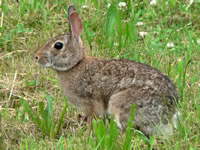
Photo of a rabbit

When adding more animals to the Celtic Connections section on Omniglot the other day, I started wondering about the origins of the Celtic words for rabbit – connín (Irish), coinean (Scottish Gaelic), conning (Manx), cwningen (Welsh), conyn (Cornwell), c’honikl (Breton). They appear to be related to each other, and also to the English word coney, which was used for rabbit until the 18th century, while rabbit was used for the young of the coney from about the 14th century.

Rabbit apparently comes from the Walloon robète, which is a diminutive of the Flemish or Middle Dutch robbe.

Coney comes from the Anglo-Norman conis, the plural of conil “long-eared rabbit” (Lepus cunicula) from the Latin cuniculus, which means burrow and comes from the Greek κύνικλος (kýniklos), which is thought to come from an Iberian word for burrow. Related words in other languages include kanin (Danish), konijn (Dutch), bunny (English), Kaninchen (German), coniglio (Italian).

There’s a popular theory that the Roman name for Spain, Hispania, which became España and Spain, comes from the Phoenician name for Iberia i-shepan-im, the land or coast of rabbits. When the Phoenicians first visited Iberia in around 500 BC they saw lots of rabbits there which they named after a similar animal, the hyrax of North Africa.

Peeling the library

Today’s word, library, comes from the Old French librairie, a ‘collection of books’, which is a nominal use of adjective librarius, ‘concerning books’, from Latin librarium, ‘chest for books’, from liber (genetive of libri), ‘book, paper, parchment’, originally the ‘inner bark of trees’, probably a derivative of Proto-Indo-European (PIE) base *leub(h) – ‘to strip, to peel’.

In French the word librarie means bookshop. A French library is a bibliothèque, which comes via the Latin bibliothēca, from the Greek βιβλιοθήκη (bibliothêkê), ‘a place to store books’, which breaks down into βίβλος (biblos), ‘book’, and θήκη (thêkê), ‘chest’.

Variations on the theme of bibliothèque are used in a number of other languages, including:

Dutch – bibliotheek
German – Bibliothek
Greek βιβλιοθήκη (bibliothiki)
Italian/Portuguese/Spanish – biblioteca
Russian – библиотека (biblioteka)

In Welsh, a library is a llyfrgell, from llyfr, ‘book’ and cell, ‘cell’, while in Irish it’s leabharlann, from leabhar, ‘book’ and lann (not sure of it’s meaning*). In Chinese, a library is 圖書館 [图书馆] (túshūguăn) = ‘map book house’.

It seems that the word library, or something like it, is not used in it’s English senses in many languages. The only ones I can find are Sesotho and Tswana (laeborari), Tsonga (layiburari) and Venda (laiburari), which appear to be loanwords from English. The Basque word for library, liburutegia, might possibly have Latin or Greek roots.

[Addendum] *lann in Irish is an archaic/obsolete word that means floor, enclosure or church. It comes from the Old Irish lann (building, house, land, plot, plate), from the Proto-Celtic *landā ((open) space, land), from the Proto-Indo-European *lendʰ- (land, heath). It is cognate with the Welsh word llan (church, parish, monastery, yard, enclosure, village), the Spanish landa (plain), and the English words land and lawn [source].

Sources: Online Etymology Dictionary, Wiktionnaire, Yawiktionary

Language and time travel

A recent commenter on my post about learning Latin, Ancient Greek and other ancient/dead languages has suggested an interesting reason for learning such languages – it’s the closest thing we have to time travel. A knowledge of these languages enables you to explore ancient civilisations and gain insights into the thoughts and lives of people who lived thousands of years ago.

If you want to learn an ancient/dead language, do you think it’s better to learn its modern descendants first, or to jump straight in with the ancient language?

I suspect it’s probably easier to learn the modern languages first.

Word of the day – Brekekekex (Βρεκεκέξ)

I came across the word brekekekex in a book I’ve just finished reading – A Time of Gifts, the first part of Patrick Leigh Fermor’s fascinating account of his epic journey on foot from the Hook of Holland to Constantinople (Istanbul), which he made in the early 1930s. He has a good ear for languages and acquired quite a good knowledge of German, plus bits and pieces of Hungarian, Greek and a number of other languages.

He mentions at one point that there were many frogs brekekekexing in the woods. I thought he’d made the word up, but it seems Atrisophanes got there first. The word comes from the chorus of Atrisophanes’ comedy, Βάτραχοι (Bátrachoi) – The Frogs, which was first presented at the Lenaea in 405 BC:

Brekekekex koax koax
Brekekekex koax koax.
Children of the marsh and lake
harmonious song now sweetly make,
our own enchanting melodies
koax koax
The songs we sang for Nysa’s lord,
for Dionysus, son of Zeus,
in Limnai at the Feast of Jars
as people in their drunken glee
thronged into our sanctuary.
Brekekekex koax koax.

The words brekekekex koax koax are intended to imitate the croaking of the frogs. You can see the original Greek version of the play here. In the above translation an extra syllable seems to have been added to Brekekekex – it’s Βρεκεκέξ (Brekekex) in the original.

Does anyone know if this word is still used in Modern Greek?