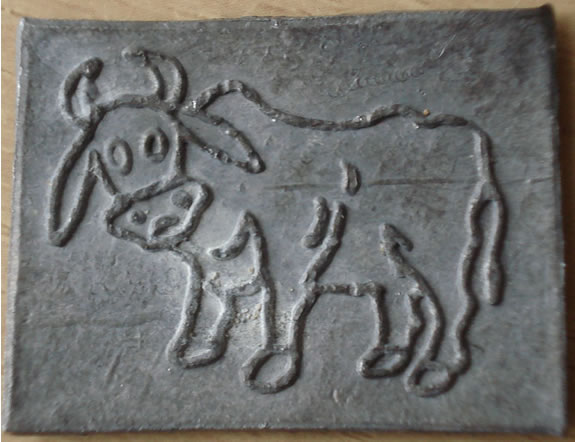
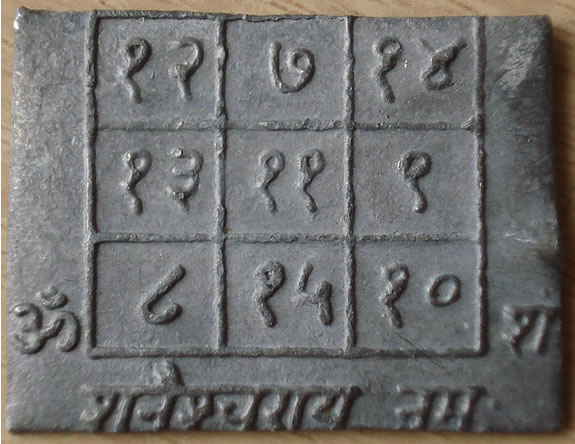
A visitor to Omniglot sent me the following photos today asking if anybody can decipher the writing on it, knows the significance of the numbers, or can provide any other details about this metal plate.
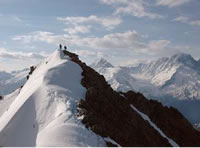
I came across the word highpointing the other day in a list of a blogger’s hobbies. It’s not a word I’m familiar with so I looked it up.
According to Wikipedia highpointing is “is the sport of visiting (and finding) the point with the highest elevation within some area (the “highpoint”), for example the highest points in each county within a state. It can be considered a form of peak bagging.”
Peak bagging (a.k.a. hill bagging, mountain bagging, Munro bagging, or just bagging) involves climbing a collection of mountains or hills – often those above a certain height or with a particular feature. Munro bagging, for example, involves climbing as many Scottish hills over 3000 ft (914.4m) as possible. Such peaks are known as Munros and named after Sir Hugh Munro (1856–1919), who was the first to catalogue them.
Another example of peak bagging is the Three Peaks Challenge, which involves climbing the three highest peaks in England (Scafell Pike), Wales (Snowdon / Yr Wyddfa) and Scotland (Ben Nevis / Beinn Nibheis) within 24 hours.
Are you a highpointer or peak bagger? Is this sport practised in your country? If so, what’s it called?
Here’s a recording in a mystery language.
Do you know or can you guess which language it’s in and where it’s spoken?
The word ectomorph is used to describe one of the characters in a novel I read last week. It’s not a word I’ve come across before so it caught my attention.
According to The Free Dictionary, an ectomorph is “an individual having a lean, slightly muscular body build in which tissues derived from the embryonic ectoderm predominate.”
The Encyclopedia Britannica defines the word ectomorph as “a human physical type (somatotype) tending toward linearity, as determined by the physique classification system developed by the American psychologist W.H. Sheldon.”
The Compact Oxford English Dictionary defines an ectomorph as “a person with a lean and delicate build of body”, and related words include endomorph, “a person with a soft round build of body and a high proportion of fat tissue”, and mesomorph, “a person with a compact and muscular body”.
According to these definitions, I think I am an ectomorph. What about you?
Hie mee snaue jiu er yn chied cheayrt rish bleeantyn. Va mee smooinaghtyn by chair dou smoo lheiltys y yannoo er y gherrid, as jiu ren mee red ennagh fo.
Mi es i nofio heddiw am y tro cyntaf ers blynyddoedd. Ro’n i’n meddwl am neud mwy o ymarfer corff yn ddiweddar, ac heddiw mi nes i rywbeth amdano o’r diwedd.
Moves are afoot to rename the language of Moldova Romanian rather than Moldovan, according to this report.
The Moldovan Prime Minister believes that the “Moldovan people speak in Romanian like Americans speak in English. The national language can be renamed in the future from Moldovan to Romanian”.
While the main language they speak in Moldova is not exactly the same as the Romanian of Romania, it can be considered a dialect of Romanian, according to the government in Bucharest.
Arguments over whether Moldovans speak Moldovan or Romanian have been bubbling away at least since the country became independent in 1991. When independence was declared the official language was named as Romanian, but the 1994 constitution named Moldovan as the the national language of Moldova. In 1996 a proposal by the Moldovan President to refer to the Moldovan national language as Romanian was dismissed by the parliament, and the 2004 census found that 60% of Moldovans thought of their language as Moldovan, while only 16% thought of it as Romanian.
Before 1989 Moldovan / Romanian in Moldova was written with the Cyrillic alphabet. Since then it has been written with the Latin alphabet, except in the Transdniestrian region, where the population is mainly Russian and Ukrainian they still use Cyrillic.
Moldova was part of Romania before it was taken over by the Soviet Union after the Second World War, and recently has began seeking closely ties with Romania.
Jea cheau mee y laa goaill arrane Y Messiah as noa ‘syn ollooscoill lesh ram studeyryn as sleih elley voish Bangor. Ren shin cliaghtaghey feie’n laa, as ghow shin arrane lesh kiaullane beg ayns co-unnaneys ‘syn astyr. Shen yn chied cheayrt y ghow mee arrane Y Messiah, as v’eh y skeeal cheddin da’n chooid smoo jeh’n sleih ayns shen. Hie y co-unnaneys dy mie, agh dy meeaighar va smoo sleih ‘syn sheshaght chiaullee as kiaullane ny ‘syn lught eaishtagh. Va taitnys vooar aym jeh’n laa agh v’eh tooilleilagh.
Ddoe mi dreulies i y dydd yn canu Y Messiah o’r dechrau yn y prifysgol efo llawer o fyfyrwyr a phobl eraill o Vangor. Mi ymarferon ni yn ystod y dydd, ac mi ganon ni efo cerddorfa fach mewn cyngerdd gyda’r nos. Dyna y tro cyntaf ydw i wedi canu Y Messiah, ac roedd hi’n yr un stori ar gyfer mwyafrif y pobl yna. Roedd y gyngerdd yn wych, ach yn anffodus roedd mwy o bobl yn y corws a’r gerddorfa nac yn y gynulleidfa. Mi fwynheues i y dydd yn fawr ond roedd hi’n flinedig.
Here’s a recording in a mystery language.
Do you know or can you guess which language it’s in and where it’s spoken?
A translation agency has contacted me asking for help finding someone who can translate from English to Fijian.
If you can do this, or know someone who can, please contact Stephen at stealthtranslations@googlemail.com as soon as possible.
Thank you / Vinaka
Hie mee stiagh ayns possan coloayrtys Frangish riyr. Cheayll mee mysh ‘sy Jerrey Geuree, as riyr hoshee mee goll huggey fy yerrey. Daittin lhiam dy oddym loayrt Frangish foast, er yn oyr cha loayrt mee ram jeh rish yn feed bleeaney shoh chaie. Tra va mee loayrt Frangish va focklyn Bretnish dy kinjagh geabbey tar magh ass my veeal er yn oyr dy vel Bretnish my hengey joarree stroshey ec y traa t’ayn. Loayrmayd er shoh as er shid, by vooar yn spoyrt eh, as v’eh braew çheet ry-cheilley lesh sleih noa.
Va ram sleih noa ‘syn sheshaght chiaullee co-hellooderys yn çhiaghtyn shoh myrgeddin, as ta ain stiureyder shirrey boayl elley smoo dy yannoo cliaghtey.
Mi ymunes i rŵp sgwrsio Ffrangeg neithiwr. Mi glywes i amdano ym Mis Ionawr, a neithiwr mi es i iddo o’r diwedd. Ro’n i’n falch mod i dal i siarad Ffrangeg yn eithaf rhugl, achos dw i ddim wedi siarad mwy ohoni yn ystod yr ugain mlynedd diwethaf. Pan o’n i’n siarad Ffrangeg roedd geiriau Cymraeg yn wastad eisiau dod allan o fy nheg achos Cymraeg ydy fy iaith estron cryfaf ar hyn o bryd. Mi siaradon ni am bethau amrywiol, mi fwynheues i fy hunan yn fawr, ac roedd hi’n hyfryd cwrdd â phobl newydd.
Roedd lawer o bobl newydd yn y côr cymuned yr wythnos hon hefyd, ac mae ein arweinydd yn chwilio am le arall mwy i ymarfer.