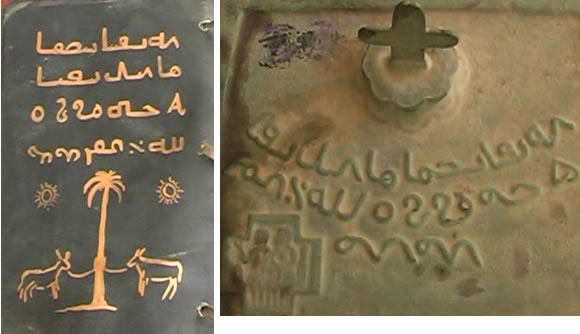
Can anybody identify the script in these pictures and decipher it?
There images were sent in by a visitor to Omniglot. I think I might be Syriac.
11 thoughts on “Puzzle”
Definitely Arabic. I don’t know the cursive Arabic script, but e.g., the first word in the bottom line in the left picture is lam-lam-ha, meaning “to Allah”. Right before that is the digit 5.
I’m not sure that’s a 5. The two inscriptions say the same thing, with the exception of the word (or numeral?) following lillahi (lam-lam-ha) and if you look at the one on the right, that 5-like character is joined to the previous one.
It has a strong syriac element to it rather than Arabic.
The word that looks like “lillah” لله can simply be “gimel-het” or “gimel-waw (vav)”.
The letter that looks like “H'” ح, is pronounced ” ‘ayin” in Syriac (similar to Arabic ع).
The cross on the image on the right also connects it more to Syriac and probably it’s not exactly syriac but rather Nabatean or a sub-group.
Looks more like some variant style of Arabic, rather than Syriac. The word after the % sign following the Allah ‘لله’ (sans alif) , feels like عمر to me.
Shanth, I wouldn’t say it’s دعا because Dal isn’t joined on the left, unlike the first letter in that word. And the second letter there is either Qaf or Fa.
Also, dots were added to Arabic letters during the early spread of Islam, so this inscription was made before that.
This inscription is not Arabic. I’m an Arab and I can tell this is not Arabic.
It is a related script. Judging from the curves of the letter, it is Syriac or one of its relatives like Nabatean.
The word in the middle is not دعا since, as Lev said, Dal is not supposed to join from the left. It is first part of a word (and probably the word starts with N-F-).
The word in the middle at the bottom line is not عمر [`Umar], but it is more like the Syriac (T-Q-N). The letters N, M and K, change shapes when they come at the end of the word and this shape here can be “N”, but also it can be “Z” if you checked the various versions for Syriac (or Assyrian) on Omniglot.
However, the script is definitely not Arabic.
Definitely Arabic. I don’t know the cursive Arabic script, but e.g., the first word in the bottom line in the left picture is lam-lam-ha, meaning “to Allah”. Right before that is the digit 5.
I’m not sure that’s a 5. The two inscriptions say the same thing, with the exception of the word (or numeral?) following lillahi (lam-lam-ha) and if you look at the one on the right, that 5-like character is joined to the previous one.
It does look a bit like Syriac, but it isn’t.
It has a strong syriac element to it rather than Arabic.
The word that looks like “lillah” لله can simply be “gimel-het” or “gimel-waw (vav)”.
The letter that looks like “H'” ح, is pronounced ” ‘ayin” in Syriac (similar to Arabic ع).
The cross on the image on the right also connects it more to Syriac and probably it’s not exactly syriac but rather Nabatean or a sub-group.
I was just checking the list of Semitic languages, and I’m wondering now – How come Redjang is enlisted as a Semitic language?
TJ – I’m not sure how Redjang sneaked in among the Semitic languages – I’ll remove it.
you know what’s interesting?
Why there are two suns in the picture on left?
Looks more like some variant style of Arabic, rather than Syriac. The word after the % sign following the Allah ‘لله’ (sans alif) , feels like عمر to me.
Also ‘دعا’ (meaning prayer) occurs twice (middle word on the first line, and last word on second line, in the image on the left).
Shanth, I wouldn’t say it’s دعا because Dal isn’t joined on the left, unlike the first letter in that word. And the second letter there is either Qaf or Fa.
Also, dots were added to Arabic letters during the early spread of Islam, so this inscription was made before that.
This inscription is not Arabic. I’m an Arab and I can tell this is not Arabic.
It is a related script. Judging from the curves of the letter, it is Syriac or one of its relatives like Nabatean.
The word in the middle is not دعا since, as Lev said, Dal is not supposed to join from the left. It is first part of a word (and probably the word starts with N-F-).
The word in the middle at the bottom line is not عمر [`Umar], but it is more like the Syriac (T-Q-N). The letters N, M and K, change shapes when they come at the end of the word and this shape here can be “N”, but also it can be “Z” if you checked the various versions for Syriac (or Assyrian) on Omniglot.
However, the script is definitely not Arabic.