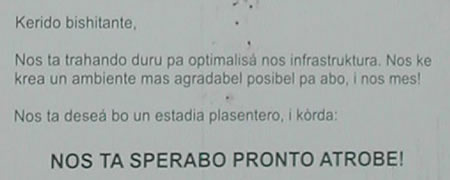
Here’s a photo of a sign in a mystery language sent in by Lara, who took it while on holiday. Do you know or can you guess which language it is?
16 thoughts on “Language quiz”
Is it Papiamento, a creole language of Aruba?
I’m going to guess Guinea-Bissau Creole.
I’m sure it’s Papiamentu
Whatever it is, I can understand it.
It must be a Portuguese or Spanish creole, because I can understand almost all of it.
It it written:
“Dear visitor,
We are working hard to make our infrastructure better (lit. “optimize our infrastructure”). We want to create a place (lit. “environment”) as nice (lit. “agréable”) as possible for you, in two months. (I’m not sure about “two”, but it seems to be that)
We wish you to have a pleasant stay, and we “kórda” (“we remember you”?):
We are wating you “right again” (something like it).
By the way, Google tell us that “atrobe” is Papiamento. Thus…
hmm is there a chance for Basque?
It is a Portuguese creole for sure. I’ll say Cape Verdian Creole.
” and the Oscar goes to’ Colm, Jerry and José, of course is Papiamento, spoken in Aruba, one of the three Netherlands Antilles island in Caribbean Sea. José made a very good translation.
(as always without reading comments)
It´s very close to Portuguese, but not standard. Gallago, but I don´t think so (I once read a gallegan poem in a spanish novel with the help of a brazilian friend).
the spelling is very interesting (k for the [k] sound is like text messaging in spanish.
It means roughly
Dear visitor,
we are working hard to improve our infrastructure, we want to make the best possible environment for you, [i nos mes… something about months… must be the period of time: in 9 months?] We wish you a pleasant stay, and remember,
we are looking forward to see you again soon (that´s a bit of a guess, no idea what atrobe is)
J
TJ: Basque is not an Indo-European language, but an isolate. It is not related to Romance languages even though it is spoken near them and has Romance based orthography.
BG: Yep I know 🙂 although when you read some words in Basque it has some sense of spanish …… I mean in sense of sounds or so!
But anyway I see everyone agrees that this language is spoken in some island ……. but the argument goes to which island is it! 🙂
Could “i nos mes” maybe mean something like, “and us as well”?
“We want to make the best possible environment for you, and us as well!”
Mike, ‘i nos mes’ has an ellipted word, ‘pa’ (for). The sentence would be ‘pa abo, i pa nos mes’. So, in English, we should say: ‘to you, and for us as well’.
Sorry: ‘for you, and for us as well’.
The answer is Papiamentu, which is also spelled Papimento, a Creole spoken mainly on the Caribeann islands of Curaçao, Bonaire, and Aruba. It’s a mixture of Spanish, Portuguese, Dutch, English, French, and also has some Arawak and African influences.
Lara took the photo in Curaçao, part of the Netherlands Antilles. The sign is from a UNESCO funded restoration of the capital Willemstad.
yes it was the ellipsis that got me:
i pa nos mes’. ´y para nosotros “más”´
oh, and (oops) I was not the first to translate, but zt least we basically agree
Is it Papiamento, a creole language of Aruba?
I’m going to guess Guinea-Bissau Creole.
I’m sure it’s Papiamentu
Whatever it is, I can understand it.
It must be a Portuguese or Spanish creole, because I can understand almost all of it.
It it written:
“Dear visitor,
We are working hard to make our infrastructure better (lit. “optimize our infrastructure”). We want to create a place (lit. “environment”) as nice (lit. “agréable”) as possible for you, in two months. (I’m not sure about “two”, but it seems to be that)
We wish you to have a pleasant stay, and we “kórda” (“we remember you”?):
We are wating you “right again” (something like it).
By the way, Google tell us that “atrobe” is Papiamento. Thus…
hmm is there a chance for Basque?
It is a Portuguese creole for sure. I’ll say Cape Verdian Creole.
” and the Oscar goes to’ Colm, Jerry and José, of course is Papiamento, spoken in Aruba, one of the three Netherlands Antilles island in Caribbean Sea. José made a very good translation.
(as always without reading comments)
It´s very close to Portuguese, but not standard. Gallago, but I don´t think so (I once read a gallegan poem in a spanish novel with the help of a brazilian friend).
the spelling is very interesting (k for the [k] sound is like text messaging in spanish.
It means roughly
Dear visitor,
we are working hard to improve our infrastructure, we want to make the best possible environment for you, [i nos mes… something about months… must be the period of time: in 9 months?] We wish you a pleasant stay, and remember,
we are looking forward to see you again soon (that´s a bit of a guess, no idea what atrobe is)
J
TJ: Basque is not an Indo-European language, but an isolate. It is not related to Romance languages even though it is spoken near them and has Romance based orthography.
BG: Yep I know 🙂 although when you read some words in Basque it has some sense of spanish …… I mean in sense of sounds or so!
But anyway I see everyone agrees that this language is spoken in some island ……. but the argument goes to which island is it! 🙂
Could “i nos mes” maybe mean something like, “and us as well”?
“We want to make the best possible environment for you, and us as well!”
Mike, ‘i nos mes’ has an ellipted word, ‘pa’ (for). The sentence would be ‘pa abo, i pa nos mes’. So, in English, we should say: ‘to you, and for us as well’.
Sorry: ‘for you, and for us as well’.
The answer is Papiamentu, which is also spelled Papimento, a Creole spoken mainly on the Caribeann islands of Curaçao, Bonaire, and Aruba. It’s a mixture of Spanish, Portuguese, Dutch, English, French, and also has some Arawak and African influences.
Lara took the photo in Curaçao, part of the Netherlands Antilles. The sign is from a UNESCO funded restoration of the capital Willemstad.
yes it was the ellipsis that got me:
i pa nos mes’. ´y para nosotros “más”´
oh, and (oops) I was not the first to translate, but zt least we basically agree