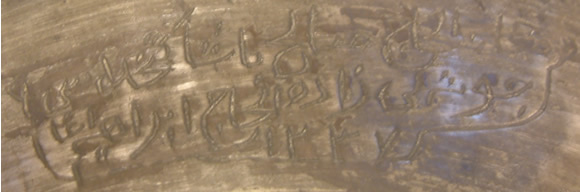
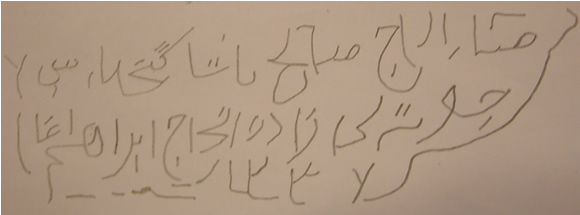
This inscription was sent in by a visitor to Omniglot and appears on a copper plate he bought in Turkey.
Can any of you decipher the text?
7 thoughts on “Copper plate mystery”
That seems a lot like Urdu –
The second word would be “ilaj” or “cure)
The first word on the second line seems to be “jo” (who/which),
– I’ve only had a semester of Urdu (but am fluent in Hindi) so the rest seems difficult but it defintely seems like it’s written in an earlier form of Nastaliq.
Well its hardly legible, but anyway I can tell the language is not Arabic here. I see names. Mainly 2 names.
Al-Haj Saleh (Al-Haj is a title given to people who performed pilgrimage, specially elders). The other name is Al-Haj Ibrahim Agha.
The language can be Farsi, Urdu I suppose.
ah sorry just noticed now that you mentioned it is from Turkey.
Yes, makes sense now a bit. The language is Ottoman Turkish I guess. And the two names would be: Al-Haj Saleh Pasha, and Al-Haj Ibrahim Agha.
Pasha and Agha are typical nobility rank titles in the Ottoman times.
But it’s extremely hard to read.
Yup, pretty sure that’s Ottoman Turkish. I’m not that fluent in it and it is quite hard to read, though. Sorry.
by the way i think the lowest most part of the plate is a date … i think it is 1237 … of course A.H.
New word recognized: second line in the middle, the word “Zadeh” (or Zade I think in modern Turkish) meaning “son” or “son of”.
It’s Ottoman Turkish indeed. I asked an Iranian Azeri friend who is familiar both with Perso-Arabic script and Turkish language. He could read it easily. Here is what he answered:
Arabic script:
مغازه الحاج صالح پاشا کتخداسی
جوته لی زاده الحاج ابراهیم آغا
1237
Modern Turkish script:
Mağaze El-hâc Salih Paşa Kethüdası
Cüteli-zade El-hâc İbrahim Ağa
1237 should be lunar Hijri year. 1431 now. So the thing ages only 6 lunar Hijri years and 7 solar years less than two centuries.
The meaning is not much but a name.
“The shop of El-hâc Salih Paşa Kethüdası
Cüteli-zade El-hâc İbrahim Ağa”
That seems a lot like Urdu –
The second word would be “ilaj” or “cure)
The first word on the second line seems to be “jo” (who/which),
– I’ve only had a semester of Urdu (but am fluent in Hindi) so the rest seems difficult but it defintely seems like it’s written in an earlier form of Nastaliq.
Well its hardly legible, but anyway I can tell the language is not Arabic here. I see names. Mainly 2 names.
Al-Haj Saleh (Al-Haj is a title given to people who performed pilgrimage, specially elders). The other name is Al-Haj Ibrahim Agha.
The language can be Farsi, Urdu I suppose.
ah sorry just noticed now that you mentioned it is from Turkey.
Yes, makes sense now a bit. The language is Ottoman Turkish I guess. And the two names would be: Al-Haj Saleh Pasha, and Al-Haj Ibrahim Agha.
Pasha and Agha are typical nobility rank titles in the Ottoman times.
But it’s extremely hard to read.
Yup, pretty sure that’s Ottoman Turkish. I’m not that fluent in it and it is quite hard to read, though. Sorry.
by the way i think the lowest most part of the plate is a date … i think it is 1237 … of course A.H.
New word recognized: second line in the middle, the word “Zadeh” (or Zade I think in modern Turkish) meaning “son” or “son of”.
It’s Ottoman Turkish indeed. I asked an Iranian Azeri friend who is familiar both with Perso-Arabic script and Turkish language. He could read it easily. Here is what he answered:
Arabic script:
مغازه الحاج صالح پاشا کتخداسی
جوته لی زاده الحاج ابراهیم آغا
1237
Modern Turkish script:
Mağaze El-hâc Salih Paşa Kethüdası
Cüteli-zade El-hâc İbrahim Ağa
1237 should be lunar Hijri year. 1431 now. So the thing ages only 6 lunar Hijri years and 7 solar years less than two centuries.
The meaning is not much but a name.
“The shop of El-hâc Salih Paşa Kethüdası
Cüteli-zade El-hâc İbrahim Ağa”