A visitor to Omniglot who would like to know what the Latin and Greek bits on this postcard mean, and whether anybody has any ideas about the identity of the writer.
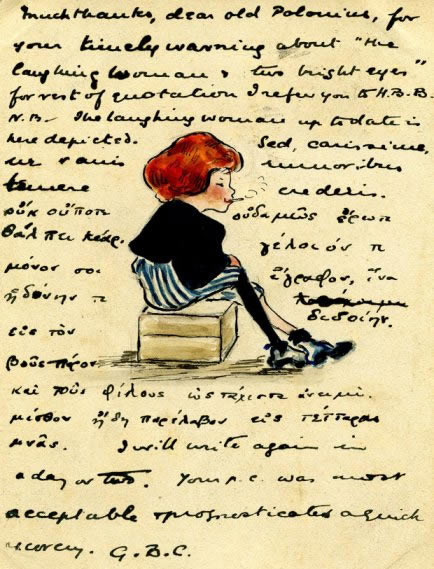
The postcard that was sent to an address in the UK and has a UK stamp on so was probably it was posted in the UK, though the postmark is unreadable, apart from the date – 1904.
The quote about the “laughing woman and two bright eyes” comes from the last stanza of a poem called “The Temptations of St Anthony” which is in Bentley’s Miscellany of 1868 and is by a poet with the initials T.H.S. The full quote is “A laughing woman with two bright eyes is the worsest devil of all”.
Hard to read, but the Latin I can make out is
“sed carissime….(?perhaps ‘cur’?) ramis(?) (mem??)oribus t–ere crederis”
“but Dear, ……(‘why’?) (memorable)(?) branches(?) to — you are[or ‘will be’] believed”
sorry, I’m just an amateur
There are some difficult readings and grammatical anomalies in the following, but I believe it’s close.
– Sed, carissime, me vanis mulieribus tolerare crederis.
– But, dearest, you would believe that I am tolerant of vain women.
– οὔκ οὔποτε οὐδαμῶς ἐρῶτι θάλπει κέαρ.
– Not ever in any way does the heart warm with love.
– γέλοιόν τι μόνον σοι ἔγραφον, ἵνα ἡδόνην τι δεδοίην.
– I was just writing you something amusing, so that I might give some pleasure.
– εἰς τὸν βοῦς τρόφον καὶ τοὺς φίλους ὡς τάχιστα ἀνειμὶ.
– I return to my ox-rearer and dear ones as soon as possible.
– μίσθον ἤδη παρέλαβον εἰς τέτταρας μνᾶς.
– I already received payment for four months.
To me, the first Latin sentence looks more like
Sed, carissime, cur vanis memoribus temere crederis.
But, dearest, why would you rashly believe vain memories.
And the payment is four minas, mina being 100 drachmae.
Pretty awful handwriting, I can’t even make out all the English.
Great, I used the wrong nickname. Well, no harm done 😀
Yes, ookami/Rauli’s corrections are clearly right: better match for the handwriting and better grammatical sense.
What I’m still uncertain about are:
– the word-order of the οὔκ οὔποτε οὐδαμῶς collocation, though the author has obviously been reading Aeschylus’ Prometheus vinctus for the remainder of the sentence);
– the reading βοῦς τρόφον;
– the accentuation.
I had another idea for βοῦς τρόφον. Could it be βοῦσπορον for Βοσπορον, the Bosphorus? We would then have a writer who, having earned four minas (in a place where the drachma was used), planned to go back to his friend in the Bosphorus area.
Another variant. I think the Latin sentence is:
Sed, carissime, cur vanis rumoribus temere crederis.
But, dearest, why (would you) blindly believe empty rumours?
About the Greek parts:
– I think οὔκ οὔποτε οὐδαμῶς ἐρῶτι θάλπει κέαρ means “she [the laughing woman] never ever in no way sets the (my?) heart on fire”, according to the meaning in Aeschylus’s play (thanks fiosachd)
– I don’t read βοῦς τρόφον but something like βοῦς πτέρον, which is impossible, assuming there is no grammar error in the original text, because 1) the accentuation on πτέρον would be wrong and 2) πτέρον (the feather) is neuter and not masculine and the article therefor should be το
– I don’t buy the βοῦς τρόφον hypothesis either, because the word does exist but usually in a single word and with a different accentuation βουστρόφον
– by the way, this βοῦς is strange, with this accent it can only be (according to my Greek-French dictionary Bailly) a sing. nominative or plural nominative or accusative and not a genitive like this location, between article and noun, suggests.
Well crowdsourcing is all very good, but perhaps our honorable host Simon who put us on this quest could kindly provide a little more context. Hello Simon, how did you find this text?
Sandra – I’m not sure why your comments were marked as spam, but they appear now. I’ve provided all the context available, by the way.