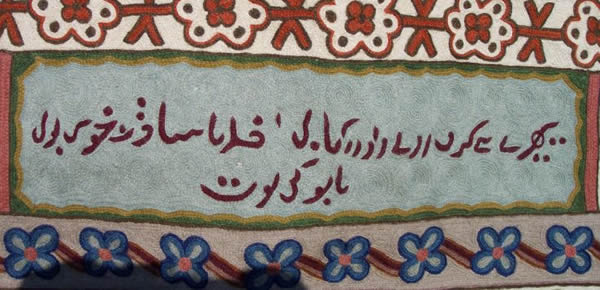
Can decipher this piece of writing or identify the language in which it’s written?
The person who sent in the image thinks the rug is appears on probably comes from Pakistan, and that the writing might be in Persian, Punjabi, Pashto or Urdu.
24 thoughts on “Mystery writing on rug”
I think it’s Urdu, one letter looks like a “bari ye”
I think it’s Urdu too… Persian (written usually in the same style of calligraphy) have different endings somehow… Urdu is unique for the shape used in first word, 4th letter (from right).
Punjabi do write in Perso-Arabic script? I thought they use more like an Abogida there. Pashto and Persian are much a like in the style of orthography and letters set, but Pashto have more consonants I believe.
That is definitely Arabic script and if it comes from Pakistan I’m guessing it’s Urdu.
It can only be pashto or urdu, and I’m betting on the latter… The last “character” is a smiley face. 🙂
d.m.f.
haha.. it is indeed a smiley face but it’s a “T” believe ……. they don’t weave smiley faces on carpets and rugs in the orient!
If the last character is a smiley face, the first three form a loop integral.
Ah! Contour Integrals……… you are a Physicist, prase?
I hate those integrals as I couldn’t understand what was going on and why they are special and how their calculation is different from the normal integrals! And mostly connected to the imaginary numbers which I don’t find any relation for them into the real world!
[off topic] Yes, I am a physicist (hopefully it isn’t written with capital P, is it?). The contour integrals in the complex plane (if you speak about them – the mark is used for other integrals as well) are quite useful, but I don’t like them either.
[on topic] Concerning the rug, the beginning is
يهي
(yhy)? Arabic calligraphy together with many ligatures always seemed to me as a perfect way to destroy readability (although I must admit that it is beautiful).
I am almost sure it is urdu.I doubted between Pasto and Urdu but the characters are more like urdu.
Well the rug seems from Pakistan in general since it is related to Urdu or the languages like it in Pakistan.
I checked the list of Arabic scripts on omniglot and I was looking for scripts where a letter Noon with no dot is available. This was available in Urdu … and some others that are used in Pakistan. Beluchi as well (also in Pakistan and other areas).
there are a lot of letters that seem to be incomplete, missing the dots that would differentiate them.
Missing the dot of the letter is not, necessarily, a “missing” thing. In Urdo and some other languages, the N letter with no dot above is called Nun-e-Ghunna, where Ghunna is an Arabic word meaning to give the letter more nasalized pressure. In the art of reading Quran, special signs are used in special places to note for the reader that he must nasalize the M or N more, BUT, in Arabic language as it is spoken, there is no emphasis on Ghunna. It is only noted in the script of the Quran to make reading fluent and in tune.
As for Asian languages like Urdu or Beluchi, Ghunna is a PART of the language, just like how the French and Breton have it as an essential part of their tongues as well.
How can N or M be more nasalized? They are fully nasalized already!
I think that letter indicated nasalization of the previous phoneme, much like the French N.
Daniel: Maybe I miss-interpreted that, but I think there is more nasalization. Check the IPA. Unfortunately I can’t type with IPA here. In Sanskrit transliteration (check omniglot) you will find that there is “N” and also “N” with dot below. I think it’s not like more nasalization but maybe a change of nasalization of the letter itself. I can say it, but I don’t know how to describe it.
i also agree with daniel. i’ve never heard of more nasalized nasals before, and it seems kind of impossible, though i know nothing about classical arabic.
as far as i know, the N with a dot under it in indic language transcriptions means retroflex, as it does with the S, T, L, etc.
according to omniglot, the nun without a dot stands for a uvular nasal in urdu.
TJ, I believe the term you are looking for is retroflex, where the tip of the tongue is retracted to touch the hard palate behind the alveolar ridge.
In fact after checking my tongue myself… I think it is not retroflex.
The tip of the tongue is behind the lower ridge as I say it now. This is the Ghunna.
@TJ, @James C.: You might be thinking of the anusvāra and chandrabindu, which can be transliterated as ‘ṃ’ and ‘ṁ’ (other schemes include ‘m̐’ and ‘ⁿ’). These are used to indicate vowel nasalisation or a homorganic nasal consonant.
Arakun, they might be “marks” in Sanskrit and other brahmic scripts, but in Urdu and its likes, it is a separate letter. The letter name is Noon-e-Ghunna, which means the original sound evolves from the letter “Noon” (N), but with more nasal sound. It sounds in fact just like the French nasalization, but it is not like “N.” Breton, uses N-tilda after a vowel to make it more nasalized. I think it is the same situation here, but in case of Urdu it is considered a letter by itself and not a mark or a nasalized vowel.
I didn’t mean noon ghunna. It seems as though a lot of letters are missing marks, or marks are ambiguously placed. I dunno. You only really see noon-ghunna at the end of words, and it seems like a lot of medial and initial letters are unmarked, as well.
I think “ghunna” refers to what’s formally called nasalization, and it’s a quality of some vowels. French has many nasalized vowels, as TJ noted and I believe many Indic languages do too.
I recognize the happy face in the second line, nothing more. 🙂
Well, I read Urdu to a certain extent…being Indian and residing in India I speak Hindi-Urdu on a daily basis. The term “nun-e-Ghunna” signifies the nasalization of the vowel. So if we have the letters k (kaaf) + r (ray) + w (vav) + N (nun-e-ghunna), the resultant pronunciation would be “karoo~” (I do, subjunctive). Or, say ch (chay) + a (aliph) + N (nun-e-ghunna) + d (daal) = chaa~d (moon). The tilde signifies the nasalization.
Since I also speak french, I can tell for sure that the nasalization in both Urdu and French is almost exactly similar (there is a very very very fine point of difference, though, which may be discerned if one listens to both closely enough).
As for the writing on the rug, the letters are, well, quite ill-formed, and that would be an understatement. So, apart from may be a k (kaaf) here or a r (ray) or a t (tay) there, very little is discernable and can’t be sure of the letters and which language it represents. Sorry for that…Doesn’t seem to mean anything in Urdu when I read them…
I really liked your blog post, I certainly think its essential to keep one self upto date with as much of information as possible, Thanks keep this blog updated, I am coming back for more.
I think it’s Urdu, one letter looks like a “bari ye”
I think it’s Urdu too… Persian (written usually in the same style of calligraphy) have different endings somehow… Urdu is unique for the shape used in first word, 4th letter (from right).
Punjabi do write in Perso-Arabic script? I thought they use more like an Abogida there. Pashto and Persian are much a like in the style of orthography and letters set, but Pashto have more consonants I believe.
That is definitely Arabic script and if it comes from Pakistan I’m guessing it’s Urdu.
It can only be pashto or urdu, and I’m betting on the latter… The last “character” is a smiley face. 🙂
d.m.f.
haha.. it is indeed a smiley face but it’s a “T” believe ……. they don’t weave smiley faces on carpets and rugs in the orient!
If the last character is a smiley face, the first three form a loop integral.
Ah! Contour Integrals……… you are a Physicist, prase?
I hate those integrals as I couldn’t understand what was going on and why they are special and how their calculation is different from the normal integrals! And mostly connected to the imaginary numbers which I don’t find any relation for them into the real world!
[off topic] Yes, I am a physicist (hopefully it isn’t written with capital P, is it?). The contour integrals in the complex plane (if you speak about them – the mark is used for other integrals as well) are quite useful, but I don’t like them either.
[on topic] Concerning the rug, the beginning is
يهي
(yhy)? Arabic calligraphy together with many ligatures always seemed to me as a perfect way to destroy readability (although I must admit that it is beautiful).
I am almost sure it is urdu.I doubted between Pasto and Urdu but the characters are more like urdu.
Well the rug seems from Pakistan in general since it is related to Urdu or the languages like it in Pakistan.
I checked the list of Arabic scripts on omniglot and I was looking for scripts where a letter Noon with no dot is available. This was available in Urdu … and some others that are used in Pakistan. Beluchi as well (also in Pakistan and other areas).
there are a lot of letters that seem to be incomplete, missing the dots that would differentiate them.
Missing the dot of the letter is not, necessarily, a “missing” thing. In Urdo and some other languages, the N letter with no dot above is called Nun-e-Ghunna, where Ghunna is an Arabic word meaning to give the letter more nasalized pressure. In the art of reading Quran, special signs are used in special places to note for the reader that he must nasalize the M or N more, BUT, in Arabic language as it is spoken, there is no emphasis on Ghunna. It is only noted in the script of the Quran to make reading fluent and in tune.
As for Asian languages like Urdu or Beluchi, Ghunna is a PART of the language, just like how the French and Breton have it as an essential part of their tongues as well.
How can N or M be more nasalized? They are fully nasalized already!
I think that letter indicated nasalization of the previous phoneme, much like the French N.
Daniel: Maybe I miss-interpreted that, but I think there is more nasalization. Check the IPA. Unfortunately I can’t type with IPA here. In Sanskrit transliteration (check omniglot) you will find that there is “N” and also “N” with dot below. I think it’s not like more nasalization but maybe a change of nasalization of the letter itself. I can say it, but I don’t know how to describe it.
i also agree with daniel. i’ve never heard of more nasalized nasals before, and it seems kind of impossible, though i know nothing about classical arabic.
as far as i know, the N with a dot under it in indic language transcriptions means retroflex, as it does with the S, T, L, etc.
according to omniglot, the nun without a dot stands for a uvular nasal in urdu.
TJ, I believe the term you are looking for is retroflex, where the tip of the tongue is retracted to touch the hard palate behind the alveolar ridge.
In fact after checking my tongue myself… I think it is not retroflex.
The tip of the tongue is behind the lower ridge as I say it now. This is the Ghunna.
@TJ, @James C.: You might be thinking of the anusvāra and chandrabindu, which can be transliterated as ‘ṃ’ and ‘ṁ’ (other schemes include ‘m̐’ and ‘ⁿ’). These are used to indicate vowel nasalisation or a homorganic nasal consonant.
Arakun, they might be “marks” in Sanskrit and other brahmic scripts, but in Urdu and its likes, it is a separate letter. The letter name is Noon-e-Ghunna, which means the original sound evolves from the letter “Noon” (N), but with more nasal sound. It sounds in fact just like the French nasalization, but it is not like “N.” Breton, uses N-tilda after a vowel to make it more nasalized. I think it is the same situation here, but in case of Urdu it is considered a letter by itself and not a mark or a nasalized vowel.
I didn’t mean noon ghunna. It seems as though a lot of letters are missing marks, or marks are ambiguously placed. I dunno. You only really see noon-ghunna at the end of words, and it seems like a lot of medial and initial letters are unmarked, as well.
I think “ghunna” refers to what’s formally called nasalization, and it’s a quality of some vowels. French has many nasalized vowels, as TJ noted and I believe many Indic languages do too.
I recognize the happy face in the second line, nothing more. 🙂
Well, I read Urdu to a certain extent…being Indian and residing in India I speak Hindi-Urdu on a daily basis. The term “nun-e-Ghunna” signifies the nasalization of the vowel. So if we have the letters k (kaaf) + r (ray) + w (vav) + N (nun-e-ghunna), the resultant pronunciation would be “karoo~” (I do, subjunctive). Or, say ch (chay) + a (aliph) + N (nun-e-ghunna) + d (daal) = chaa~d (moon). The tilde signifies the nasalization.
Since I also speak french, I can tell for sure that the nasalization in both Urdu and French is almost exactly similar (there is a very very very fine point of difference, though, which may be discerned if one listens to both closely enough).
As for the writing on the rug, the letters are, well, quite ill-formed, and that would be an understatement. So, apart from may be a k (kaaf) here or a r (ray) or a t (tay) there, very little is discernable and can’t be sure of the letters and which language it represents. Sorry for that…Doesn’t seem to mean anything in Urdu when I read them…
I really liked your blog post, I certainly think its essential to keep one self upto date with as much of information as possible, Thanks keep this blog updated, I am coming back for more.