Here’s a recording in a mystery language.
Can you identify the language, and do you know where it’s spoken?
Here’s a recording in a mystery language.
Can you identify the language, and do you know where it’s spoken?
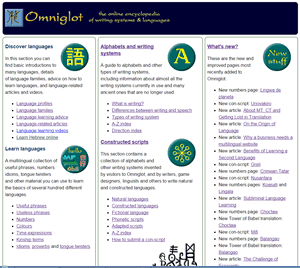
I think I’ve managed to make Omniglot work better on mobiles and other devices with small screens now. I know that the homepage goes a bit strange in IE when you make your browser narrow (not sure how to fix that), and there may be some other elements that are not behaving themselves, but it seems to be generally okay in the tests I’ve run on different screen sizes and devices. If you spot anything that isn’t working, please let me know. If you can suggest solutions, even better.
| français | English | Cymraeg |
|---|---|---|
| la plate-forme électorale | hustings | llwyfan etholiad; hustyngau |
| défraîchi; en mauvais état; écorné | tatty | aflêr |
| être en lambeaux | to be in tatters | bod yn llarpiau / yn garpiau / yn gareiau |
| le champ de force | force field | maes grym |
| le groupe de réflexion | think thank | seiat ddoethion |
| revendiquer | to claim (land, right, title) | hawlio; honni |
I came across a lovely Czech word today – směšný [‘smɲeʃni:] – which means funny or ridiculous, and sounds quite funny to me. I think it comes from smích (laughter), from the Proto-Slavic *směxъ [source]
Related words include:
– směšnost = ridiculousness; absurdity
– směšně = ridiculously
– smich = laughter
– smát = to laugh
– posměšek = a jeer, sneer, gibe
– posmívat se = to sneer, jeer at; to mock, tease, taunt
– úsměv = smile
– usmát se = to smile
The title of this post, Nebuď směšný!, means ‘Don’t be absurd!’.
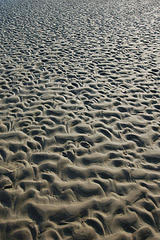
While walking along by estuary of the River Dwyryd at Portmeirion yesterday, the Czech friend I was with asked me the name of the patterns in the sand and mud made by water. I wasn’t sure and suggested ripples or sand ripples. She misheard the latter and thought I said sun dribbles, which I really like the sound of.
I checked today and discovered that the marks in sand and mud left by flowing water are known, rather boringly, as ripple marks, or wave-formed ripples, according to Wikipedia.
Do they have more poetic names in other languages?
Here’s a recording in a mystery language.
Can you identify the language, and do you know where it’s spoken?
| français | English | Cymraeg |
|---|---|---|
| braiser; cuire à l’étouffée | to braise | mudstiwio; brwysio |
| bœuf braisé/mode/en daube | braised beef | cig eidion wedi ei frwysiedig |
| faire une purée de (pommes de terre) | to mash (potatoes) | mwtro/stwnsio/stompio (tatws) |
| une purée de pommes de terre | mashed potatoes | tatws stwmp/stwmsh; stwnsh tatws |
| le joint de culasse | gasket | gasged |
| casser/griller un joint de culasse | to blow a gasket (car) | chwythu gasged |
| péter un fusible; se mettre en colère | to blow a fuse | chwythu/llosgi ffiws |
| péter les plombs | to blow one’s top | gwylltio’n lân/ulw; colli’ch tymer; mynd ar gefn eich ceffyl |
| faire un bruit de pet | to blow a raspberry | hisian; hwtio; wfftio |
In an article I came across today in the Irish Times the writer, an Irish speaker, wonders whether the compulsory teaching of Irish language in schools in Ireland is the best way to keep the language alive. He argues that those who are interested in the language will continue to learn it and speak it even if it is no longer compulsory in schools. I’ve seen suggestions like this many times for Irish and other minority languages, and it is difficult to say what is best as there is some truth in the idea that making a subject compulsory isn’t necessarily the best way to get people to study it.
What are your thoughts on this?
One of the Czech lessons I studied yesterday included the word nemocnice (hospital), and though I hadn’t seen or heard it before, I was familiar with the word nemocný (ill; sick) and guessed from the context that nemocnice was a hospital. It feels good to be able to work out the meanings of words from their form and context, and this is somewhat easier in Czech as most words seem to be built from native roots, rather than being borrowed from other languages.
Words related to nemocnice include:
– nemoc = illness; disease
– moc = power, potency, force, forcefulness; strength
– mocný = powerful; mighty
– mocnost = power (nation, state)
– bezmoc = helplessness, powerlessness
– bezmocný = powerless, helpless
Source: Wikitionary
Hospital in Czech is also špitál or lazaret, which is probably related to the Italian lazzaretto (a leper hospital; place of quarantine) or the French lazaret (an isolation hospital for patients with contagious diseases). The Italian word comes from Nazaretto, a quarantine station in Venice, which was named after Santa Maria di Nazareth, a church on the island where it was located [source].
Here’s a recording in a mystery language.
Can you identify the language, and do you know where it’s spoken?