Here’s a recording in a mystery language.
Can you identify the language, and do you know where it’s spoken?
Here’s a recording in a mystery language.
Can you identify the language, and do you know where it’s spoken?
People who make language learning apps, online language courses and similar sometimes contact me asking me to review their apps/courses, and to link to them / promote them on Omniglot. This is often in exchange for free use of their courses for a certain period. This is exactly the kind of thing I hoped might happen when I set up Omniglot. Well, actually I hoped that language schools might offer me free or reduced rate courses in other countries – back in 1998 there weren’t so many online courses about, and no language learning apps – and I thought that one day I would be going from country to country learning languages, at least part of the time.
In the course descriptions for these apps/courses they say that they will teach you the real language that you need to know, and often promise that the course won’t bore you with complex grammar or befuddle you with grammatical terms. They also might say that their courses provide new, innovative, never-before-seen ways to learn languages quickly and easily.
I’ve tried quite a few of these apps and courses, and generally they are variations on the same basic model: you learn a bunch of phrases, often travel-related, maybe with pictures, and are tested on them, often using some kind of spaced repetition system. Some courses give you a chance to make sentences using the words you’ve learnt. Some include a bit of grammar as well, but not too much, as that’s boring and might scare the horses.
I’m not trying to belittle all the work that goes into these courses, and the people who make them do seem to believe that their courses are truely innovative. However I rarely find anything genuinely new in them.
One app I heard about recently is Smigin, which is free and available for iOS and Android. It teaches you basic travel-related phrases, and has a neat feature that you can construct your own phrases and hear them spoken. The recordings give you an idea of pronounciation, but as each part is recorded separately they do not give you the best model for how to pronounce the whole phrase. The people at Smigin are also planning to create an app to teach you more language beyond the travel phrases – Smigin Pro, which looks like it will be an expanded version of the travel app, with a few extra features, like a way to practise conversations virtually, and videos. Most importantly it is “without the hassle of grammar rules.”
After trying Smigin Travel I starting thinking about how a similar system might be used to teach you those dreaded grammar rules. I’m not sure exactly how, but have a few ideas.

Last week I started learning Toki Pona, the language consisting of just 120 words created by Sonja Lang in 2001. I’ve been thinking about giving it a try since the Polyglot Gathering in Berlin last year, when I went to talk about the language and met people who speak it, and Sonja herself.
It’s an interesting language, and as the vocabulary is so small, most words have multiple meanings, and you have to think creatively to express things not in the vocabulary. The structure is also interesting – it’s an isolating language with grammatical particles somewhat like Japanese, and word order is the most important thing, as words do not conjugate or decline or change in any way.
I’ve mainly been using the online lessons at: http://tokipwnage.webs.com
I have also discovered that there’s a signed version of Toki Pona http://tokipona.net/tp/janpije/signlanguage.php, which is the first constructed sign language I’ve come across, though you may know of others.
Do you speak toki pona, or have you dabbled with it? What are your experiences?
By the way, the title of this post means “Do you speak Toki Pona?” (literally, “you talk not talk [direct object particle] toki pona?”)
Here’s a recording in a mystery language.
Can you identify the language, and do you know where it’s spoken?
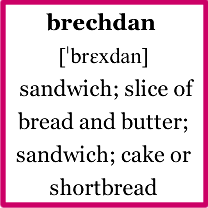
The Welsh word for sandwich is brechdan [ˈbrɛxdan], which comes from the Irish word brechtán (butter, fat), according to the Geiriadur Prifysgol Cymru.
However according to MacBain’s Dictionary, is related to the Scottish Gaelic word for pancake, breacag, which is related to breachdan (custard), which comes from the Middle Irish breachtán (a roll), which is related to the Welsh words brithog (mottled, variegated, multi-coloured, speckled, fine) and brith (marked with different colours, variegated, coloured, chequered, mottled, pied, spotted, speckled, brindled, grey), which are related to the word word breac (speckled) in Irish and Scottish Gaelic.
According to the Geiriadur Prifysgol Cymru, brechdan is a sandwich, and also a slice of bread and butter; sandwich; cake or shortbread.
There are also a number of interesting types of sandwich in Welsh:
– brechdan fawd / gorddi = slice of bread on which butter is spread with the thumb
– brechdan gaerog / ddwbl / linsi / fetal / deiliwr = an oatcake on a slice of buttered white bread or between two slices of white bread
– brechdan grasu = toast, toasted sandwich
– brechdan i aros pryd = slice of bread and butter to carry on with until the next meal, snack
– brechdan doddion = slice of bread spread with dripping
– brechdan driagl / driog = slice of bread spread with treacle
For details of the origins of the word sandwich, see Sandwiches and Portsmouths
| français | English | Cymraeg |
|---|---|---|
| les dentier | dentures | dannedd gosod |
| le chantier | building site | safle adeiladu |
| la dictature | dictatorship | unbennaeth; awtocratiaeth; teyrnlywodraeth |
| le dictateur | dictator | unben; teyrn |
| l’autocratie | absolute dictatorship | unbennaeth |
| une quinzaine; quine jours; deux semaines | fortnight | pythefnos |
| le dent de sagesse, le gros dent | wisdom tooth | cilddant olaf, cefnddant |
| poser sa candidature pour | to apply for (a job) | cynnig, ymgeisio, ymgynnig, gwneud cais |
| dépliant | leaflet | taflen; dalen |
| la disquette | floppy disk | disg llipa |
| déblie; allumé | geek, nerd | llipryn, gwlanen, brechdan |
| le monument classifié | listed builing | adeilad cofrestredig |
| le conseil d’administration | board (of directors) | bwrdd (cyfarwyddwyr) |
| l’affairiste; le magouiller | wheeler dealer | sgemiwr a sgiliwr |
| magouiller | to wheel and deal | sgemio a sgilio |
| mettre son nez partout | to have a finger in every pie | bod gan fys ym mhob brŵes/cawl |
| se mêler partout | to have a finger in many pies | bod gan fys ym mhob brŵes/cawl |
I learnt an interesting word today – retronym – a new name for something that already existings that distinguishes the original from a more recent version. For example, ebooks are becoming increasingly popular, so there’s a need for a new word for non-ebooks. On the program I heard the word retronym, Word of Mouth, they suggested pbooks, paper books or printed books for the non-electronic version. Do you have any other suggestions?
They also discussed phones – since the default phone for most people these days is a mobile/cell phone, there’s a need to a different word for a non-mobile phone. Home phone or landline were suggested. Do you have other words?
For more information about retronyms, see: https://en.wikipedia.org/wiki/Retronym and https://en.wikipedia.org/wiki/List_of_retronyms
When you’re in a restaurant or café, how do you get the attention of a waiter/waitress?
This cartoon shows how it can be difficult in France.
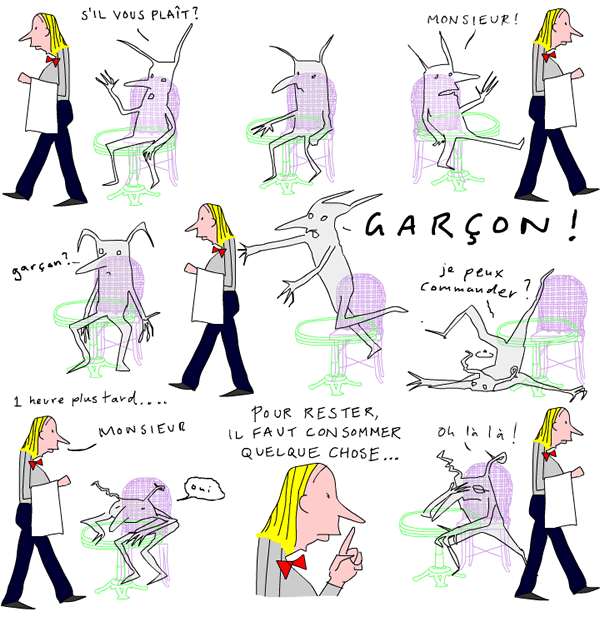
The customer in the cartoon first says “Please”, then “Sir/Mr”, then “Waiter”, then ‘Can I order?’, then a hour later the waiter finally speaks to him and says, “Sir, to stay here you must have something to eat or drink.”
What’s it like where you are? Are waiting staff in restaurants quick to respond to you, or do they go to great lengths to ignore you? What do you call waiting staff?
I’ve worked as a waiter and as a barman and know that at busy times it can be difficult to respond to everybody immediately, but I’ve never ignored anyone deliberately.
Image supplied by Frantastique, who can teach you how do you get the attention of a French waiter, and help you to learn French.
Here’s a recording in a mystery language.
Can you identify the language, and do you know where it’s spoken?
One Hawaiian word that is used in English is a’a, which is defined as “a kind of rough-surface volcanic rock” [source].
However in Hawaiian it is written ʻaʻā, pronounced [ʔəˈʔaː] and means:
1. to burn, blaze, glow; fire; staring (eyes)
2. lava; stony, abounding with ʻaʻā lava
3. Sirius (the star)
4. young stage of damselfish
The word aʻa [əˈʔa] means:
1. small root, rootlet, vein, artery, nerve, tendon, muscle
2. to send greetings or love; joyous hospitality; joy at greeting a loved one
There is also ʻaʻa [ʔəˈʔa], which means:
1. to brave, dare, challenge, defy, check, venture; to accept a challenge; to volunteer; to act wickedly or presumptuously; bold, venturesome, valiant, intrepid
2. belt, girdle, waist; to gird, to tie on
3. bag, pocket, caul, envelope for a foetus, scrip; fiber from coconut husk; clothlike sheath at base of coconut frond; cloth; chaff, hull
4. a wind
5. booby bird
And ʻā.ʻā [ʔaː.ʔaː], which means:
1. dumbness, inability to speak intelligibly, a dumb person; dumb, silent, still; to stutter and stammer, as a dumb person
2. dwarf, small person; dwarfish, small
3. demented, panic-stricken
4. booby bird.
5. male ʻōʻō bird
Source: Hawaiian Dictionaries
This shows the importance of the ʻokina (“cutting”) and kahakō (“long mark”) in Hawaiian. The former represents a glottal stop [ʔ] and is a letter in Hawaiian, and the latter indicates a long vowel.