
Here’s a recording in a mystery language.
Can you identify the language, and do you know where it’s spoken?
Here’s a recording in a mystery language.
Can you identify the language, and do you know where it’s spoken?
One of the words that came up at the French conversation group this week was brise (breeze), which appears in the following expressions:
– pare-brise = windscreen / windshield
– brise matinale = early breeze
– brise insulaire = island breeze
– brise de mer = sea breeze
– brise de terre = land breeze
The French word brise and the English word breeze come possibly from the Old Spanish briza (cold northeast wind), which was used from the 1560s in West Indies and the Spanish Main to mean a “northeast trade wind”, and then a “fresh wind from the sea”. Breeze came to mean a “gentle or light wind” from the 1620s, and something easy from the 1920s in the USA.
Alternatively the English word breeze might come from is from East Frisian brisen (to blow fresh and strong), or the Saterland Frisian briese (breeze) or the Dutch bries (breeze).
Apparently as well as being a light, gentle wind, a breeze can be:
– Any wind blowing across a cricket match, whatever its strength.
– Any activity that is easy, not testing or difficult.
– Ashes and residue of coal or charcoal, usually from a furnace.
– An excited or ruffled state of feeling; a flurry of excitement; a disturbance; a quarrel.
Sources: Online Etymology Dictionary, Wiktionary and Reverso
| français | English | Cymraeg |
|---|---|---|
| la brise | breeze | awel |
| convenable; adéquat; apte | suitable | addas |
| la poterie | pottery | crochenyddiaeth; crochenwaith |
| sculpté; gravél ciselé | carved | cerfiedig; nadd |
| tailler; sculpter; grave; ciseler | to carve | cerfio; carfio; naddu |
| plongée | diving | plymio |
| luxuriant | lush | toreithiog; iraidd; ir |
| enflé; gonflé | swollen | wedi chwyddo |
| la cheville | ankle | ffêr; migwrn |
| le bord | edge | min; ymyl |
| le pare-choc | bumper (on car) | bymper; ffender |
| le course à travers champ | cross-country (race) | ras ar draws gwlad / traws gwlad |
| seul; solitaire | lonely | unig; digwmni |
There is now an Omniglot app for Andriod developed by علي الساعدي (Ali al-saaedi Ali shirpaz) from Iraq. It only works online at the moment, and is available here.
Any comments or suggestions on how it might be improved are welcome.
Many thanks to علي الساعدي for doing this.
Last week a friend asked me about the origins of the word joskin [ˈdʒɒskɪn], which I hadn’t come across before. According to the Urban Dictionary it is defined as follows:
North-Walian term used in both English and Welsh to describe anyone from a rural or farming background. It is used both affectionately and in a derogatory way depending on the audience.
Example: He’s a right joskin – he’s got a tractor and everything.
According to the Collins English Dictionary joskin is a slang word meaning “a country bumpkin; hick”.
Wiktionary suggests that is comes from the dialect word joss (bump) and (bump)kin. Alternatively it comes from the name Joseph + (bump)kin [source].
Bumpkin, a clumsy, unsophisticated person or a yokel, apparently comes from the Dutch boomken (shrub, little tree) [source]. Or it might come from the Dutch bommekijn (small cask), from the Middle Dutch bomme (cask) [source], and was also used as a derogatory reference to short and dumpy Dutch people [source].
Yokel possibly comes from German dialect word Jokel, a diminutive of Jakob, or an English dialect word meaning woodpecker [source].
What other words are there for joskins?
Here’s a recording in a mystery language.
Can you identify the language, and do you know where it’s spoken?
| français | English | Cymraeg |
|---|---|---|
| l’attaque d’apoplexie (f); la congestion cérébral |
stroke | strôc; trawiad |
| avoir un accident vasculaire cérébral | to have a stroke | cael strôc / trawiad |
| caresser | to stroke | tynnu llaw; anwesu |
| le trait de génie | stroke of genius | fflach / strôc o athrylith |
| le coup de chance | stroke of good luck | tamaid / tipyn / strôc o lwc |
| aller se promener | to go for a stroll | mynd am dro |
| l’atrophie (f) | atrophy | gwywiad; edwiniad; crebachiad |
| la corbeille d’arrivée; la corbeille de courriers à traiter; le classeur pour le courrier entrant |
in tray | cawell derbyn; basged dderbyn |
| le courrier sortant | out tray | cawell allan |
| le plateau | tray | hambwrdd |
| le casier | pigeon-hole | twll colomen; cloer; colomendwll |
| cousin(e) au deuxième degré | first cousin once removed | plentyn eich cefnder/cyfnither |
| petit(e) cousin(e) | second cousin | cyfyrder (m); cyfyrderes (f) |
| enfant unique | only child | unig plentyn |
| le tonneau | barrel (beer; wine) | casgen; baril |
| la casque | barrel (fish) | casgen; baril |
| le baril | barrel (oil) | casgen; baril |
| l’animal empaillé; l’animal en peluche |
stuffed animal | anifail stwffiedig |
| le cogneur; le malabar | bruiser | colbiwr; paffiwr |
| diriger | to conduct (an orchestra) | arwain; tywys(u) |
| le chef d’orchestre | conductor | tywyswr; tywysydd; arweinydd |
| l’entrepôt | warehouse | warws; stordy; strorfa |
| la taille | size | maint |
| le pic | woodpecker | cnocell y coed |
| marcher sur la chaussée | to jaywalk | croesi diofal |

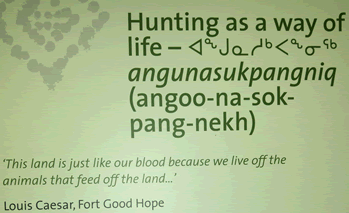
Last Sunday I went to Liverpool for a polyglot meet-up. Before the meet-up I went to the World Museum, which is fascinating and well worth a visit.
Among the artifacts and exhibits, there are examples of languages and scripts from around the world, including Cuneiform tablets from Sumeria, a Mayan codex and other artifacts with Mayan writing, and a collection of artifacts from the arctic with Inukutitut syllabics on the information panels (see photo).
There’s an interesting post on the lingualift blog today entitled “What is fluency in a language?”, which includes ideas and discussion of what it means to be fluent from various polyglots and language enthusiasts, including me.
How do you define fluency?
Which languages do you consider yourself fluent in, and which ones would you like to be fluent in?
How many languages do you think it’s possible to be fluent in (based on your definition of fluency)?
While listening to Russian language radio yesterday I finally worked out the meaning of a word that kept on coming up: союз (soyuz) [sɐjˈʉs] , which is often used in the expressions Европейский союз and Евросоюз (European Union, EU).
It was obvious once I realised they were talking about Europe, and the word Soyuz is familiar as the name of the Russian spacecraft, and of the Russian version of the USSR, though I didn’t recognize it at first with it’s Russian pronunciation.
Союз means union, alliance, league or conjunction, and appears in expressions like:
– союзник = ally
– союзный = allied; conjunctive
– профсоюз = trade / labor union
– студенческий союз = students’ union
– Союз композиторов = Musicians’ Union
– Союз Советских Социалистических Республик (СССР) = Union of Soviet Socialist Republics (USSR)