Here’s a recording in a mystery language.
Can you identify the language, and do you know where it’s spoken?
Here’s a recording in a mystery language.
Can you identify the language, and do you know where it’s spoken?
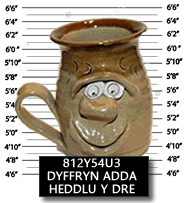
When listening to the Answer Me This podcast today I heard some discussion of mug shots, which got me thinking about the origins of that name.
According to Wiktionary, a mug shot (or mugshot) is:
1. A photograph taken of the head and shoulders, often from the front and in profile, usually taken in conjunction with somebody’s arrest.
2. An unflattering photograph of a person’s face (Britain slang)
The police mug shot is also known as a police photograph or booking photograph. According to Wikipedia, “Photographing of criminals began in the 1840s only a few years after the invention of photography, but it was not until 1888 that French police officer Alphonse Bertillon standardized the process.”
Mug is a slang word for face and shot comes from snapshot, another word for photograph, especially one taken quickly.
The origins of the word mug are uncertain, but its use as a slang word for face possibly comes from the grotesque faces on some drinking vessels.
Are there other interesting words for face in English or other languages?
This week Rocket Languges are celebrating their 13th Anniversary with a 4-day sale starting today and continuing until Friday 17th March, or until they’ve sold 1,000 courses.
During this time you can get 60% off any of their online language courses, which include: French, Spanish, Italian, Chinese (Mandarin), German, Japanese, Russian, Arabic, Hindi, ASL, Korean, Portuguese and English (for Spanish or Japanese speakers).
The coupon code to receive the discount is ANNIVERSARY
They also offer online piano courses, in case you fancy a break from your language studies.
I have tried and reviewed their Hindi and Japanese courses, and think they are definitely worth a look. Since then they have added some new languages – Russian and Portuguese – and I’m tempted to try their Russian course, even though I already have plenty of other Russian courses and learning materials. Can you ever have too many language learning materials?
Note: I am a Rocket Languages affiliate, and will receive commission if you buy any of the courses via the links above.
Here’s a recording in a mystery language.
Can you identify the language, and do you know where it’s spoken?
| français | English | Cymraeg |
|---|---|---|
| le boulon | (nut and) bolt | bollt |
| le boulon à oreilles | wing bolt | bollt adeiniogf/asgellog |
| le verrou | bolt (on door) | bollt(en) |
| verrouiller | to bolt (a door) | bolltio (drws) |
| boulonner | to bolt (on) | bolltio |
| engloutir | to bolt (food) | llowcio/claddu/bolgian bwyd |
| boulotter | to tuck (into smth); to eat | claddu bwyd |
| accordeur de piano | piano tuner | tiwniwr pianos dyn tiwnio pianos |
| accorder | to tune (an instrument) | tiwnio |
| battre un record | to break a record | torri/curo record |
| collant | sticky | gludiog/td> |
Today we have a guest post from Sebastien Marion

As most expats would agree, the best way to learn a language is to go abroad. When abroad, you are immersed in the culture and are forced to speak the language. But whether you are abroad already or trying to improve your language skills from home, vocabulary will be key to quick progress. Learning grammar and tenses is very important indeed, but without vocabulary, you will soon find yourself very limited.
When I arrived in Spain two years ago, I had some leftover fragments of my years in school studying the language. This was invaluable to me as it allowed to have some kind of conversation. When I did not know a word, I quickly typed it in a translation app and it gave me its translation on the fly.
As useful as these translation apps are however, to me they had a major flaw. As the conversation went on, I systematically forgot the words that I had searched for and their translations, making progress somewhat slow. And what’s worse, when I got home my history was gone. And while some apps do keep a record, to be able to practice the words using flashcards I would then have to copy them to a flashcard application, which slowed me down considerably.
To solve this problem, I have been working on a small application acting as a translator (using Google Translate and soon also WordReference) but with the twist that each translation gets automatically recorded and turned into flashcards for you to practice at a later time. Using flashcards you can learn vocabulary faster and improve you level quickly. You can even create lists and we will in the future add a bit to help you train better.
The app is nearly ready and will hopefully go live by the end of March. The website is available at http://www.leaknows.com and as a special offer to readers of Omniglot, you can claim a free lifetime membership by sending me a message before the 1st of April and quoting “OMNIGLOT_FREE_ACCOUNT” in the message field.
When listening to The Allusionist podcast today I learnt an interesting word – tritagonist, who was the actor who played the third role in ancient Greek drama.
Tritagonist comes from the Ancient Greek word τρίτἀγωνιστής (triagōnistḗs), from τρίτ (third) and ἀγωνιστής (combatant, participant).
The actors who played the first and second roles in ancient Greek drama were known as the protagonist and deuteragonist, or sidekick. Proto- comes from πρῶτος (first), a superlative of πρό (before), and deuter- from δευτερ (second).
Proto goes back to the Proto-Indo-European *pro/*per- (to go over), which is also the root of:
– Proto-Celtic *ɸro = before, in front of, in addition
– Welsh rhy = too
– Irish ro = too
– Proto-Germanic *fram = from, by, due to
– English from
– Scots frae = from
– Swedish från = from; and fram = forward
– Icelandic frá = from, away from, about
– Latin per = through, by means of, during, and related words in Romance languages.
The antonym of protagonist is antagonist, from ἀντί (against) and ἀγωνιστής (combatant, participant).
Source: Wiktionary
Here’s a recording in a mystery language.
Can you identify the language, and do you know where it’s spoken?
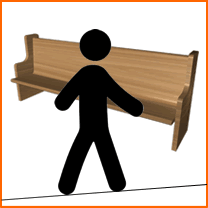
One thing that came up in the French Conversation Group last night was church pews, and particularly how uncomfortable they are. We discovered that in French a pew is un banc (d’église).
Banc also means seat or bench, and can mean other things in combination with other words:
– banc de sable = sandbank
– banc des accusés = dock (in court)
– banc des témoins = witness box
– banc de touche = dugout
– banc des avocats = (legal) bar
– banc de brouillard = patch of fog
– banc de sable = sand bar
Banc comes ultimately from the Proto-Indo-European *bʰeg- (to bend, curve, arch), which is also the root of banque (bank) and banquet (dinner, reception, banquet), as well as bank, banquet and bench in English, and related words in other languages.
The French equivalent of pull up a pew or take a pew (take a seat, sit down), is prends-toi une chaise or tire-toi une bûche (pull up a log). Are there other ways to say this?
Sources: Reverso, Wiktionary, WordReference.com
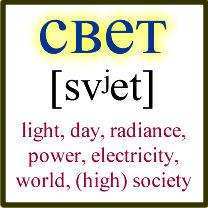
An interesting and useful Russian word I came across today is свет [svʲet], which means light, and also lights, lighting, day, radiance, power, electricity, world and (high) society.
It comes from the Old East Slavic свѣтъ (světŭ – light; world), from Proto-Slavic *světъ (light; world), from the Proto-Balto-Slavic *śwaitas, from the Proto-Indo-European *ḱwoytos / *ḱweytos (bright; shine), from *ḱwey-.
Related words in other Slavic languages include: Belarusian: свет (world), Ukrainian: світ (world, universe), Bulgarian свят (world, earth, universe), Macedonian: свет (world), Slovene: svẹ̑t (sacred, holy), Czech: svět (world), Polish: świat (world), and Slovak: svet (world) and svetlo (light).
Words for white in Germanic languages come from the same PIE root: such as white in English, weiß in German, wit in Dutch, hvit in Norwegian, vit in Swedish and hvid in Danish.
Here are some examples of related words and usage:
– светать = to get/grow light
– светлый = bright, light, lucid
– светильник = lamp
– светить = to shine
– светлеть = to lighten
– свети́ло = heavenly body; luminary
– светофо́р = traffic light
– свеча́ = candle; spark plug; suppository
– дневно́й свет = daylight
– со́лнечный свет = sunshine, sunlight
– я́ркий свет = bright light
– ско́рость све́та = speed of light
– при свете луны/свечи = by moonlight/candlelight
– в свете = in the light of
– ни свет ни заря = at the crack of dawn
– чуть свет = at daybreak
– появи́ться на свет = to be born (“to arrive in the light/world”)
– выходить в свет = to be published (“to face the light/world”)
– проливать свет на что = to shed/throw light on sth
– тот свет = the next world
The name Светлана (Svetlana) also comes from the same root.
Sources: Reverso, Wiktionary