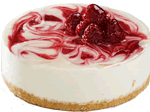
One of the things we discussed last night at the French conversation group was cheesecake – a member of the group has a weakness for this dessert and couldn’t resist when she saw it on the menu.
We concluded that the word cheesecake is also used in French and that there probably isn’t a French word for it. According to my French dictionary though, cheesecake is flan au fromage blanc, and another possible translation is gâteau au fromage.
In Germany cheesecake is Käsekuchen or Quarkkuchen, in Switzerland it’s Quarktorte, and in Austria it’s Topfenkuchen, according to Wikipedia.
What about in other languages?
In Estonian there are two words:
kohupiimakook (cake of curd milk) and kodujuustu kook (cake of cottage cheese)
Kohupiim is also called ‘quark cheese’ in English, according to Wikipedia (as you mention above).
In Irish it’s: císte cáise, simply cheesecake. 🙂
In Tlingit, there’s no word for cheese and no word for cake. So, no word for cheesecake.
(Actually there is a word occasionally used for cheese, kaháakw, but it usually refers to a preparation of dried salmon eggs.)
In Hebrew it’s ugat-gvina (עוגת-גבינה). Literally a cake of cheese.
Uga=cake
Gvina=cheese
Scandinavian: ostekage/ostekake/ostkaka
Finnish: juustokakku
All of them literally mean cheesecake.
In Spanish it is either “pastel de queso” or “torta de queso”. I’ve also heard “tarta de queso”, but that doesn’t seem very common.
Here in Canada, I’ve always seen it called gâteau au fromage… It’s a pretty common thing here because of shared North American culture, so maybe more common than in Europe?
There’s a traditional Polish cake called sernik (ser- = chees, -nik derived noun formative). But it’s not much like real (to me) cheesecake. There are versions closer to NAmerican style but they’re not distinguished AFAIK.
Kwarktaart, in dutch. And yes, this sounds slightly barfy to native ears as well.
In Portuguese we would have two name bolo de queijo and torta de queijo. In this case, the second one it would be more appropriate. The first is used more for sweet dessert.
Yeah, here in France people just say cheesecake. Gâteau au fromage (blanc or not) is definitely not the same thing.
@Lau: In Swedish the word “ostkaka” is used to describe a different kind of cake which is flavoured with sweet and bitter almonds. Cheesecake is referred to by its English name.
http://en.wikipedia.org/wiki/Ostkaka
In Welsh it’s “teisen gaws” which just paraphrases English cheesecake.
In Arabic it’s almost a translation for the English version (I saw in some cooking books). Although, in the daily life and the dialect, we use “cheesecake” normally.
The Arabic version would be: Ka?kat Al-Jubnah
كعكة الجبنة
I think the first word: Ka?kah (or Ka?kat in case of addition to another word) is just an Arabicization of the word “Cake.” The word itself in our dialect here in Kuwait is more commonly referred to as “Kaikah” (or Kaikat).
Forgot to mention that cheesecake is “cacen gaws” in the North dialect of Welsh (North Walian).
@Jennie
Some people in France say “gâteau au fromage blanc” for the British cheesecake, even though it refers to something else.
But I never heard “gâteau au fromage” for a cheesecake. In my opinion, “gâteau au fromage” (without “blanc”) could only refer to a savoury dish made from cheese (e.g. camembert, brie, roquefort etc). Not necessarily bad tasting but definitely not a pudding.
It’s interesting to see how European French has a different approach to names for things from English-speaking cultures when you compare it to Canadian French. Using the English name instead of a translated French equivalent is reminiscent of the way a weekend is only referred to as “un week-end” in Europe whereas in Canada the usual term is “une fin de semaine”, “week-end” really being a loanword from European French not used by most people. Other less culture-related examples are “magasinage” versus “shopping”, “stationnement” versus “parking”, and I could go on and on…
In Mexico I’ve heard “pay de queso,” that is, “cheese pie.” And actually, that name makes more sense to me than the word “cheesecake”!
In America they tend to use the word “pie” more freely and more in the singular like a collective noun than we do in British English where pie tends to be used for savory dishes and more usage of the plural.
If I may be allowed to divert a little from the main topic:
Chris Miller wrote: >>It’s interesting to see how European French has a different approach to names for things from English-speaking cultures when you compare it to Canadian French.<>“stationnement” versus “parking”<<: can anyone elucidate what is the precise ca/fr usage here? In French French, "stationnement" means the act (stationnement interdit / no parking), while "parking" (in a typical Franglais mutilation!) means the area where cars may be parked (AmE: parking lot / BrE: car park).
In Japanese, they just a transliteration of “cheesecake”, so its チーズケーキ (chiizu keeki). In case you are wondering, both “cheese” and “cake”, separately, are also imported transliterations (チーズ chiizu; ケーキ keeki).
What’s additionally interesting about the Japanese word is that keeki by itself means “cake” in the British sense. What we in the US call cake is mostly ガナシ ganashi (ganache) in Japan.
@Petrea
I think you are referring to ガナッシュ (ganasshu), which is usually a chocolate desert, sometimes in the form of cake, in Japan.
There is also カステラ (kasutera) sponge cake, which is from the Portuguese “castela”. My guess based on questionable observation is that ケーキ (keeki) and カステラ (kasutera) are used a lot in conversation to refer to “cake”, while ガナッシュ may something that people just recognize on a menu or something, just a guess.
In Esperanto it’s fromaĝkuko (cheese cake)
In Cherokee it would be gelisgi unvdi gadunv ᎨᎵᏍᎩ ᎤᏅᏗ ᎦᏚᏅ, but I will assume most say
jísgegi ᏥᏍᎨᎩ
In France it is definitely just cheese cake… all this talk of cheesecake is making me hungry now!
In Malay it’s kek keju, kek being cake and keju being cheese. In Mandarin Chinese it’s called qi si/qi shi dangao, qi shi (起司 in mainland China and 起士 in Taiwan) being cheese and dangao (蛋糕) being cake.